Roguelike Upgrade Pick: How Choosing One of Three Cards Works
A roguelike upgrade pick is a choice the game gives you between rounds: it shows you three options, usually as cards, you keep one, and it stays with you until the run ends. This post explains how that pick works, why games offer three choices, and how to decide when every card looks good.
If you want to practice the skill, Tank City Reboot is a free browser game with a three-card upgrade pick after every wave in its second game, and you can play it on a computer or a phone with no account.
What is a roguelike upgrade pick? Choosing one of three cards
A run in a roguelike is one attempt from start to finish. You start weak. When the run ends, the next one starts from scratch. The upgrade pick is how you get stronger during a run.
The pick is a small decision with a long tail. You choose once, but the choice shapes every round after it. Two players can start with the same tank, ship or character and finish with very different ones, because they chose differently at the same points.
That is the appeal. You are not only reacting to what is on screen. You are also building something.
How choosing one of three cards works
The loop is simple:
- You clear a round.
- The game pauses the action and shows three cards.
- Each card names an upgrade and says what it does.
- You pick one, and the next round starts with that upgrade active.
The cards you do not pick are gone. You may see them again later, but you cannot count on it. That is what gives the pick weight. You are not shopping for everything you want. You are choosing the best of what you were handed.
Why games offer three choices instead of one or ten
One card is not a choice. You take it, and the pick becomes a reward screen.
Ten cards are a lot to read. With that many, it is easy to pick by name or by habit instead of by thought, and the pause between rounds starts to drag.
Three sits in the middle. You can read all three in a few seconds and compare them. Often one is the safe pick, one is the greedy pick and one is the odd pick you would not normally take. That mix makes you think about what your run needs right now.
Randomness matters too. Because the three cards change each time, you cannot plan the whole run in advance. You adapt to what shows up, which is why runs feel different even when the game is the same.
Common types of upgrade cards
Most upgrade cards fall into a few families, whatever the game calls them:
- Offense. More damage, faster fire, more shots at once.
- Defense. Shields, extra health, a way to survive one mistake.
- Mobility. Faster movement, a dash, a way to dodge.
- Utility. Shots that bounce or pass through things, better rewards, a way to fix damage.
- Insurance. An extra life or a repair, which only pays off if you would have failed without it.
A good way to read a card is to ask which family it belongs to and what your run is short on. If you keep dying, offense probably will not fix it. If you survive but take too long, defense will not fix that either.
How to choose the best card for your run
Ask three questions before you pick.
- What killed me last time? Fix the real problem first. If you died to a wall of shots, a dodge or a shield beats more firepower.
- What is coming? If you know a hard fight is two rounds away, pick for that fight, not for the round you just cleared.
- Does this card get better over time? An upgrade you can stack more than once is worth more early than one that gives a single fixed bonus.
This is the same habit as planning ahead in any game with a build. For a game-specific list of what each Tank City Zero Day upgrade does, see tank game upgrades: what to pick after each wave.
Synergies, builds, and when to skip a pick
A build is a set of upgrades that work together. A synergy is when two cards are worth more as a pair than apart.
A simple example: one upgrade makes your shots spread out, and another makes each shot bounce off walls. Together you cover far more of the screen than either does alone. Neither card looks exciting by itself. The pair is strong.
That is why it can be wrong to grab the biggest number on the table. A card that fits your build often beats a card that looks stronger in isolation.
Know when a card does not help. A bonus for something you rarely do is wasted. A fix for a problem you do not have is wasted too. When all three cards feel weak, take the one that protects your next mistake and move on.
Common mistakes with upgrade picks
- Picking by name. A card called something cool is not always the useful one. Read what it does.
- Spreading too thin. One of everything is usually weaker than a few upgrades you pushed further.
- Ignoring the limit. Many upgrades stop giving more after a few levels. Know when to move on.
- Always taking offense. Damage feels good, but a run you cannot survive never uses it.
- Rushing the screen. The game is paused. Use the time.
How Tank City Reboot uses the upgrade pick
The second game, Tank City Zero Day, uses exactly this loop. After each wave a screen called Patch Tuesday offers three upgrades, each named for a real computer idea, and you pick one. Move between the cards with up and down, then press Fire.
A few details from the game's rules are worth knowing:
- The three cards are drawn from upgrades that are not yet at their limit. About one offer in five draws only two, and whenever fewer than three come up, a Two-factor card (one extra life) fills the gap.
- Upgrades have limits. Multithreading, Cache and a few others go three levels deep. Pipelining, Load balancer, Encryption, Sandbox, Overclock and RAID go two. Hot patch can be taken once.
- Upgrades last until the run ends and reset when you start a new game.
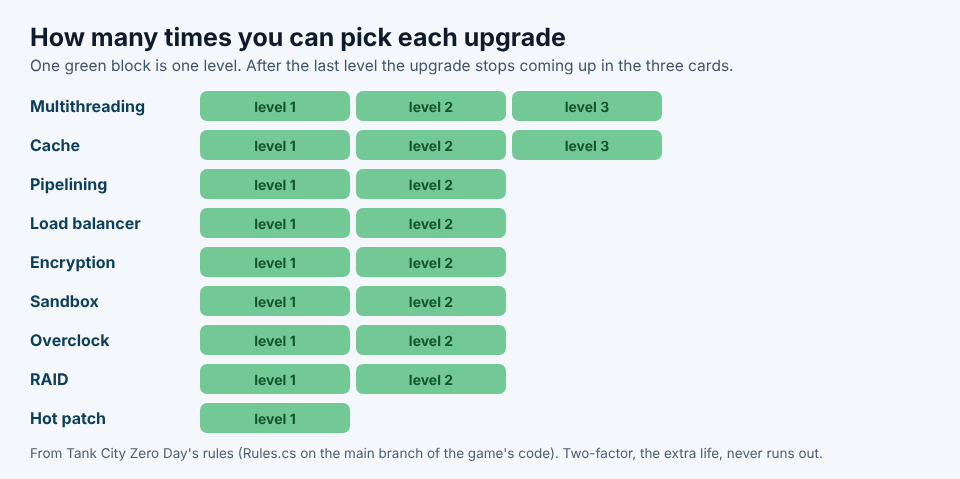
Each block is one time you can pick that upgrade, from the game's rules.
Here is a worked example, a made-up situation that uses the game's real numbers. Say you cleared wave 3 and took Multithreading earlier, so you fire two shots in a spread. The game offers Cache, Sandbox and RAID.
- Cache makes you fire 30% faster. The wait between shots drops from 0.3 seconds to 0.225, and holding Fire shoots again as soon as the wait ends. It pairs well with a spread, because every volley comes sooner.
- Sandbox is a shield that stops one hit and recharges, in 12 seconds at level 1. It protects you from the mistake that ends a run.
- RAID raises core integrity by one and repairs it fully. That matters because the wave-clear bonus grows with how much core integrity you have left.
The right pick depends on your run. If you keep losing the core, take RAID. If your tank keeps dying, take Sandbox. If you are surviving fine but kills come slowly, take Cache. Wave 5 brings the first zero-day boss with 40 hit points, and every shot that hits takes one, so firing faster is a real answer to that fight.
The pick also connects to the kill chain. Chaining kills within 2.5 seconds of each other raises your score multiplier, up to x8. Faster fire and wider spreads help you keep that chain going. For more on how chains and multipliers work, see combo meters in games.
Frequently asked questions
What is a roguelike upgrade pick?
It is a choice the game gives you between rounds: a few options, usually three cards, and you keep one for the rest of the run. The upgrade lasts until the run ends.
Why do roguelikes usually show three cards?
Three is enough to make you compare options and few enough to read in seconds. Because the cards change each time, every run ends up different.
Should I always take the strongest-looking card?
No. A card that fits what your run is missing often beats one with a bigger number. Look at what you struggled with in the last round and pick for that.
Do upgrades carry over to the next run?
In Tank City Zero Day they do not. Upgrades last until the run ends and reset when a new game starts.
Get started
The fastest way to learn the upgrade pick is to make a few of them and see what happens. Play a run, note what ended it, and choose differently next time.
Play Tank City Reboot: it is free, plays in your browser on a computer or a phone, and needs no account.
The Family Computer tank classic, rebuilt inside a computer.
Visit tankcityreboot.vlvd.net↗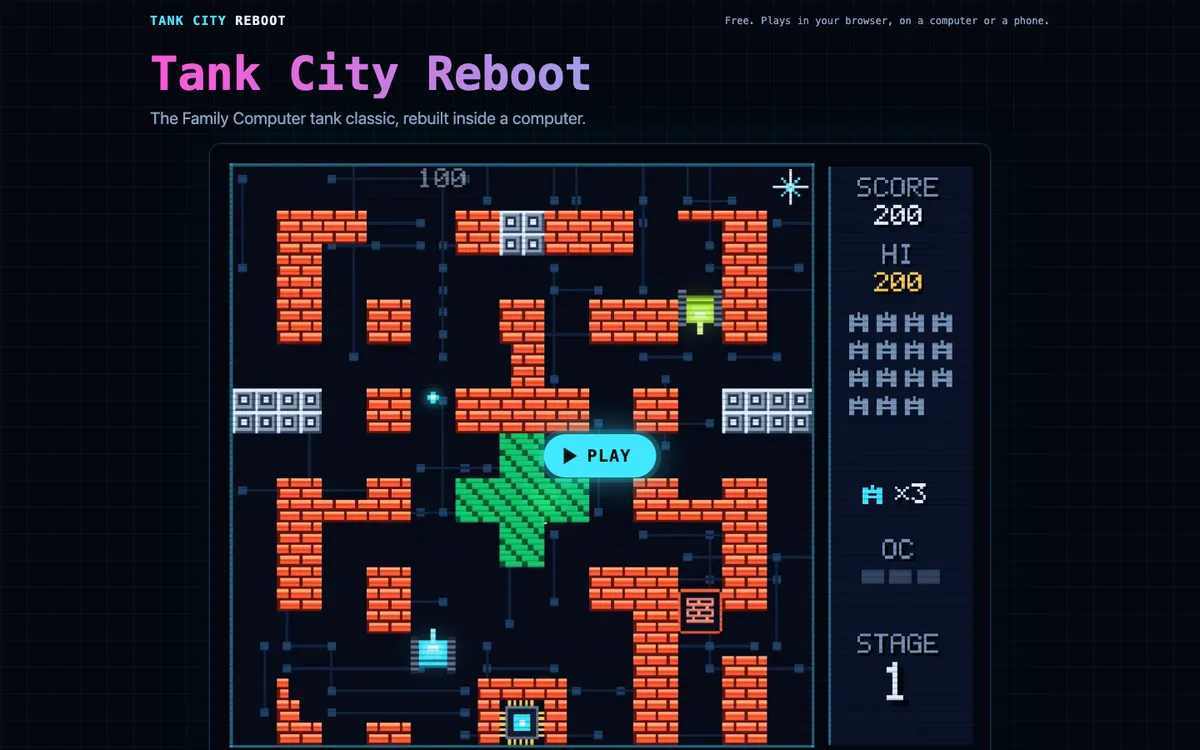
Comments
No comments yet.
Sign in or make an account to comment.