Rubik's cube corner twist: the rule of three turns
A Rubik's cube corner twist is the one move you can never make on its own. Turn the faces any way you like and the corners travel and twist, but never one corner by itself. This guide shows the three ways a corner can sit, the counting rule that keeps them in step, a check you can run on your own cube, and what it means when a single corner looks wrong.
How a corner piece sits in its spot
A 3 by 3 cube has 8 corner pieces. Each one shows three colours, one on each of the three faces that meet at that corner. According to Wikipedia's article on the cube, each corner has three possible orientations: three ways it can sit in the same spot.
Take the corner that belongs between the white, red and blue faces. It can sit the right way round, with white on top. Turn it a third and white faces you. Turn it another third and white faces the side. A fourth third brings it back where it started.
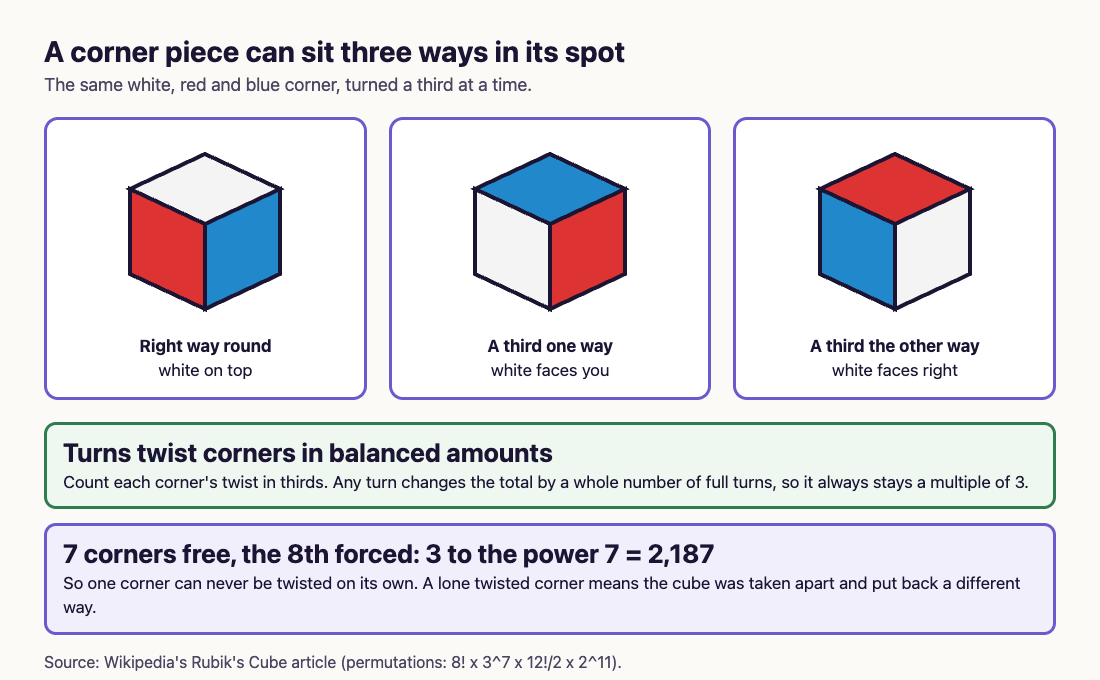
One corner, three ways to sit in the same spot.
So every corner has two things you can get wrong: where it is, and which way it is turned. Our post on how many squares a Rubik's cube has counts all 26 pieces; here we only need the 8 corners.
The Rubik's cube corner twist rule
Wikipedia gives the rule in one line: only seven of the eight corners can be turned freely. The way the eighth corner sits depends on the other seven. That is why the number of ways to turn the corners is 3 to the power 7, which is 2,187, and not 3 to the power 8.
Here is a simple way to see the rule. Give each corner a score in thirds of a turn:
- 0 if its top or bottom colour faces up or down.
- 1 if that colour sits one step round the corner, going clockwise as you look at the corner from outside.
- 2 if it sits two steps round.
Now watch what turns do to the total. A quarter turn of the top or bottom face carries four corners round without tipping them, so their scores stay the same. A quarter turn of any side face tips its four corners: two gain 1 and two gain 2. That adds 6 to the total, which is two full turns. Taking away full turns, nothing has changed.
So the rule is: the total of all corner scores is always a multiple of 3. A solved cube starts at 0, and no turn can push it off.
Why one corner can never twist alone
Picture a solved cube where one corner alone has turned a third. Its score is 1 and every other score is 0. The total is 1, which is not a multiple of 3, so no turns can ever bring the cube there, or take it back. Wikipedia says the same in its own words: there is no sequence of moves that will rotate a single corner.
The rule still leaves plenty of room. Two corners can twist at once, one a third each way, since 1 and 2 make 3. Three corners can each twist a third the same way, since 1, 1 and 1 also make 3. Wikipedia's page on the cube's group, the maths of the cube's moves, builds every change in how pieces are turned out of two kinds of move: one that twists two corners and one that flips two edges.
Solving methods lean on this. The method most speedcubers use today, Wikipedia says, turns the last layer's pieces the right way up in one step before it moves them into place. The rule means the corners there always twist back together; there is never one left over.
A worked check you can do on your own cube
You can test the rule on any scrambled cube:
- Hold the cube with one centre on top, say white. The centre opposite it is the bottom colour.
- Go round the 8 corners. On each, find the sticker that is white or the bottom colour. Every corner has exactly one.
- Score the corner 0, 1 or 2 using the list above.
- Add the 8 scores.
Say your scores come out as 1, 0, 2, 2, 1, 0, 0, 0. The total is 6, a multiple of 3, so the corners can all be turned the right way with normal moves. Now say you find a cube that is solved except one corner, whose white sticker faces the front. That corner scores 1 or 2, depending on which way it is turned, and every other corner scores 0. The total is not a multiple of 3, so no amount of turning will fix it.
If the cube's turns confuse you while you count, the layer diagram from how a Rubik's cube turns shows which 9 pieces a quarter turn moves.
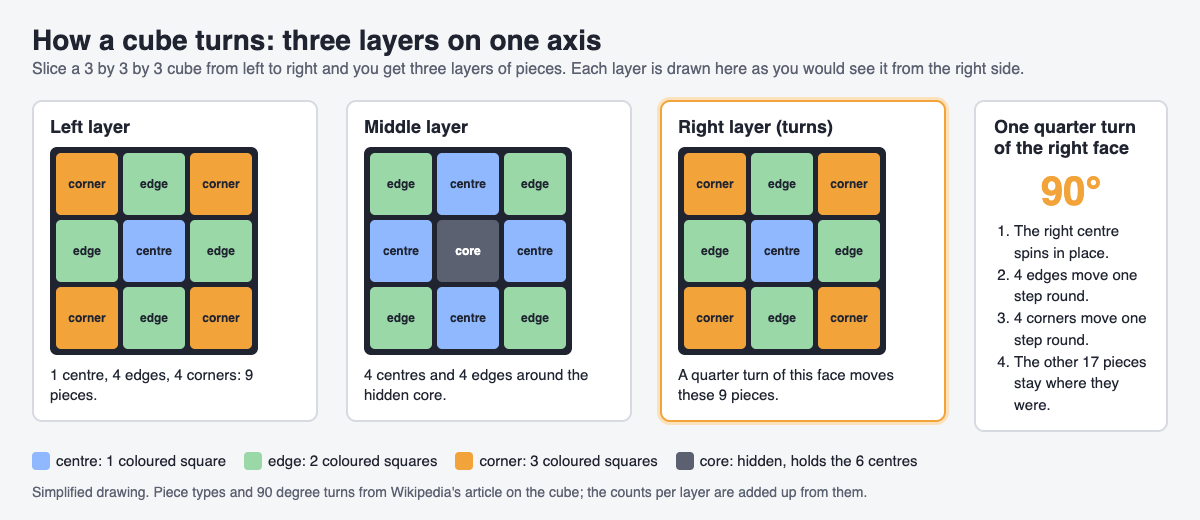
A quarter turn moves 9 pieces: 4 corners, 4 edges and 1 centre.
What a single twisted corner means
If your check gives a total of 1 or 2 left over, the cube has been taken apart and put back a different way. Wikipedia notes a cube comes apart quite easily, usually by turning the top layer 45 degrees and prying out an edge piece.
Put the pieces back at random and you may land in a position that turns can never solve. Counting every way to reassemble the pieces gives 12 times as many positions as turning alone can reach. Wikipedia calls the 12 groups "universes" or "orbits", and only one of them holds the solved cube. The 12 come from three rules: corner twists (3 ways), edge flips (2 ways) and swapping a single pair of pieces (2 ways). Three times two times two is twelve.
The fix sits outside the puzzle: take the piece out again and put it back the right way round. The centres are the one part you never have to worry about, since they are fixed to the core; our post on Rubik's cube centre pieces explains why.
Corners and twists in 3D 2048
3D 2048 puts the 2048 puzzle on a cube like a Rubik's cube: six faces of nine squares, 54 in all. You slide number tiles on the front face so equal numbers merge, aiming for a 2048 tile. There are no colours to match, so you never count corner scores.
What carries over is the layer move. Drag a row on the right face sideways, or a column on the top face, and that layer turns a quarter and carries its tiles to the next face. The game adds one rule of its own: "A twist needs one empty square for it." Turning the whole cube, by dragging the space around it or pressing Shift and an arrow key, costs nothing: in the game's words, "Turning is free."
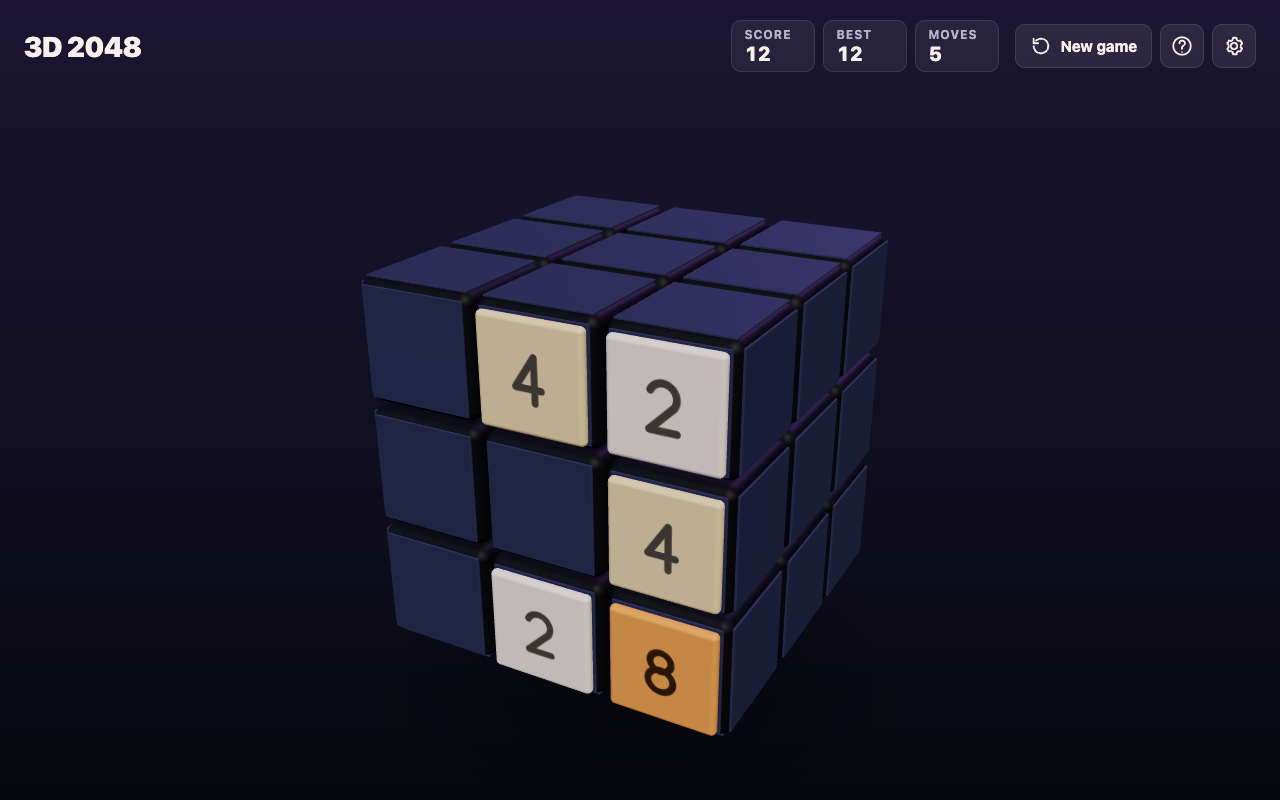
A twist in 3D 2048 carries a layer's tiles to the next face.
Frequently asked questions
Can you twist one corner of a Rubik's cube?
Not with turns. The corner twists always add up to a multiple of 3, so a single corner turned a third can only come from taking the cube apart.
How many ways can the corners of a Rubik's cube be turned?
2,187, which is 3 to the power 7. Seven corners can sit any of three ways, and the eighth is then fixed.
How do you fix one twisted corner?
Turning will not fix it. The piece has to come out and go back the right way round.
Does 3D 2048 use corner twists?
No. It is a 2048 number puzzle on a cube. It uses layer twists and whole-cube turns to bring tiles together, not to match colours.
Get started
Grab a scrambled cube and run the four-step check above. If your total is a multiple of 3, the corners will come right with normal turns. Then try twisting layers to bring numbers together instead of colours.
Play 3D 2048: it is free and plays in your browser on a computer or a phone.
Comments
No comments yet.
Sign in or make an account to comment.