Scale a Startup Without Hiring: An AI-Era Playbook
You can scale a startup without hiring by treating headcount as the last tool you reach for, not the first. Write down each job the business does, automate the repeatable ones, hand the odd ones to tools and contractors, and set clear triggers for the day a real hire becomes the cheaper option.
This post gives you that playbook in plain steps. For the economics behind it, the Scaling an AI Company course has three lessons: The Economics of AI Companies, Tiny Teams, Huge Leverage, and Your Roadmap: From First Project to Company. You sign in to open it, with your email and an emailed code.
Age of AI Entrepreneur teaches how to build, launch and grow a business with AI, in short hands-on lessons with the sources listed, so you can learn the parts of this playbook one lesson at a time.
How to scale a startup without hiring: why headcount is no longer the default
For a long time, more customers meant more people: more tickets meant a support hire, more leads a salesperson, more code another developer. Nothing else could do the work.
AI changes that for a specific slice of work: tasks that are repeated, text-heavy and easy to check. Drafting replies, sorting inbound messages, summarizing calls, cleaning data and writing first versions of documents all fit. A model can do a first pass at these in seconds.
That does not mean you never hire. It means the question changes. Instead of "who do we hire for this?", you ask "does this need a person, or does it need a system?" That small shift keeps your costs low and your decisions reversible for longer. A one-person AI company is the extreme case of the same idea.
What actually breaks first when a startup grows
It is rarely the product. It is the work around the product. When volume rises, these things usually fail first:
- Your inbox. Support, sales questions and partner emails pile up and you reply late.
- Onboarding. Every new customer needs the same five steps, and you do them by hand.
- Reporting. You stop knowing your own numbers because pulling them takes an afternoon.
- Quality. Outputs drift, and nobody notices until a customer complains.
- Your own time. You become the bottleneck for every decision.
Most of these are process problems. A new hire can paper over a missing process, but you then pay for the person and keep the mess. Fix the process first and the hire may turn out smaller, or unnecessary.
Which work to automate with AI and which to keep human
Sort every recurring task using two questions. How often does it repeat? What does a mistake cost?
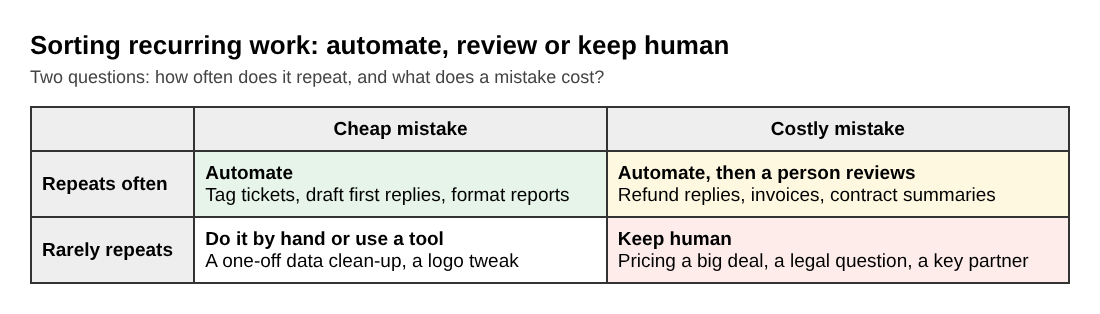
A simple way to sort recurring work before you automate or hire.
Good candidates to automate
- High repeat, low cost of a mistake: tagging tickets, drafting first replies, formatting reports, extracting fields from documents.
- Work where a person can check the result in a few seconds before it goes out.
Keep human, at least for now
- Low repeat, high cost of a mistake: pricing a big deal, handling a refund dispute, firing a vendor, anything legal.
- Relationship work where trust is the product: the first ten customers, key partners, hard conversations.
- Judgment calls about what to build next.
The course on Agents and Automation has a lesson called Workflows Versus Agents, which is the right place to learn when a fixed sequence of steps beats a free-roaming agent. For most early work, a simple fixed workflow is easier to trust.
Build systems before you build a team
A system is a written, repeatable way of doing a job that someone or something else can run. Build it before you need it.
Here is a worked example. Say you run a small tool that people sign up for, and you answer every support email yourself. Turn that into a system in four steps:
- Log the questions. For two weeks, paste every incoming question and your reply into one document.
- Group them. You will likely see a handful of themes cover most of the volume.
- Write a prompt. Give a model your product notes and your best past replies, then ask for a draft reply to each new message. For example:
You are the support voice for our product. Using only the notes below, draft a short, friendly reply. If the notes do not cover the question, say "needs human" and explain why. - Review before sending. You read each draft, edit if needed and send. Over time, you skim more and rewrite less.
The "needs human" line matters. It tells the system where its edge is, so the hard cases come to you instead of getting a confident wrong answer.
Once this works, you can hand a contractor or a future hire a documented process, a prompt and examples of good output on day one. The Your First Builds course covers this kind of work in its lesson Project 3: Automate One Boring Workflow.
Add a quality check
Keep a small set of example inputs with the answers you consider good, and rerun them whenever you change a prompt or a model. The Evals: Shipping AI That Works course teaches this, starting with why your AI product needs evals at all.
Use contractors, tools and vendors for the gaps
Between "I do it" and "I hire someone full time" there is a lot of room.
- Tools for things that are solved problems: payments, email delivery, scheduling, analytics.
- Contractors for work that comes in bursts: a design pass, a legal review, a security check, an accounting close.
- Vendors for functions you do not want to own, such as hosting or a model API.
Buy flexibility while you are still learning what the business needs. A contractor you can stop paying next month is a smaller bet than a salary.
One caution: every vendor you add is a dependency. If a part of your product runs on someone else's model, you should know what happens when its price or behavior changes. The Distribution and Moats course has a lesson, Building on Someone Else's Model, worth reading before you lean on one.
Set hiring triggers so you hire only when needed
Do not hire because you feel busy. Hire because a rule you wrote in advance was met. A trigger is a measurable condition that tells you a person is now worth more than the system.
Some examples of triggers you could write for yourself:
- "If review of automated drafts takes me more than ten hours a week for four weeks in a row, I hire part-time support."
- "If a task needs a judgment call on more than a third of cases, a person owns it."
- "If one contractor is doing the same job every week, I make it a role."
- "If I have turned down good work three times because I had no capacity, I hire for that work."
The numbers are placeholders; pick yours from your own logs. What matters is deciding before the pressure arrives, because under pressure almost any hire looks justified.
When you do hire, hire into a documented system. The new person improves a process instead of inventing one, and you can tell quickly whether the role is working.
Costs and risks of staying small
Staying lean has real downsides. Be honest about them.
- You are a single point of failure. If you are sick or away, things stall. Write runbooks so someone else can step in.
- Review is still work. Checking AI output takes time, and that time grows with volume. Track it.
- Model costs are real. Every request has a cost, and heavy use adds up. Know what a request costs before you build a workflow around it. The AI Product Stack course has a lesson called Model APIs, Tokens and What a Request Costs.
- Quiet errors. A confident wrong answer can do more harm than a slow one. This is why the review step and your eval set matter.
Nothing here guarantees a business outcome. Staying small is a way to keep options open while you learn, not a promise of success. If you want a wider map of where each of these topics sits, the 12-course path from zero to launch lays out the order.
Frequently asked questions
Can I really scale a startup without hiring anyone?
You can scale much further than before on repeatable work, but most businesses reach a point where a person is the better choice. Plan for that point with written hiring triggers instead of avoiding it.
What should I automate first?
Start with a task that repeats often, is easy to check and costs little if it goes wrong, such as drafting support replies. Keep yourself in the loop to review at first.
When is it time to make my first hire?
When a condition you set in advance is met, for example review work eating a fixed number of your hours for several weeks. Hiring because you feel busy is a weaker signal.
Is using contractors better than hiring?
For uneven or specialist work, often yes, because you can stop paying when the work stops. For steady work that never goes away, a role may cost less and keep knowledge in the company.
How do I stop AI mistakes from reaching customers?
Review outputs before they go out, tell the system to flag what it cannot answer, and keep a small set of example cases you rerun after every change.
Get started
Pick one repeated task this week and log it for two weeks. Then write the prompt, the review step and one hiring trigger. That small loop is the whole playbook in miniature.
To go deeper, open the Scaling an AI Company course. You sign in with your email and an emailed code. You can also read more on starting and growing a business with AI on the blog.
Start Age of AI Entrepreneur: short hands-on lessons on how to build a business in the age of AI, with every side of the debate and the sources to read next.
Building a business in the age of AI, from a first project to a company.
Visit aientrepreneur.vlvd.net↗
Comments
No comments yet.
Sign in or make an account to comment.