Sense of Meaning in Life: How to Build One Step by Step
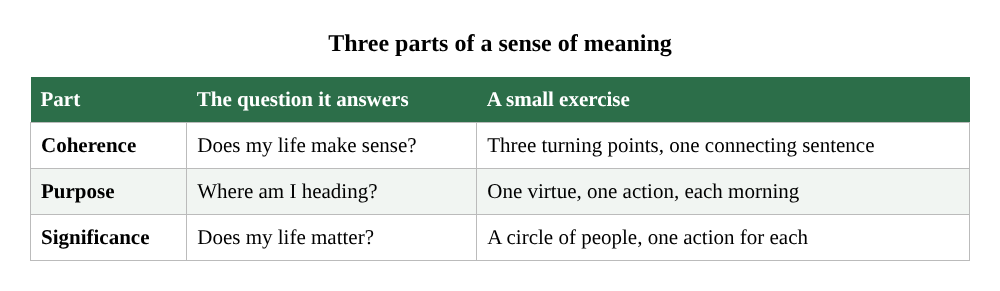
A sense of meaning in life is the feeling that your life makes sense, points somewhere, and matters. Researchers distinguish three parts: coherence, purpose and significance. You can check each part on its own, and you can build each one with small, repeatable exercises.
If you want a place to practise, How to Find Your Meaning is a free web app of short hands-on lessons on Stoic philosophy, healthy habits and the story of who you are, with a daily Stoic practice to help you live what you learn. This article gives you the framework and the exercises first.
What a sense of meaning in life actually is
"Meaning" sounds vague, so it helps to break it down. In their 2016 paper "The three meanings of meaning in life: Distinguishing coherence, purpose, and significance" (Journal of Positive Psychology), Frank Martela and Michael Steger set out three components:
- Coherence: your life makes sense to you. Events fit into a pattern you can explain.
- Purpose: you have goals and a direction worth moving toward.
- Significance: you feel your life matters, to you and to other people.
The useful part is that these can come apart. You can have a clear goal and feel it means nothing. You can feel important to your family and have no idea what your life is for. When you say "I feel lost," you usually mean one of the three is weak, not all of them.
This also changes the job. You do not need to find one grand answer. You need to work on the part that is thin.
Coherence: when your life makes sense
Coherence is about story. You are not asking "what should I do?" but "how did I get here, and does it hang together?" People with low coherence often say their days feel random, or that big events (a move, a loss, a job change) never got explained to themselves.
Stoicism gives you a starting point. The Enchiridion opens by separating what is in your control from what is not, and it counts your opinions among the things that are. Events that hit you from outside are not up to you. The judgement you form about them is. A coherent story does not mean everything happened for a reason. It means you have made your own account of what happened and what you did with it.
The Stoic habit of reviewing the day fits here. A story is built from many small reviews, not one big session.
Purpose: having direction worth moving toward
Purpose is forward-looking. It is the sense that tomorrow's effort connects to something you care about. It does not have to be a career or a mission statement. It can be raising a child well, getting a craft right, or being someone your neighbours can rely on.
The Stoics frame direction through virtue. The Stoics named four main types of virtue: wisdom, justice, courage and moderation. They give you something to aim at that does not depend on luck. You cannot control whether a project succeeds, but you can choose to act with courage or fairness today. That makes purpose something you can act on in one afternoon.
Habits matter here too. A direction only counts if you walk it, and walking takes repetition. If you want the research on how long that takes, see 66 days to form a habit: what the research shows. If worry is what pulls you off course, things you can't control sorts it into what is yours and what is not.
Significance: feeling that your life matters
Significance is the hardest to talk about and the easiest to neglect. It is the sense that your existence makes a difference, that you are not interchangeable. It often comes through other people: being needed, being missed, being part of something.
Marcus Aurelius wrote in his notebook: "That which is not good for the swarm, neither is it good for the bee" (Meditations 6.54, Long translation). You do not have to agree with every Stoic claim to find the thought useful: you are one part of something larger. Ask not "am I important?" but "who depends on me, and what do I owe them?" That question is concrete enough to answer.
How to tell which part of meaning is missing
Take ten minutes with a notebook and answer these six prompts. Rate each from 1 (not at all) to 5 (very much). This is a self-check for you, not a clinical test.
- I can explain, in a few sentences, how I got to where I am. (coherence)
- When something bad happens, I can usually find a way to make sense of it. (coherence)
- I know what I am working toward this year. (purpose)
- Most of my week points at things I care about. (purpose)
- At least one person would notice and be affected if I disappeared from their life. (significance)
- I contribute something that I would be proud to describe. (significance)
Add each pair. The lowest pair is where to start. If all three are low and you also feel flat, hopeless or unable to enjoy anything for weeks, talk to a doctor or a mental health professional. A lack of meaning can be a sign of something that needs more than exercises.
Simple exercises to strengthen each part
For coherence: the three turning points
Write down three moments that changed the direction of your life. For each one, write two sentences: what happened, and what you did next. Then write one sentence connecting all three. It will be rough. That is fine. The point is to practise telling your own story instead of leaving it unspoken.
Return to it in a month and change it. A story that never changes is probably not being used.
For purpose: one virtue, one action
Each morning, pick one of the four virtues. Ask: where could I practise this today? Then choose one small, specific action. "Be more courageous" is vague. "Send the email I have been avoiding before noon" is not.
The daily Stoic practice in How to Find Your Meaning follows this shape. In the morning you get a question for the day ahead and one of the four virtues to practise. During the day you get a short passage from Epictetus, Marcus Aurelius or Seneca, and one thing to try. In the evening you answer the three questions Seneca learned from Sextius: What bad habit did I cure today? What fault did I resist? In what way am I better? The whole thing takes about ten minutes, and doing all three steps in a day keeps your streak.
For significance: the circle of people
Draw a small circle for yourself and add the people who rely on you or would feel your absence: family, friends, colleagues, neighbours. Next to each name write one thing you actually do for them. If a name has no action next to it, that is your next step. Call, help, show up.
The "Your Roles" lesson in the course You: Finding Your Meaning works on the same idea, looking at the roles you hold and what each asks of you.
Keep notes in one place
These exercises work better if you can look back at them. The app lets you keep Stoic notes and meaning notes on any course, any lesson and each day of the practice, all in one place. Paper works too. What matters is that your earlier answers are still there when you write the next ones.
Why meaning changes over time
A sense of meaning in life is not a trophy you win once. It moves with your circumstances. A child leaves home, a job ends, a friend dies, and one of the three parts can drop. That is normal, not a failure.
The Stoics took this seriously. Their lessons on remembering death and on grief and consolation exist because loss is part of every life, and a life that depends on nothing changing is fragile. Building meaning on things you can always do (act with a virtue, review your day, serve people near you) gives you something steadier than a single goal.
Different thinkers also disagree about what makes a life meaningful. The app sets out 34 cards where thinkers disagree, and every lesson lists its sources, so you can see each side and decide for yourself. This post takes no side in that debate.
No exercise guarantees you will feel more meaning, and the lessons do not promise it. They give you a structure to try and a record to look back on.
Frequently asked questions
What is a sense of meaning in life?
It is the feeling that your life makes sense (coherence), has direction (purpose) and matters (significance). Psychologists treat these as three separate parts, so you can be strong in one and weak in another.
How long does it take to build a sense of meaning?
There is no set time, and nobody can promise a result. Small daily actions, like a morning intention and an evening review, are easier to keep going than a single big overhaul.
Is a lack of meaning the same as depression?
They are not the same thing, and this post cannot tell you which one you have. If you feel hopeless, flat or unable to enjoy things for weeks, speak to a doctor or a mental health professional rather than relying on exercises alone.
Do I need to study Stoicism to do this?
No. The exercises above work without any background. Stoic ideas give you long-used tools, such as the virtues and the evening review, but you can use them as plain practices.
Get started
Pick the lowest score from the self-check and do the matching exercise today. If you want short lessons and a daily practice to go with it, start How to Find Your Meaning. The lessons are free with an account, and you sign in with your email and an emailed code. You must be 13 or older.
The app installs free from the site. You can read how on the get the app page, or learn who built it and what the courses cover on the about page.
Find what your life is for.
Visit findyourmeaning.vlvd.net↗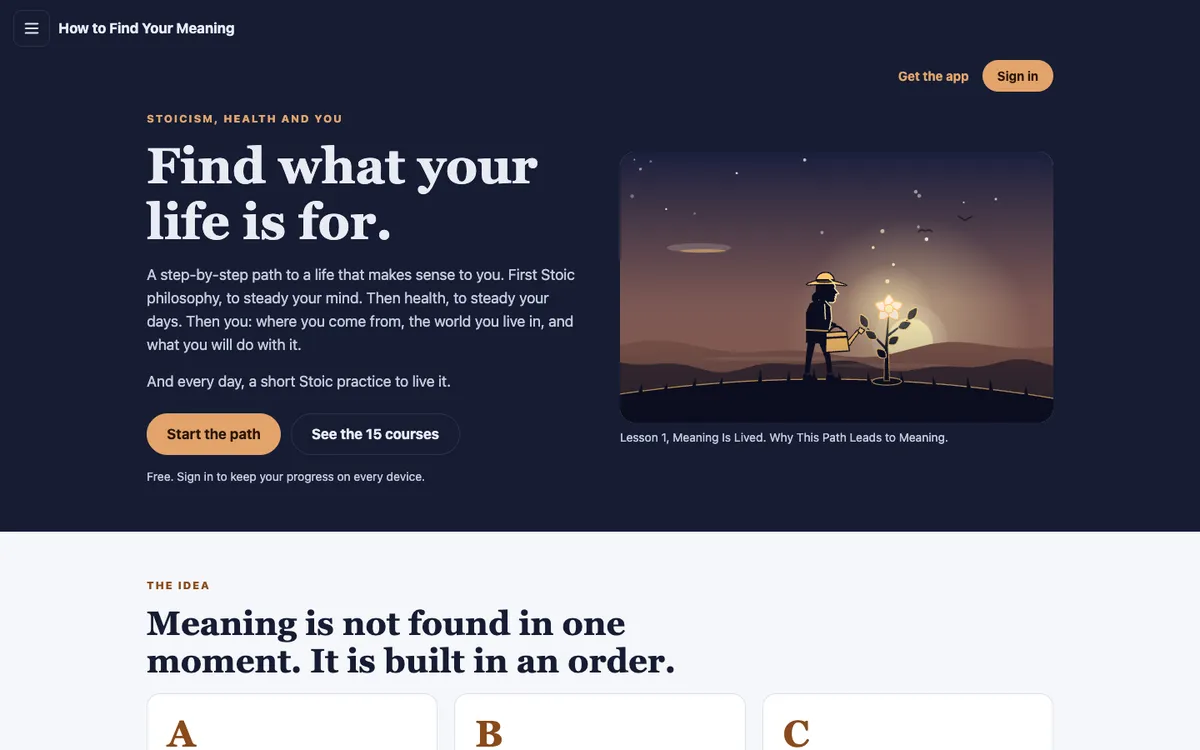

Comments
No comments yet.
Sign in or make an account to comment.