St Mawes Castle: Henry VIII's artillery fort in Cornwall
St Mawes Castle on the Cornish coast is a four-storey artillery fort of the 1540s, and English Heritage calls it perhaps the best surviving example of a Henrician artillery fort. It was not built to stand a long siege in the old way. It was built to shoot at ships. This post explains why Henry VIII built it, why it came as a pair with Pendennis across the water, who lived in it and how long it stayed in use.
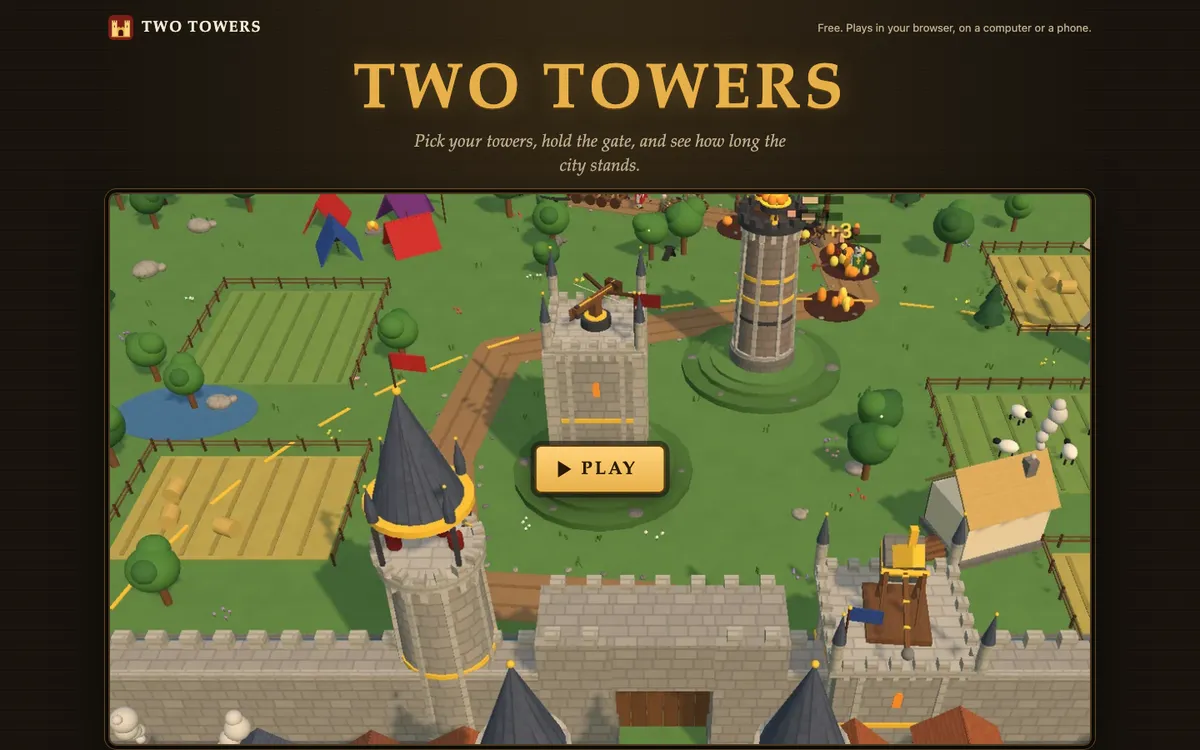
If guarding a single approach with a few well-placed weapons sounds like your kind of puzzle, Two Towers is a free medieval tower defense game that plays in your browser, where you choose the two towers that guard a city gate.
Why Henry VIII built St Mawes Castle
In 1538 France and Spain made an alliance, and England, cut off from Rome by Henry's break with the Church, found itself politically alone. The king looked to fortify the south and east coasts. English Heritage says the Fal estuary was one of several places where an enemy might gain a foothold.
Local people had seen the risk first. In 1537 a local dignitary, John Arundell, had petitioned the king to protect the Fal with "blockhouses made upon our haven". He had to wait until 1539 and after, when St Mawes was begun as one of 30 new fortifications built by Henry VIII to defend important ports and anchorages. English Heritage calls the whole programme the largest national coastal defence effort since the Roman era.
Two castles and a crossfire
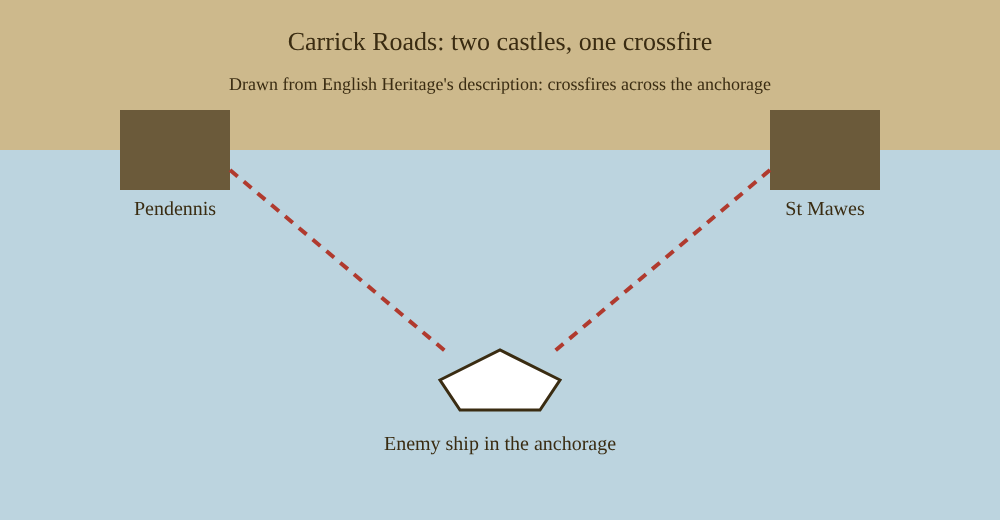
The crossfire idea: two castles on facing headlands cover the same water.
The Fal opens into a wide anchorage called Carrick Roads. The plan was to guard it with two main castles, Pendennis and St Mawes, set on facing headlands and developed to create crossfires across the water. A ship that sailed in would be under fire from both sides.
Two smaller blockhouses added protection, with guns positioned to fire from the shoreline, one of them a small blockhouse on the shore below St Mawes that put Tudor firepower at the waterline. The two castles look very different in size today, but English Heritage says their size and armaments were similar when they were new. Pendennis grew into the larger fort you see now when it was expanded in 1597 to 1600 and after. Both stayed in military use from 1540 until 1956.
What an artillery fort changed
An older castle was built to be hard to climb and hard to break into. A fort like St Mawes was built around guns, and its aim was to stop a ship before it reached the shore. Its four-storey main tower and its bastion fit that job. The walls still show arrow and gun slits, which English Heritage describes as a loop, and you can compare them with the arrow loops of an older castle.
The change in weapons is the story behind it. The bombard had shown that gunpowder could break a wall. By the 1540s the answer was to put guns of your own on the coast. English Heritage's page does not give a count of guns for the 1540s castle, so this post does not either.
Wars at St Mawes: the Armada and after
The castle seldom fired in anger, but it was often on alert. English Heritage lists the occasions:
- 1574. The small garrison was increased when word came of a hostile fleet gathering at a Spanish port.
- 1585 to 1604. War with Spain was formally declared in 1585. In 1588 the Spanish Armada caused high alert but sailed past.
- 1595. A small Spanish force raided Cornwall at Penzance, Newlyn, Mousehole and Paul.
- 1596 and 1597. Another Spanish Armada set sail for England with Carrick Roads as its target, but bad weather defeated it.
- 1779 to 1783. Militia were called up in the American War, when a French invasion was expected.
- 1793 to 1815. The castle was garrisoned during the French Revolutionary and Napoleonic Wars, and ten heavy 24-pounder guns were placed on a battery close to the shore.
New guns for a new century
After 1815 things were quiet for about 40 years. Then a French naval threat led to a complete rebuild of the shore battery. The Grand Sea Battery for 8-inch guns, with a magazine for the ammunition, was ready by the mid 1850s.
The guns kept changing. In the 1880s the port of Falmouth was seen as open to attack, and the 8-inch guns gave way to 64-pounder rifled guns. In the 1890s quick-firing 6-pounder guns and machine guns were added to meet fast torpedo boats. In the Second World War twin 6-pounder guns were built on the shore north-west of the castle, and in spring and summer 1944 American troops and equipment arrived for training before D-Day.
Who lived in the castle
The garrison was small. English Heritage says it was normally no more than 15 people, and at times it was only a master gunner. In an emergency it would be filled out by trained militia and volunteers.
When the castle was built, Cornwall was remote from central government and had its own language, so the Crown worked through local commissioners and gentlemen. At St Mawes the first of these was Thomas Treffry, a rich merchant from Fowey. For its first 150 years the people who worked there were mainly local and loyal to their captains, and they probably served part-time with soldiering and gunnery not their only job. That may have changed under the Commonwealth (1649 to 1660), when professional soldiers may have been in garrison. In the 18th century a master gunner and a couple of assistants kept the castle in care and maintenance.
A worked example: two towers over a crossfire
St Mawes and Pendennis were two strong points covering one stretch of water. Two Towers asks you to do the same thing for a gate, so it is a good way to feel the idea of covering an approach.
- Pick two towers from the four kinds: Archer Tower, Trebuchet, Ballista and Fire Tower.
- Place them so they overlap on the road to the gate, so an attacker is hit from more than one side, as ships in the Fal would have been.
- Read the tip for the next attacker and spend your gold on upgrades, or buy two more towers for the hills.
- Keep going. Every stage is harder than the last and there is no final stage.
The lesson from St Mawes is that a small, well-placed defence can last a long time. The castle stayed in use for over 400 years, and it never needed a large garrison to do it.
Frequently asked questions
Where is St Mawes Castle?
It is on a headland on the Cornish coast, directly opposite Pendennis Castle across the Fal estuary. English Heritage looks after it.
When was St Mawes Castle built?
It was begun in 1539 or after, as part of Henry VIII's coastal defence programme, and it was in military use from 1540 until 1956.
What is a Henrician castle?
It is one of the artillery forts Henry VIII built in the 1530s and 1540s to defend the coast. St Mawes was one of 30 new fortifications in that programme.
Did St Mawes Castle ever fight a battle?
English Heritage's history page names no battle fought there. It tells of alerts in 1574, 1588, 1595 to 1597 and later wars, when the garrison was raised or the Armada sailed past.
Get started
If the crossfire at St Mawes made you want to guard something of your own, try it. Pick two towers, spend your gold on upgrades and see how many stages you can hold.
Play Two Towers: it is free and plays in your browser on a computer or a phone. For the full story of the castle, read English Heritage's history of St Mawes Castle.
Comments
No comments yet.
Sign in or make an account to comment.