Starving a castle: how sieges ended without a breach
Starving a castle was the slow way to win a siege. Instead of breaking the walls, the attackers closed every road in and out, then waited for food to run out. This guide explains why armies chose to wait, what a blockade needed, how defenders held out, and how the siege of Carlisle in 1644 to 1645 ended in surrender step by step.
Medieval records are patchy. What follows is the best reading of the evidence on the pages cited, and where two sources disagree, you will see both.
Why choose starving a castle over storming it?
Storming a castle was quick but dangerous. Walls, ditches and towers were built to make attackers pay for every step. English Heritage's 10 things about sieges puts it simply: if a castle had good defences, attackers often decided to wait and try to starve the defenders out.
Waiting was not cheap either. English Heritage's guide to medieval siege warfare calls blockade and starvation generally a last resort, "not desirable for either side as it could be lengthy and costly." The same page notes that only the wealthy and powerful could keep an attack going for a long time.
So the choice was a trade. Storm and lose men. Wait and spend money, time and food of your own. For how long that wait could run, see how long a medieval siege lasted.
What a blockade needed, and how defenders answered
A blockade had one goal. In English Heritage's words, the aim was "to prevent anyone and anything arriving or leaving," so that the defenders' supplies dwindled, bringing starvation and disease. Water supplies were sometimes poisoned or tainted.
To do that, the attackers needed three things:
- A ring around the castle. Troops, camps and earthworks on every side, so no cart or messenger slipped through.
- Food for themselves. The besiegers had to eat for as long as the siege lasted. English Heritage calls keeping a besieging army fed and armed "a hugely expensive challenge."
- Time. Weeks at the least, and often months.
The defenders had answers of their own. The same guide says good defence relied on knowing a siege was coming. If possible, people who could not fight were sent away to save food. Food and water were stockpiled, with beer and wine in case the water was poisoned, and most castles had wells and cisterns for rainwater. For the walls, gates and plans behind those stores, see how castles defended against a siege.
The defenders' last hope was a relief army: a friendly force that could march up and break the ring from outside. As the worked example shows, the end of that hope could matter as much as the end of the food.
A worked example: Carlisle, 1644 to 1645
This siege comes from the English Civil War, so it is early modern, not medieval. It is used here because English Heritage's Carlisle Castle history page sets out each stage of a starving siege clearly. Follow it in five steps.
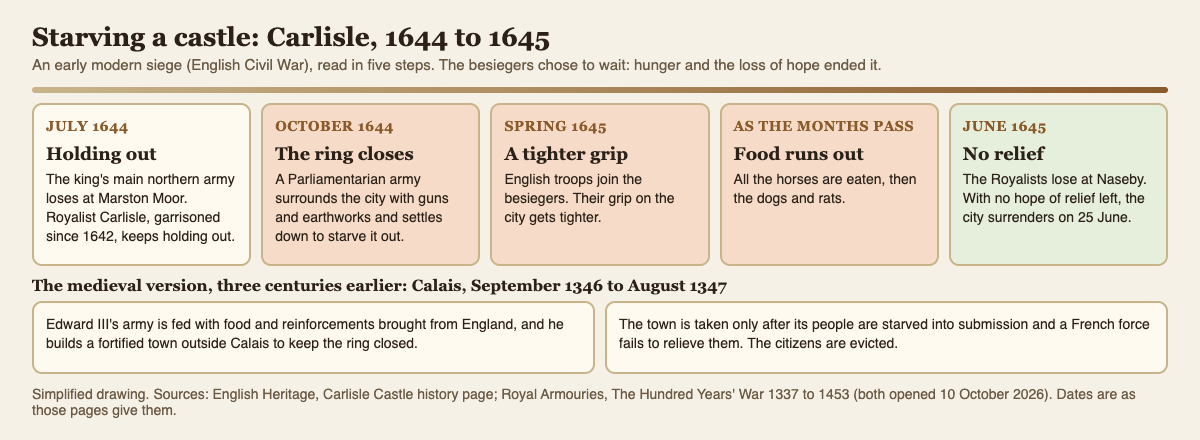
- July 1644: holding out. Carlisle had been garrisoned by the Royalists since 1642. After the king's main northern army was beaten at Marston Moor, it was one of the few places in the north still holding out for him.
- October 1644: the ring closes. A Parliamentarian army swiftly surrounded Carlisle with guns and earthworks, and "settled down to starve the city out."
- Spring 1645: a tighter grip. English troops joined the besiegers, and their grip on the city became tighter.
- Food runs out. All the horses were eaten, then the dogs and rats. The page does not date this step, so read it as the months between.
- June 1645: no relief. After the Royalist defeat at Naseby, there seemed no more hope of relief. On 25 June the city surrendered.
Notice what ended it. The guns and earthworks held the ring, but the page credits the surrender to two things: empty stores and the loss of hope that help would come.
The medieval version: Calais, 1346 to 1347
The same pattern appears three centuries earlier. The Royal Armouries' Hundred Years' War story describes Edward III's siege of the port of Calais, from September 1346 to August 1347, after his victory at Crécy.
Each part of a blockade shows up. Reinforcements and food were brought in from England to feed the besiegers. Edward built a fortified town, Villeneuve-le-Hardi, outside Calais to keep the town surrounded. The page says the town was only taken after its people had been starved into submission and a French force failed to relieve them. The citizens were then evicted and replaced with English settlers.
Calais was a walled town rather than a single castle, but the method is the one this post is about. The same page lists starving the inhabitants out as one option when siege engines could not break the walls, alongside undermining the walls.
How surrender terms worked
A starved garrison did not have to fight to the last man. English Heritage's siege guide describes three possible endings: a successful assault, where the defenders were at the attackers' mercy; a surrender on agreed terms; or a siege the attackers gave up. Under agreed terms, usually only the elite could expect fair treatment and leave with some belongings. Poorer people often lost their homes, their possessions and sometimes their freedom.
Terms could vary a great deal. The 10 things page says that in the Civil War the garrison at Pendennis marched out with full honours of war and stayed free men, while the Royalists at Goodrich became prisoners and gave up their arms and property.
The sources do not all tell the same story about these two sieges:
- Pendennis, 1646. The Pendennis history page says about 1,000 soldiers and their dependents endured a five-month siege and agreed an honourable surrender in August when their food ran out. The castle's main page gives an 800-strong force. The gap may be the dependents, but neither page says so.
- Goodrich, 1646. The 10 things page lists Goodrich among castles where hunger was a key factor. The Goodrich history page says the Royalists surrendered on 31 July 1646 under threats of undermining and a deadly mortar called Roaring Meg. Both may be true at once.
Why waiting could fail
Starving a castle was never a sure thing, and there is a fair case against it.
- It was slow. Calais took over a year. Carlisle took eight to nine months, from October to late June.
- It was costly. The besiegers had to be fed the whole time. English Heritage notes that royal armies often forced farmers to sell to them at low prices.
- A relief army could end it. The defenders of Calais and Carlisle gave in only once relief failed or was lost. A relief that arrived could have turned the siege the other way.
- The besiegers could give up. Carlisle's own history shows it. The Scots besieged the town and castle seven times between 1173 and 1461, and in 1315 Robert the Bruce failed to take the castle and retreated.
The other side of the case is just as real. Kenilworth in 1266, which English Heritage calls almost six months long, ended in an honourable surrender when the defenders' food was exhausted. In these cases, when the ring held and no help came, hunger won in the end.
Two Towers shows the storming side
In Two Towers, nobody starves you out. The attackers come to the gate and you hold it. So the game shows the storming side of a siege, not the waiting side.
You choose two towers for the gate from the Archer Tower, Trebuchet, Ballista and Fire Tower. Between attacks you can repair the gate or reinforce it with in-game gold. Every stage comes stronger, faster or in greater numbers, and there is no final stage. Between stages the game says "Stage N held" and warns "The enemy grows stronger", "The enemy grows in number" or "The enemy marches faster". That steady pressure is the nearest thing in the game to a long siege.
Frequently asked questions
How did attackers starve a castle?
They surrounded it so that no one and nothing could get in or out, then waited for food and water to run low. English Heritage says the aim was to make the defenders' resources dwindle, bringing starvation and disease.
How long did it take to starve a castle into surrender?
It varied with the stores inside and the help outside. Pendennis held for five months in 1646, and the siege of Calais took over a year.
What did starving defenders eat?
English Heritage says it was not uncommon for them to eat their horses, or even their dogs and cats. At Carlisle in 1645, the horses were eaten first, then the dogs and rats.
Can attackers starve you out in Two Towers?
No. In Two Towers the attackers march on the gate and try to break it, so you face the storming side of a siege. Each stage comes stronger, faster or in greater numbers.
Get started
Want to hold a gate yourself? Play Two Towers: it is free and plays in your browser on a computer or a phone. Pick your two towers, keep the gate repaired, and see how many stages you can hold.
Comments
No comments yet.
Sign in or make an account to comment.