Stoicism and Grief: How Seneca Consoled People in Loss
Stoicism and grief are often set against each other, as if a Stoic should feel nothing at a funeral. The Roman Stoic Seneca, who wrote three consolations to people in mourning, said something different: weep, but do not let grief rule your life. This post walks through what he wrote, who he wrote it to, where he admits his own tears, and how to use his words in your own loss without turning them into a rule against feeling.
If you want to go further than a few quotes, How to Find Your Meaning is a free web app of short hands-on lessons on Stoic philosophy; its course Memento Mori includes a lesson called Grief and Consolation, and its daily Stoic practice takes about ten minutes.
What Seneca wrote about grief, and to whom
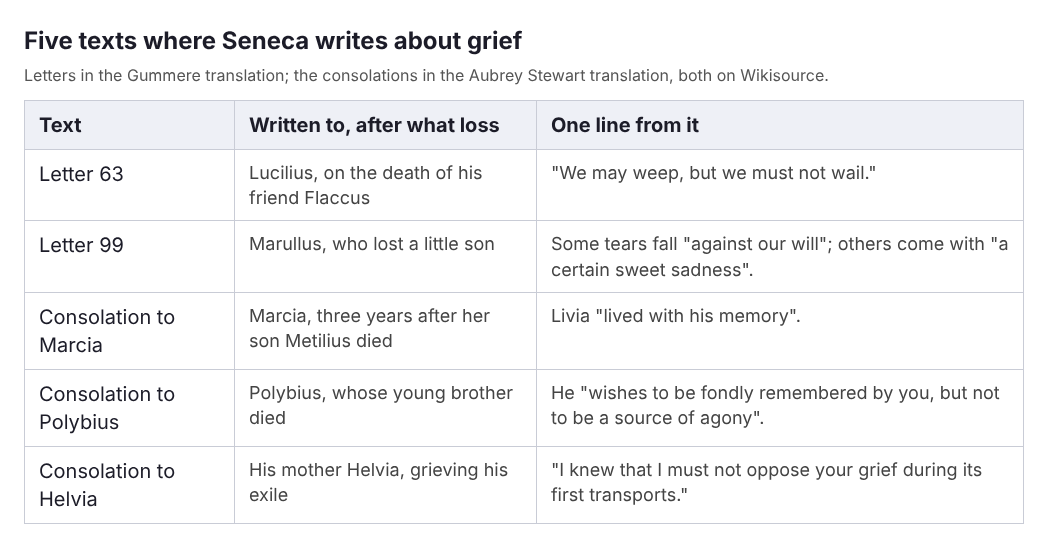
A consolation was a known kind of writing in the ancient world: a letter or essay meant to comfort someone after a loss. Seneca wrote three that survive, and several letters to his friend Lucilius after deaths.
- To Marcia, a Roman woman whose son Metilius had died. Three years had passed, and her grief had not eased.
- To Polybius, a man in the emperor's service, whose young brother had died.
- To Helvia, Seneca's own mother, who was grieving because he had been sent into exile.
- Letter 63, to Lucilius after his friend Flaccus died.
- Letter 99, a copy of a stern letter to Marullus, who had lost a little son.
Each text has its own tone because each reader had a different need. That is worth knowing before you pull a line out of it.
Letter 63: "We may weep, but we must not wail"
Letter 63 is the gentlest place to start. In the Gummere translation, Seneca tells Lucilius: "Let not the eyes be dry when we have lost a friend, nor let them overflow. We may weep, but we must not wail."
He does not ask for a dry face. He asks that tears not run on without end. Then he turns to memory: "Let us see to it that the recollection of those whom we have lost becomes a pleasant memory to us." And he ties grief to love: "Let us greedily enjoy our friends, because we do not know how long this privilege will be ours."
Then comes a confession. Seneca says he "wept so excessively" for his friend Annaeus Serenus that he must be counted "among the examples of men who have been overcome by grief". He grieved so hard, he thinks, because he had never imagined his younger friend could die first. The teacher admits he did not follow his own advice.
Marcia: when grief has gone on a long time
Seneca's worry for Marcia was that time, which he calls "nature's greatest remedy", had not helped her. Her grief, he writes, "renews and strengthens itself day by day".
So he sets two women before her. Octavia, the sister of Augustus, lost her son Marcellus, and "never ceased to weep and sob during her whole life", never letting her thoughts turn from her sorrow. Livia, the wife of Augustus, lost her son Drusus. She grieved, then "did not cease to make frequent mention of the name of her Drusus", set up his portrait and loved to hear others speak of him. She "lived with his memory". Seneca asks Marcia to choose which example to follow.
He also gives the idea the Stoics are best known for in loss: the people we love are "only borrowed", lent to us "with no fixed date for its return". Read gently, this is not a reason to love less. It is a reason to love with open eyes.
Polybius and Helvia: the living still need you
Seneca wrote to Polybius from exile, and he praises the emperor's mercy in it, saying he has "no fear that I alone shall be passed over by it". It is fair to read it knowing he hoped to be called home.
Its advice still holds. Seneca reminds Polybius that his brother "wishes to be fondly remembered by you, but not to be a source of agony". His work and the people who depend on him are still there.
The letter to his mother Helvia is unusual: the son in trouble comforts the mother. Seneca points her toward what she still has: his two brothers, her grandson Marcus, "whose sight no sorrow can withstand", his niece Novatilla, and the liberal studies she had begun. He also knew when not to speak: "I knew that I must not oppose your grief during its first transports."
Stoicism and grief: what the Stoics did not say
Read these texts and you find a man who says weep, who admits he wept too much, and who wants the memory of the dead to turn sweet, not bitter. He also writes, in Letter 99, that some tears fall "against our will", and others come "when we muse in memory upon those whom we have lost", with "a certain sweet sadness". He objects to grief kept up for show, not to grief itself.
The Stoics did hold that strong passions rest on judgements. Epictetus says in the Enchiridion, chapter 16, that when you see someone weeping for a son, it is "the judgment which he makes about it" that distresses them. "My life is over" is a judgement. The loss is real; the extra weight added to it is what can be checked.
Where readers disagree
Some lines sound harsh today. Epictetus advises, in chapter 3, that when you kiss your child you remind yourself you kiss a human being, so that you "will not be disturbed" if the child dies. In chapter 11 he says never to say "I have lost it" but "I have returned it." Seneca's letter to Marullus opens with "a scolding". Some readers find in these lines a calm that helps; others find them too cold to use in fresh grief. Seneca himself said the first shock should be left alone for a while. You do not have to accept every line to find a few that help.
If grief stays very heavy for a long time and stops you living your daily life, talk to a doctor or a grief counsellor. A quote is not a treatment.
A gentle daily practice in grief
Old words work best a little at a time. Here is a week built on the three steps of the daily Stoic practice in How to Find Your Meaning: a question and one of the four virtues in the morning, a short passage and one thing to try during the day, and Seneca's three questions in the evening.
- Morning. On a hard day, answer the question with your loss in mind. If the virtue is courage, your answer might be: "Today I will say her name out loud to someone." That is Livia's way.
- During the day. Read one line, such as "We may weep, but we must not wail." If it does not fit your grief today, write what it does make you think of.
- Evening. Seneca learned three questions from Sextius: What bad habit did I cure today? What fault did I resist? In what way am I better? In grief, keep the answers small: "I ate a real meal." "I let myself cry instead of holding it in."
- End of the week. Read back your notes. Mark one memory that hurt a little less to write down. Seneca's hope was that memory would become "a pleasant memory".
The app keeps notes on each day of the practice in one place, so you can see how a line reads a week later. Our posts on memento mori and Seneca's evening questions go deeper into both practices.
Frequently asked questions
Did the Stoics think it was wrong to grieve?
No. Seneca wrote that the eyes should not be dry when a friend dies, and admitted weeping heavily himself. His concern was grief that never eases or is kept up for show.
What is the best known Stoic line on grief?
Probably Letter 63, in the Gummere translation: "Let not the eyes be dry when we have lost a friend, nor let them overflow. We may weep, but we must not wail."
Which Seneca text should I read first after a death?
Letter 63 is short, warm and honest about his own tears. The Consolation to Marcia fits better when grief has gone on a long time.
Is Stoicism a treatment for grief?
No. It is a way of thinking that some people find steadying. If grief is severe or lasting, speak to a doctor or counsellor.
Get started
How to Find Your Meaning has 15 courses and 46 lessons of about 9 minutes, moving from Stoicism to health to the story of who you are. Its course Memento Mori has lessons on why to remember death, on the shortness of life, and on grief and consolation, and every lesson lists its sources. Lessons are free with an account, and you sign in with your email and an emailed code. Read what the app covers.
Start How to Find Your Meaning: short hands-on lessons on Stoicism, healthy habits and your own meaning, with a daily Stoic practice to live it.
Find what your life is for.
Visit findyourmeaning.vlvd.net↗


Comments
No comments yet.