Memento Mori: How the Stoics Used Death Meditation
Memento mori is Latin for "remember you will die." The Stoics did not treat it as a mood or a motto. They treated it as an exercise: call death to mind on purpose, for a set time, and then ask what it changes about today. It sounds grim. Done well, it is closer to sharpening a pencil than to staring into a void.
If you want guided lessons on this, How to Find Your Meaning is a free web app whose Basic path includes a short course on remembering death, plus a daily Stoic practice you sign in to with your email and an emailed code.
What does memento mori mean for the Stoics?
The phrase itself is later Latin, but the habit is ancient. Three features make the Stoic version different from simply being gloomy:
- It is deliberate. You pick a time and a method instead of waiting for a scare.
- It aims at action. The point is how you act in the next hour, not how you feel about the next fifty years.
- It rests on a distinction. That you will die is not up to you. How you use the time you have is. The Stoics built their approach on sorting those two apart, which is the same sorting you can see in our post on the things you can't control.
What did Marcus Aurelius, Seneca and Epictetus actually say?
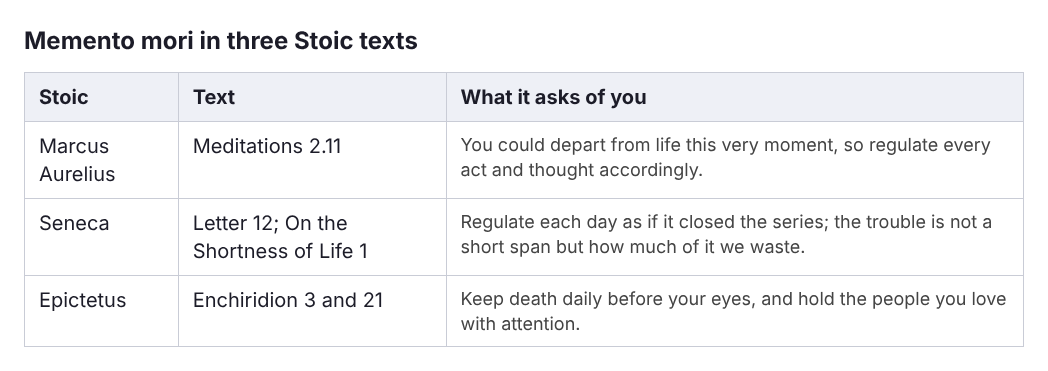
Each of the three left a different angle on the same habit. Here is what each text says, in the translations we opened for this post.
Marcus Aurelius: you could leave life this very moment
In his private notebook, the emperor writes (Meditations 2.11, Long translation): "Since it is possible that thou mayest depart from life this very moment, regulate every act and thought accordingly." Notice the verb. He does not say "feel sad." He says regulate what you do and think.
Seneca: close each day as if it were the series' end
In On the Shortness of Life, chapter 1 (Basore translation), Seneca starts from the common complaint that life is brief and answers: "It is not that we have a short space of time, but that we waste much of it." In his twelfth letter to Lucilius (Gummere translation) he goes further: "every day ought to be regulated as if it closed the series, as if it rounded out and completed our existence." He adds an odd story of a man named Pacuvius who held a mock funeral for himself every day. You do not need to copy that. The idea is that each day should be a finished piece of business.
Epictetus: keep it before your eyes, and hold loved ones lightly
In the Enchiridion (section 21, Carter translation), Epictetus says: "Let death and exile, and all other things which appear terrible be daily before your eyes, but chiefly death, and you will never entertain any abject thought, nor too eagerly covet anything." In section 3 he gives a small version: if you kiss your child or your wife, say that you only kiss things which are human, and you will not be disturbed if either of them dies. That line is hard to read, and it is meant to make you pay attention, not to make you cold. A reader who finds it too stark is not wrong to feel that; the point it makes is about attention.
The app's course Memento Mori: Remember You Will Die has three lessons that follow these themes: Why Remember Death?, On the Shortness of Life, and Grief and Consolation.
Why would remembering death make life feel more meaningful?
The claim is modest. When you remember that time runs out, trivial things lose some of their grip, and the things you care about get clearer. A petty argument, an overflowing inbox and a comparison with someone else's life all look smaller from the end.
The Stoics tied this to living by your values. If the time is limited, putting off the people and work that matter becomes harder to excuse. The exercise does not hand you meaning. It removes some of the clutter that hides what you already find meaningful. For a wider look at what meaning is made of, see our post on building a sense of meaning in life.
Not everyone finds it helpful. Some people feel calmer afterward and some feel stirred up. Both reactions are common, and the exercise is the same either way.
A ten-minute memento mori practice you can try tonight
You need a quiet spot, a timer and something to write with. Do it in the evening, when the day is behind you.
- Settle (2 minutes). Sit still and breathe normally. Do not try to feel anything yet.
- Say the fact plainly (1 minute). Tell yourself: "I will die. I do not know when. Today is one of the days I have." Keep it flat and factual.
- Look at today (3 minutes). Go through the day as if it had been your last. Which moments would you keep? Which went on worry, hurry or things outside your control? Just look, without judging.
- Look at the people (2 minutes). Think of one or two people you care about. Notice what you would want to say to them.
- Choose one action (2 minutes). Write one sentence: "Tomorrow, because of this, I will ___." Keep it small and doable.
A worked example. Say your day was mostly a stressful project and a short, snappy talk with your partner. In step three you notice the project took your whole attention while the conversation barely registered. In step five you write: "Tomorrow I will put my phone away for the first ten minutes of dinner and ask one real question." That is the whole output: one small sentence you can actually carry out.
Questions to ask after the practice
If you have a few minutes left, these help the idea settle. Write short answers or just think them through.
- What am I putting off that I would regret putting off?
- Whose opinion am I spending energy on that will not matter much later?
- What part of today was up to me, and did I use it well?
- If I had less time than I think, what would I stop doing first?
These pair well with Seneca's nightly review, which our post on evening reflection questions sets out in his own words. The two together make a short review you can repeat. If the exercise stirs up fear, our post on Stoic exercises for anxiety has gentler ones.
Common mistakes: morbid, numb or avoidant
Going morbid
If you spend the ten minutes imagining worst cases, you are doing something else. Return to the plain sentence in step two and the question "what do I do with today?" The Stoic version always ends in action.
Going numb
Repeating "I will die" until it means nothing is a real risk. If the words feel empty, change the object: a specific person, a specific place, a specific unfinished task.
Avoiding it
Many people skip the practice because it feels uncomfortable, then tell themselves they understood it already. Reading about it is not the same as doing it. Ten minutes once a week beats a perfect plan you never start.
Using it when you need other help
This is a reflective exercise, not treatment. If thoughts about death feel heavy or frightening, are tied to harming yourself, or come with fresh grief, talk to a doctor, a counsellor or a local crisis line instead of working through it alone with a philosophy exercise.
Carrying it into your days
The practice only pays off if it reaches an ordinary day. Three ways to carry it over:
- Attach it to a habit you already have. Say the plain sentence while the kettle boils or before you open your laptop. Thirty seconds counts.
- Keep the one-sentence action. Write it where you will see it again.
- Use a daily rhythm. The app's daily Stoic practice has three short steps, about ten minutes in all: a morning question and one of the four Stoic virtues, a short passage from Epictetus, Marcus Aurelius or Seneca with one thing to try during the day, and in the evening the three questions Seneca learned from Sextius.
The app also has a Stoic Exercises course with lessons on Seeing Trouble Coming, The View from Above and The Morning and Evening Review. You can read about it and its sources on the about page.
Frequently asked questions
Is a Stoic death meditation the same as memento mori?
They are closely linked. Memento mori is the phrase and the idea. A Stoic death meditation is a structured way of practising it, with a set time, a plain statement of the fact and a small action at the end.
How often should I do it?
Once a week for ten minutes is a reasonable start, with a thirty-second version on other days if you like. Pick a rhythm you will keep, because the exercise works through repetition.
Will it make me anxious?
It can stir up feelings, especially if you are grieving or already anxious. If it feels like too much, stop, and speak to a doctor or counsellor about your own case.
Do I need to know Stoic philosophy first?
No. The ten-minute version needs no background. If you want the ideas behind it, Marcus Aurelius, Seneca and Epictetus are the three to read, and the app's lessons introduce each of them.
Get started
You can try the ten-minute version tonight with a timer and a pen. If you would like guided lessons, a daily practice and a place to keep your notes, start How to Find Your Meaning. The lessons are free with an account, and you sign in with your email and an emailed code. It is a web app you install from the site, as the get the app page shows.
Find what your life is for.
Visit findyourmeaning.vlvd.net↗

Comments
No comments yet.
Sign in or make an account to comment.