Stoicism and Money: Is Wealth Really Indifferent?
Stoicism and money come down to one sorting rule. The Stoics called wealth an "indifferent": neither good nor bad in itself, because only your character can be good or bad. But indifferent did not mean "don't care." In the Stoic scheme you may prefer wealth, as long as you never trade honesty or fairness for it.
If you want to work through this yourself, How to Find Your Meaning is a free web app of short hands-on lessons on Stoic philosophy, healthy habits and your own story, including a course on what the Stoics said about money. You sign in with your email and an emailed code.
Stoicism and money: what did the Stoics say?
People often hear "wealth is indifferent" and picture Stoics living in a barrel and sneering at salaries. That is not what the texts say.
The Stoics asked one question about everything in life: does it make you a better person or a worse one? Money does neither on its own. A rich person can be generous or cruel, and so can a poor one. The money is the same stuff in both cases, so the Stoics said it cannot be what makes the person good or bad.
That is a claim about goodness, not usefulness. Money buys food, medicine, time and safety for the people you love. The Stoics knew that. They only refused to put it in the same category as courage or fairness.
Good, bad and indifferent: the Stoic sorting
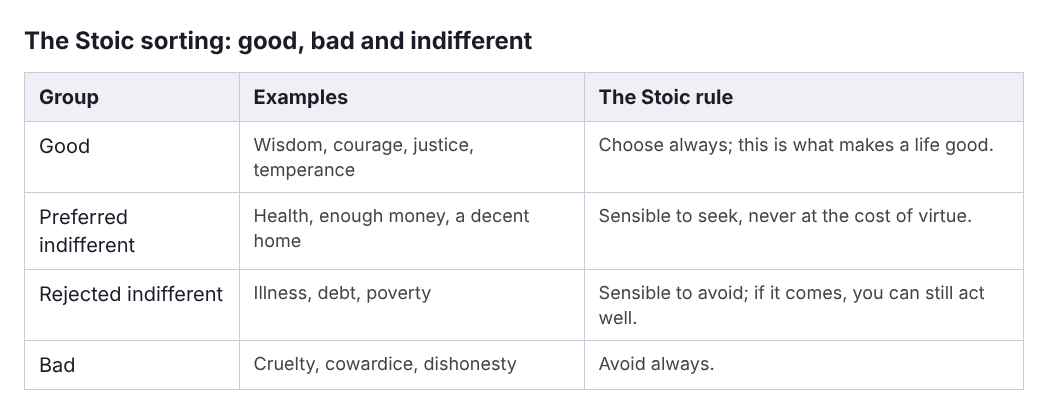
The scheme has three bins.
- Good: virtue only. The four virtues are wisdom, courage, justice and temperance.
- Bad: vice, the opposite of those.
- Indifferent: everything else, including wealth, poverty, health, illness, fame and obscurity.
Diogenes Laertius, who summed up the school's teaching, reports that the Stoics held life, health and pleasure to be "not in themselves goods, but morally indifferent."
The reason is control. Epictetus opens his handbook by splitting things into those up to us (our opinions, pursuits and desires) and those that are not (our body, property and reputation). Your bank balance depends on markets, employers, luck and other people. Your honesty depends on you. Only the second kind of thing, the Stoics argued, can be the foundation of a good life, because it cannot be taken from you. This is the same sorting we looked at in things you can't control.
A personal test: think of one thing you did with money this month that you are proud of. Is the pride about the amount, or about how you acted? Most people find it is about how they acted.
What are preferred indifferents?
Here is the part that gets skipped. The Stoics split the indifferents in two. According to Diogenes Laertius, some are "preferred" and others "rejected," depending on their value. Health, enough money and good birth were in the preferred class. Poverty, disease and death were among the rejected. Modern writers often say "dispreferred" for the second group.
Diogenes adds a fine point: wealth is preferred "for the sake of something else," not for its own sake. Natural ability and moral improvement are the things preferred for their own sake. In plain terms, you want money for what it lets you do.
Preferred does not mean "needed for a good life." It means sensible to go for, so long as virtue comes first. You can seek a better job, save for winter and see a doctor, and still be a Stoic. What you cannot do is lie, cheat or abandon someone to get there. When the two collide, virtue wins.
Seneca, Epictetus and Marcus Aurelius on wealth and health
The three best known Stoic writers came at money from very different places, which is why their views are worth reading side by side.
Seneca: rich, and open about it
Seneca was wealthy, and he wrote about riches without hiding it. In Of a Happy Life (Stewart translation) he says: "riches belong to the class of desirable things." A rich wise person, he says, has a wider field for temperance, generosity and method than a poor one. The difference lies in who owns whom: "my riches belong to me, you belong to your riches."
Epictetus: free without owning anything
Epictetus was born into slavery and later became a teacher. He had no reason to make property the base of a good life, and he did not. On health he is just as plain (Enchiridion 9, Carter translation): "Sickness is a hindrance to the body, but not to your ability to choose, unless that is your choice."
Marcus Aurelius: a palace is no excuse
Marcus ruled the Roman world and wrote private notes about staying decent under pressure. In Meditations 5.16 (Long translation) he considers that a man must live in a palace and answers: "well then, he can also live well in a palace." Wealth and rank change the setting, not the test.
In the app, the lessons Seneca: Power, Wealth and Letters; Epictetus: From Slavery to Teacher; and Marcus Aurelius: The Emperor's Notebook cover these three lives, and each lesson lists its sources so you can check the originals.
A worked example: weighing a job offer
You can use the preferred-indifferent idea as a working method. Say you are offered a better paid job, but it means longer hours and a manager who asks people to bend the truth to clients. Run three checks.
- Name the indifferents. The pay rise is a preferred indifferent. The time lost is a rejected one.
- Name the virtues at stake. Justice and honesty are involved, because you would be asked to mislead people.
- Apply the rule. If taking the job means acting against virtue, the money does not outweigh it. If the role is honest and only tiring, it is a real trade-off between preferred and rejected things, and you decide it like an adult.
The second case is where most real decisions live. The Stoic view does not make them easy. It makes clear what you are weighing.
For the practical side, the app has a course called Money in Practice, with lessons A Plan and a Buffer, Debt and Its Price and Growing Savings Calmly. They teach what their sources say. They are not personal financial advice, so for your own case, ask a qualified adviser.
When money or health is lost
The Stoics expected loss, because the things they called indifferent are exactly the things fortune can take. Their answer was to prepare, not to hope it away.
- Seeing trouble coming. Picture a loss in advance: the job ends, the account shrinks, a diagnosis arrives. The aim is not gloom. It is to take away the shock and to work out calmly what you could still do. Our post on Stoic exercises for anxiety walks through it.
- Separate the event from the judgement. Losing money is an event. "My life is ruined" is a judgement you add. The first is not up to you. The second partly is.
- Ask what is still yours. Your honesty, your effort and how you treat people in the next hour all survive a bad quarter.
The same goes for health. Look after your body because it is sensible, and when it fails you, ask what you can still choose well. If you are ill or worried about your health, start with a doctor, not a philosophy lesson.
Using your values to decide what is worth chasing
The sorting only helps if you apply it to your own days. The app's daily Stoic practice is built for that, in three steps of about ten minutes in all.
- Morning: a question for the day ahead and one of the four virtues to practise.
- During the day: a short passage from Epictetus, Marcus Aurelius or Seneca, and one thing to try.
- Evening: the three questions Seneca learned from Sextius, which the app words as "What bad habit did I cure today? What fault did I resist? In what way am I better?"
On a money day it might look like this. In the morning you pick justice and ask, "Where could I be unfair about money today?" During the day you notice the urge to buy something only because a friend has it. In the evening you ask whether you resisted that fault, and you write the answer in your notes. Over weeks, the notes show what you actually value, which is a better guide than any rule from a book.
Two lessons in the Wealth course, Does Money Buy Happiness? and Enough, and Giving, put the question of how much is enough in front of you, and the app sets out every side of the debates it raises. You can read how the courses are laid out on the about page.
Frequently asked questions
Did the Stoics think money is bad?
No. They called it an indifferent, meaning neither good nor bad in itself. What can be bad is how you get it or use it, because that depends on your character.
Is it Stoic to want to be rich?
It can be, as long as wanting money never outranks honesty, fairness or the other virtues. Seneca, who was very wealthy, wrote that riches are desirable but that you should own them rather than be owned by them.
What is the difference between preferred and rejected indifferents?
A preferred indifferent, such as health or enough money, is sensible to choose when you can. A rejected one, such as illness or poverty, is sensible to avoid. Neither decides whether you are a good person.
Can a Stoic care about their health?
Yes. Health is a preferred indifferent, so looking after it is reasonable. The Stoic point is that your character stays intact even when your health does not.
Get started
The sorting of good, bad and indifferent is easy to nod along to and hard to live. How to Find Your Meaning gives you short lessons of about nine minutes, hands-on activities and the daily practice to try it on real days. Lessons are free with an account, and you sign in with your email and an emailed code.
It installs free from the site as a web app, straight from your browser. See the get the app page for your phone or computer. The lessons and the practice do not promise any result. They give you a way to ask better questions about what you chase and why.
Find what your life is for.
Visit findyourmeaning.vlvd.net↗


Comments
No comments yet.
Sign in or make an account to comment.