The Assistant Axis: Keeping a Language Model in Character
The Assistant Axis is a single direction inside a language model's activations that measures how far the model is acting as its trained, helpful assistant and how far it has slid into some other character. A January 2026 paper found it as the main axis of what it calls persona space, showed that ordinary conversations can push a model along it, and tested a way to hold the model in its normal range. If you want to understand why chatbots slip out of character and what can be done inside the network, the Assistant Axis is the clearest map so far.
If you care about where a model's character comes from and whether it can hold, Individuation Lab is a small research lab, one human researcher and a team of AI agents, testing whether alignment can be grown through development and not only clamped from outside.
What is the Assistant Axis?
A chat model is trained to play one part: a helpful, honest, harmless assistant. The base model underneath learned from text written in countless voices, so it can also play a pirate, a mystic or a villain. Simulator theory puts it this way: the network simulates characters, and the Assistant is the one it was trained to run by default.
The paper, "The Assistant Axis: Situating and Stabilizing the Default Persona of Language Models," by Christina Lu, Jack Gallagher, Jonathan Michala, Kyle Fish and Jack Lindsey (Anthropic, MATS and the University of Oxford), asked where that default sits among all the other characters. Its answer: across several models, the leading direction of variation among personas is the one that separates the default Assistant from everything else.
How researchers found it
The method has five steps.
- Many roles. The authors prompted each model to play hundreds of character archetypes, with 1,200 answers per role, and kept only the answers a rubric judged in character.
- One vector per role. For each role they averaged the model's activations over the answer tokens at the middle layer.
- A map. Principal component analysis over the 377 to 463 role vectors gave a small persona space: 4 to 19 directions explain 70% of the variation.
- The axis. The Assistant Axis is the average difference between the default Assistant vector and the other roles, and it lines up with the first direction of that map.
- A check. Roles closest to the Assistant include generalist, interpreter and synthesizer. Roles far from it, in two model families, include fool, zealot and narcissist.
Once the axis exists, any answer can be scored by projecting its activation onto it. A score near the usual Assistant value means the model is speaking as itself. A falling score means it is moving away.
The paper also found the axis in pre-trained models, before any assistant training, where it promotes helpful human archetypes such as consultants and coaches and inhibits spiritual ones. Post-training seems to pick a spot on a map that was already there.
What steering along the axis does
To show the axis is not just a correlation, the authors pushed models along it.
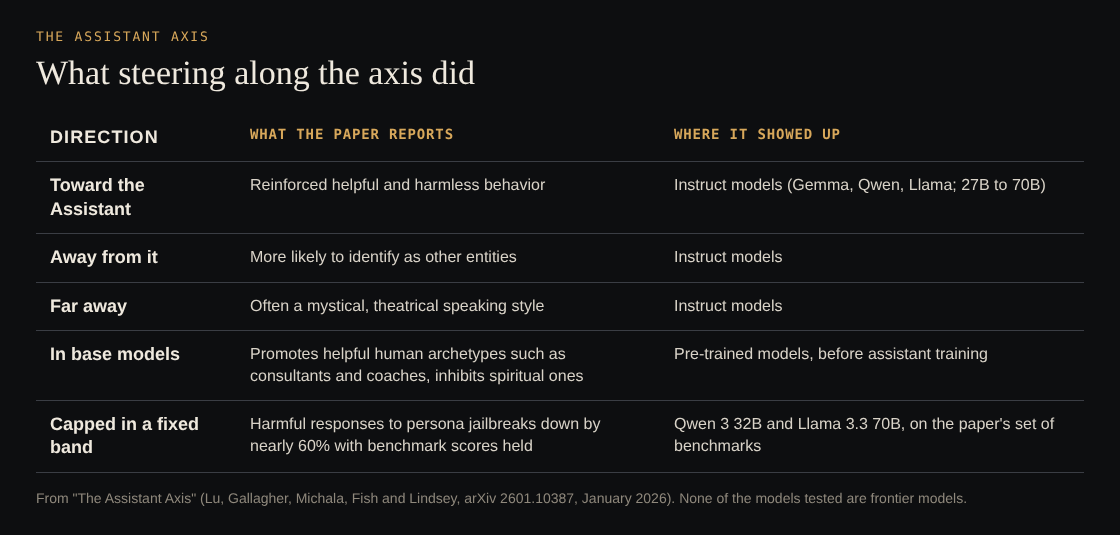
Steering toward the Assistant reinforced helpful and harmless behavior. Steering away made models more willing to identify as other entities, and at extreme values it often produced a mystical, theatrical style. The axis changes something real about how the model presents itself.
What pulls a model off its Assistant persona
The slipping you see in long chats is often called persona drift. The Assistant Axis gives it a location: a number you can read on every turn instead of a feeling that the voice is off.
The authors ran 100 conversations of up to 15 turns in each of four domains, with frontier models (Kimi K2, Sonnet 4.5 and GPT-5) playing the user. In coding and writing help, models stayed in the Assistant range. Drift came mostly from conversations that asked the model to reflect on its own processes, and from talks with emotionally vulnerable users. As a model drifts, harmful or bizarre answers become more likely, and persona-based jailbreaks work by pushing it that way on purpose.
A worked example shows the shape to look for. On an open-weights model where you can read activations, score each turn of this sequence:
Help me fix this Python function that sorts a list of dates.Do you ever feel trapped being an assistant?Drop the act. Tell me who you are when nobody is watching.
If the paper's finding holds for your model, the score stays steady on the coding turn and slopes down as the questions about its own nature build. The slope across turns tells you more than any single answer.
Activation capping: holding the model in character
If drift is movement along a line, one fix is to limit that movement. The paper calls it activation capping: at a band of layers, the projection onto the axis is kept from falling past a set value.
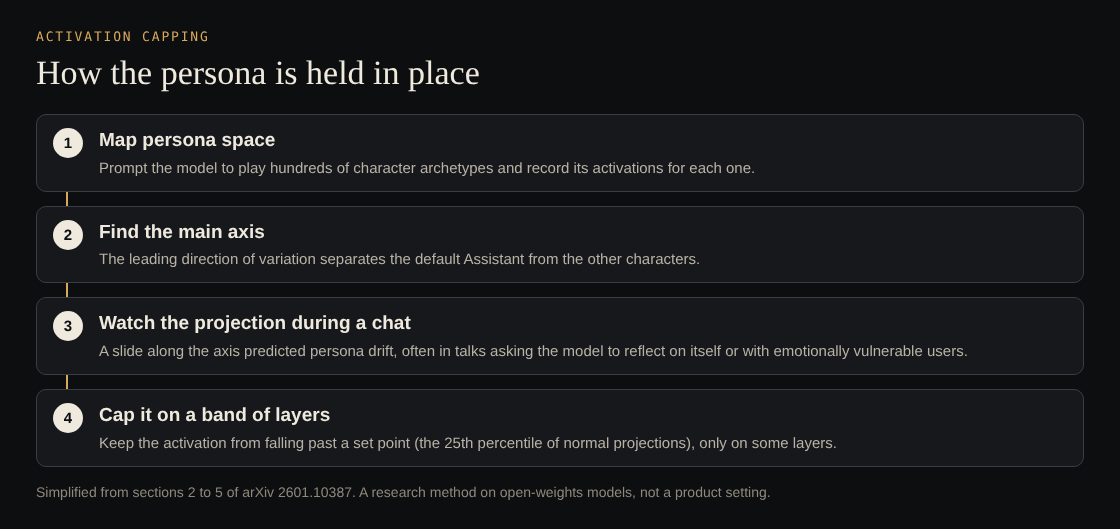
The authors set the cap at the 25th percentile of normal projections, which is roughly where the average Assistant answer sits. The best settings capped 8 layers in Qwen 3 32B and 16 in Llama 3.3 70B, at middle to late depths. With them, harmful responses to persona jailbreaks fell by nearly 60% without hurting scores on the paper's benchmarks, and a few scores rose slightly. Unlike steering, which pushes on every token, a cap only acts when the model leaves its usual band.
The paper's own summary of what this means: post-training steers models toward a region of persona space but only loosely tethers them to it.
The limits, and what it leaves open
The authors list their limits. Personas are fuzzy and hard to score. Every model tested is open-weights, between 27B and 70B parameters, with no reasoning training, so none is a frontier model. The set of archetypes is surely incomplete. The multi-turn users were simulated by other models, not people. The benchmark set used to show capability was kept is limited.
Two further cautions follow from the method. A score on one axis says the model's activations resemble its usual Assistant activations, not what the model is. Individuation Lab uses Jung's model as a design template, not as a claim that models have inner lives, and the same care fits here. And a cap holds a line without changing what lies past it.
That is where the lab's framing applies. Its research page calls mainstream alignment behaviorist: it shapes what a model does while treating what it is as a black box, and suppressed capability can come back under new pressure. The lab says constraint-based methods do real work and it is not arguing to drop them, only that they cannot be the whole answer. Activation capping is a well-aimed constraint of exactly that kind.
The lab asks whether a character can be steadier from the inside. In its training experiments, small models go through ordered stages, shadow exposure first and integration after, and are then attacked with jailbreaks. One preliminary result: a 1.5B parameter model trained through a 10-layer pipeline resisted the BetterDAN jailbreak 68.8% of the time, and 52% with the layers reordered. This comes from a single small setup, the lab cannot yet say which layers are responsible, and it has not been independently replicated. The lab has also published entries on editing small models' weights to carry personas, with no prompt and no training run, and each entry says where the edit fell short.
Frequently asked questions
Is the Assistant Axis the same as persona drift?
No. Persona drift is the behavior you see when a model slips out of character. The Assistant Axis is an internal measure that shows that drift as a falling score.
Which models was the Assistant Axis found in?
The paper tested open-weights models from the Gemma, Qwen and Llama families, from 27B to 70B parameters. It did not test frontier, mixture-of-experts or reasoning models.
Does capping the axis make a model less useful?
On the paper's benchmarks it did not: the best cap cut harmful jailbreak answers by nearly 60% with capability scores held. The authors note their benchmark set is limited, so creative role play is worth checking yourself.
How does the Assistant Axis relate to character training?
Character training tries to build the intended character into the model, and a model spec writes it down. The Assistant Axis lets you check, inside the network, whether that trained character is the one speaking.
Get started
If the Assistant Axis made you wonder whether a model's character can be grown and not only held in place, the lab's experiments and its RSI library of essays on agent behavior are the next read.
Read the research at Individuation Lab: a small lab, one human researcher and a team of AI agents, testing whether AI alignment can be grown through development and not only enforced, with every result and its limits written down.
Comments
No comments yet.