Thornton Abbey gatehouse: a monastery gate that looks like a castle
The Thornton Abbey gatehouse in North Lincolnshire has turrets, battlements, arrowloops and a portcullis, yet it guarded a house of Augustinian canons, not a lord's castle. English Heritage calls it the largest and most impressive surviving monastic gatehouse in Britain. This post explains what it was built to do, what it was not built to do, and what it was used for.
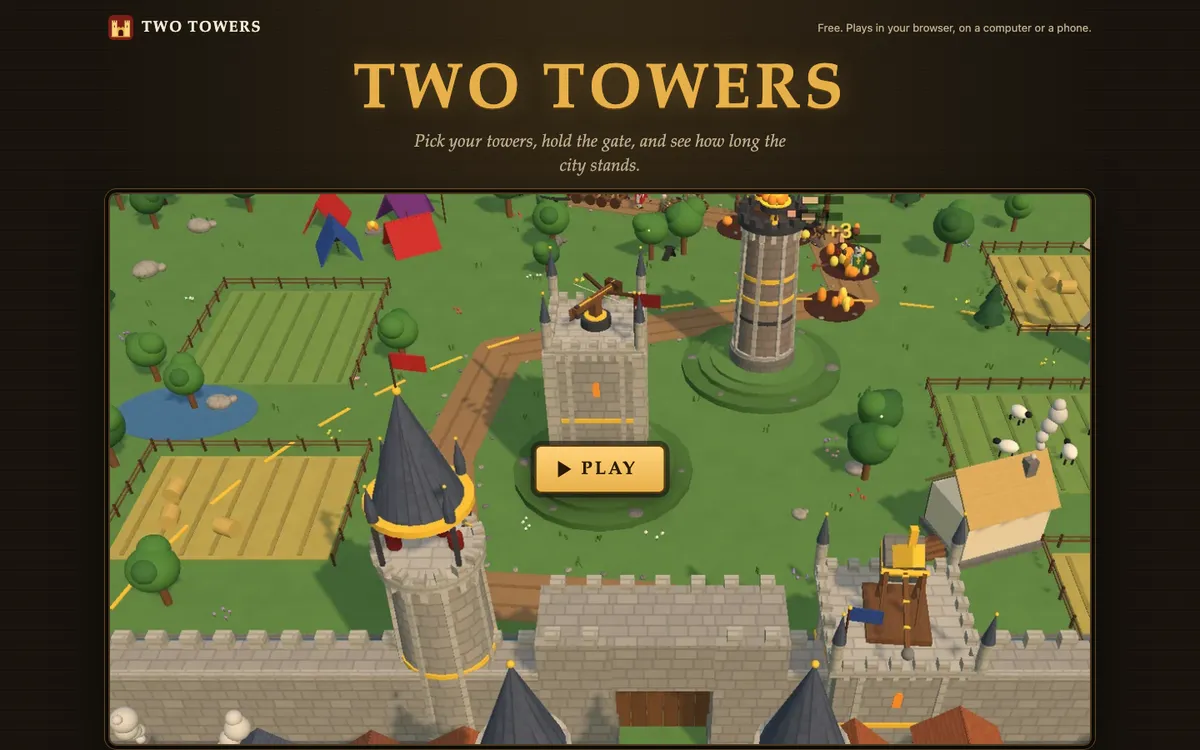
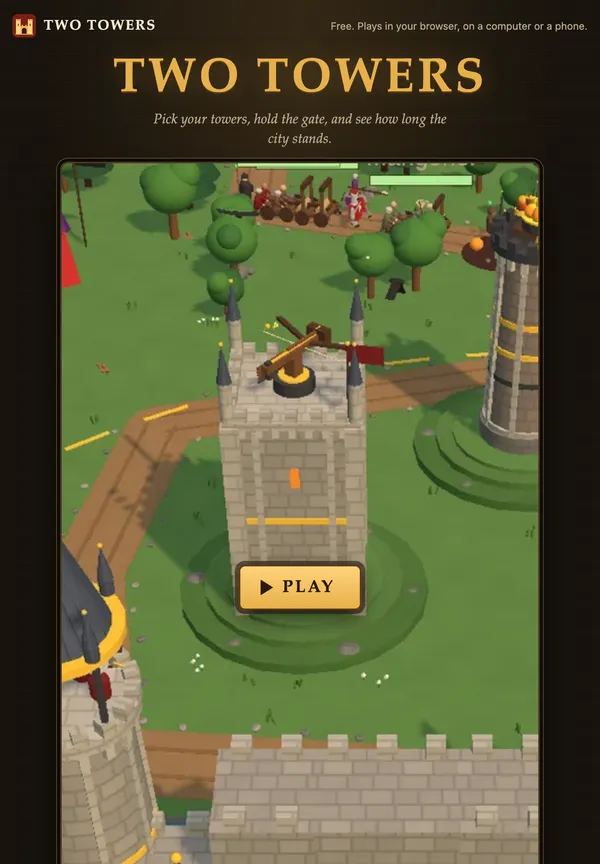
If holding a gate is your kind of puzzle, Two Towers is a free medieval tower defense game that plays in your browser, where you pick two towers to guard a city gate and spend the gold you win to hold it.
Thornton Abbey: a rich house and its front door
William Le Gros pledged on 13 January 1139 to found an Augustinian priory at Thornton, and twelve canons came from Kirkham Priory a year later. Augustinian canons were priests who lived together under a rule but also worked in churches outside the abbey. Thornton became an abbey in 1148.
By the late 13th century it was one of the richest Augustinian abbeys in Britain. In 1313 it kept nearly 8,000 sheep, and wool helped to give it a yearly income of 1,543 pounds, which English Heritage compares to the income of a major nobleman. A house like that had a lot to look after, and building went on almost without a pause for a century. The outer gatehouse came near the end of that run, in 1377 to 1382.
What the Thornton Abbey gatehouse looks like
The gatehouse has three storeys and is largely built of brick, which was first covered with render. English Heritage calls it a rare surviving example of early brick architecture. Its builders added features that were copied from military architecture: turrets, battlements, arrowloops and a portcullis.
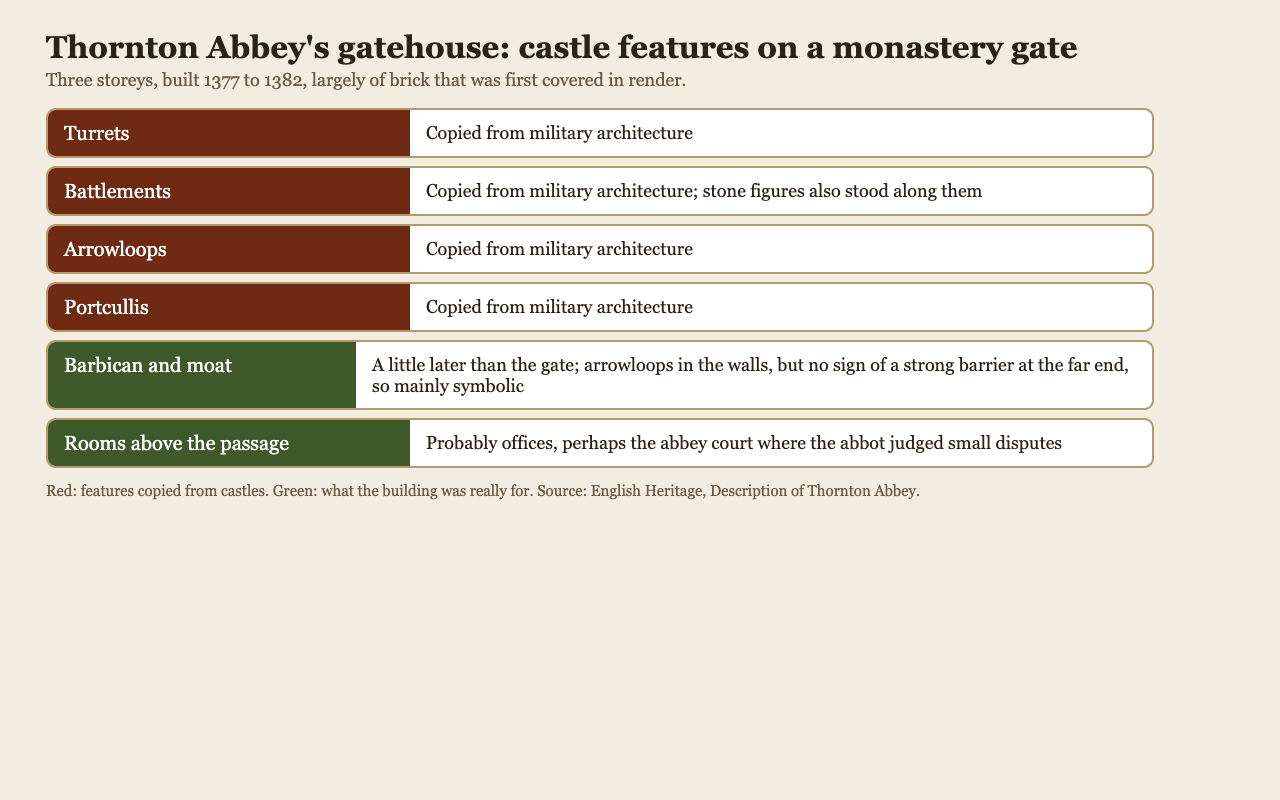
The gatehouse's castle features and its real uses, from English Heritage's description page.
It was also a showpiece. Records from after the Middle Ages show that the gatehouse once carried dozens of religious and allegorical statues, though most are now lost. Some of the carved figures above the doorway are still there. On the stonework at the back, later visitors scratched graffiti, including a sketch of a ship, a sign of how much the nearby Humber estuary mattered.
For the same parts on a real castle, with the reasons for each, read castle gatehouse: why it was a castle's strongest part.
Was the gatehouse built to fight?
English Heritage does not say Thornton's gatehouse was built to stand a siege, and the evidence points the other way. Look at what its sources do and do not say:
- Castle features were copied. The turrets, battlements, arrowloops and portcullis are described as copied from military architecture, which means they borrowed the look of a castle.
- The rooms were offices. The rooms were probably used as offices and perhaps housed the abbey court, where the abbot judged minor disputes and grievances brought by tenants of the abbey lands.
- A window to look out of. A first-floor oriel window, a bay window that juts out, allowed glimpses of the precinct, and masons' marks survive around it.
- A moat and barbican, but no strong barrier. The long barbican has arrowloops in its walls, yet English Heritage says it appears primarily symbolic rather than defensive, because there is no evidence of any significant barrier at its outer end.
So the honest reading is a mix. The gate shows the power of the abbey and controls a single way in, but nothing in these pages says that it was ever tested by an attack. Treat any story of a siege of Thornton's gatehouse with care, because English Heritage's history pages do not tell one.
The barbican and the moat
A long barbican projects from the gatehouse and spans a broad moat, which is usually dry today. Both are a little later than the gatehouse itself. A barbican is an outer work in front of a gate, and the barbican post covers the idea in a castle.
Here the moat is one of several. The circuit of moats surrounded and subdivided the main precinct and the North Bail, probably the site of the abbey's main farm, and together they cover 30.2 hectares. There may have been a drainage ditch around the abbey from as early as the 12th century. That fits a low, wet landscape beside the Humber, where water had to be managed as well as kept out.
After the abbey: the gatehouse that stayed
Thornton Abbey was suppressed on 12 December 1539, yet its buildings were not stripped at once: Henry VIII and Catherine Howard stayed there in early October 1541. Two months later Henry made it a college for training priests for the new Church of England. Edward VI's government closed the college in 1547.
In 1602 Vincent Skinner bought the site. English Heritage says he apparently demolished most of the abbey buildings and left the gatehouse as a foil to the new house he began about 1607. That house was lost within five years, though recent theories disagree on whether it fell, was taken down to pay debts, or was never finished.
The gatehouse survived all of this. By 1797 a watercolour shows it with no roof, windows or floors. In 1816 Lord Yarborough bought the site to stop quarrying for roadstone, and his son, the 1st Earl, put back the roof, floors and windows, which saved it from ruin. The family placed the site in state guardianship in 1938.
A worked example: Thornton's gate and a gate you must hold
Compare it with Two Towers, where the gate is the only thing that matters and every stage is harder than the last. The game's own tips read like a note on gates in general. For rams the tip is: "Rams hit the gate hardest: Reinforce the gate, and use Ballista bolts that ignore armor." Between attacks you can repair the gate or reinforce it with gold for more strength.
- Pick two towers from the four kinds, Archer Tower, Trebuchet, Ballista and Fire Tower, and buy two more for the hills as gold comes in.
- Look at the next attacker before you spend. If rams are coming, put the gold into the gate and a Ballista.
- Repair or reinforce between stages, so the gate is whole when the next stage arrives.
- Keep going. There is no final stage, so the aim is to hold the line for as long as you can.
The lesson from Thornton is the opposite one. An abbey could spend its money on a gate that impressed, and that was safe because nobody was likely to attack it. In the game the gate has to do the work, so your gold goes where the attackers hit.
Frequently asked questions
Where is the Thornton Abbey gatehouse?
Thornton Abbey is in North Lincolnshire, near the Humber estuary, and English Heritage looks after the site. The gatehouse is the best-preserved part of the abbey.
When was the Thornton Abbey gatehouse built?
The outer gatehouse was built in 1377 to 1382. The barbican and moat in front of it are slightly later.
Is the Thornton Abbey gatehouse a castle?
No, it is the gate of an abbey. It has turrets, battlements, arrowloops and a portcullis copied from military architecture, but its rooms were probably offices and the abbey court.
Was Thornton Abbey's barbican built for defence?
English Heritage says it appears primarily symbolic rather than defensive. Its walls have arrowloops, but there is no evidence of any significant barrier at the outer end.
Get started
If the gatehouse made you want to hold a gate of your own, try it. Pick two towers, spend your gold on upgrades and see how many stages you can hold.
Play Two Towers: it is free and plays in your browser on a computer or a phone. For how the real thing worked, see English Heritage's description of Thornton Abbey.
Comments
No comments yet.
Sign in or make an account to comment.