True Cost of Hiring an Employee: The Startup Founder's Math
The true cost of hiring an employee is the salary plus everything that comes with it: employer payroll taxes, benefits, equipment, software, recruiting, the months before the person is fully up to speed, and the hours you spend managing them. For a first hire at a small company, that usually adds a meaningful share on top of the offer letter. Most of it lands in the first few months, while your runway is still short.
Before you work out the cost, it helps to ask whether you should hire at all. The post When should a startup make its first hire? Four checks covers that. One thing worth taking from it: the answer is usually later than founders expect. This post covers the next question, which is what the hire will cost you once you decide.
Age of AI Entrepreneur helps you get the money side right before you sign an offer: its short Business Basics for Builders lessons cover revenue, costs and unit economics, with their sources, after you sign in with your email and an emailed code.
Why salary is only part of the true cost of hiring an employee
A salary is the number you negotiate. It is not the number that leaves your bank account. You pay taxes on top of it, you buy the tools the person needs, and you lose output while they learn the job. How big the gap is depends on what you offer and where you hire, so list every line yourself.
The line items founders forget: payroll taxes, benefits, equipment and software
Here is what to add to the salary. The figures below use US rules. If you hire elsewhere, check your own country's rules.
- Employer payroll taxes. The IRS sets the employer share at 6.2 percent for Social Security and 1.45 percent for Medicare. That comes to 7.65 percent on most salaries. Federal unemployment tax is 6.0 percent of the first $7,000 of wages, or 0.6 percent after the full state credit, which is $42 a year per employee. State unemployment tax varies by state and by your history as an employer.
- Workers' compensation insurance. Depending on your state, you may need it. Ask for a quote before you hire.
- Benefits. Health insurance is the big one if you offer it. Retirement matching and paid leave come next.
- Equipment. A laptop, a monitor, maybe a phone.
- Software seats. Every per-user tool you pay for gets one seat more expensive: email, chat, design tools, your code host, any AI subscriptions.
- Payroll and HR tools. Once you have an employee, you need payroll software or a provider to run it.
- Recruiting. Job board posts, a recruiter's fee if you use one, and your own hours spent reading applications and running interviews.
Ramp time and your own hours spent managing: the hidden cost
Two costs never appear on an invoice, and both are large at a small company.
The first is ramp time. A new person does not produce full output on day one. They need to learn your product, your customers and the shortcuts that live only in your head. For the first few months you pay a full salary for partial output.
The second is your time. Onboarding, answering questions, reviewing work and writing down how things are done all take hours away from selling and building. If you are the only person who can close a deal or ship a fix, those hours have a price. Write down how many hours a week you expect to spend.
A worked example: what one $80k hire does to your runway
Say you have $160,000 in the bank and spend $5,000 a month. That gives you 32 months of runway. You want to hire one person at an $80,000 salary. The tax lines below follow US federal rules. The other figures are assumptions, so swap in your own.
- Salary: $80,000
- Employer Social Security and Medicare (7.65 percent): $6,120
- Federal unemployment tax: $42
- State unemployment tax (assumed): $300
- Health insurance (assumed): $9,000
- Laptop and monitor (one-off, assumed): $1,800
- Software seats ($100 a month, assumed): $1,200
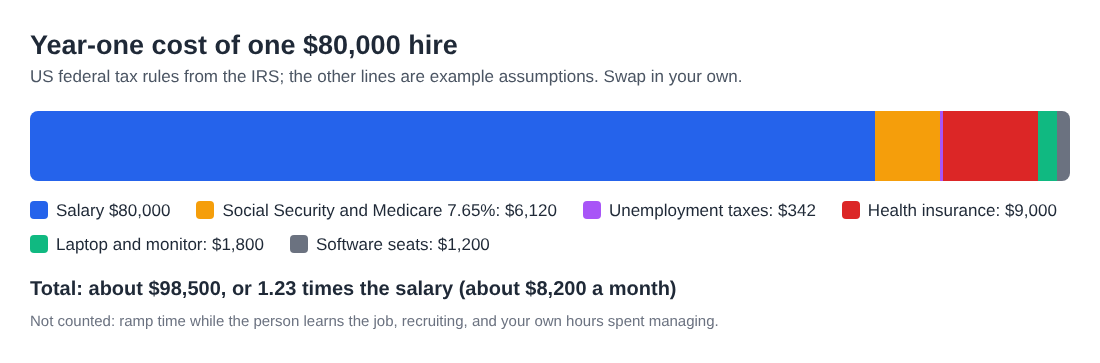
Total for year one: about $98,500. That is roughly 1.23 times the salary, or about $8,200 a month.
Your monthly spend goes from $5,000 to about $13,200. Divide $160,000 by $13,200 and your runway drops from 32 months to about 12. One hire took away almost two-thirds of your remaining time.
Now add ramp time. Suppose the person works at about half speed for the first three months. You spend roughly $24,600 in that quarter and get about $12,300 worth of work. Add five hours a week of your own time for onboarding, about 60 hours over the quarter. Those are 60 hours you are not spending on customers.
None of this means you should not hire. It means you should know what you are trading before you sign the offer.
Contractor, part-time or AI tools: what each option really costs
Contractor
You pay a higher hourly rate, but you skip employer payroll taxes, benefits and equipment, and you can stop when the work stops. The catch is control. In the US, the IRS looks at whether you control what the worker does and how they do it, not only at what the contract says, so a "contractor" you direct like staff may count as an employee. Contractors also tend to ramp once per project, not once per company, so you may pay for onboarding more than once.
Part-time employee
Payroll taxes scale with the wage, so a part-time salary costs less. A laptop, a software seat and your management time do not shrink with it.
AI tools
For narrow, repeatable work, a model subscription or an automated workflow can cost far less than a person. Think drafting replies, sorting leads or summarizing calls. The real cost is setup and checking. Someone has to write clear instructions, which is the skill covered in how to write a system prompt for your first AI tool. Someone also has to catch the mistakes. Tools do not take ownership of an outcome or make judgment calls with customers the way an employee can.
A simple test before you post a job: write the role as a list of weekly tasks. Next to each task, mark whether a contractor, a part-time person, a tool or only a full-time employee could do it. If most of the marks are not "full-time," you may not need a full-time hire yet.
How to tell if the hire pays for itself, and when it is still too early
A hire pays for itself when it does one of two things. It brings in more gross profit than it costs, or it frees your time for work worth more than its cost. Using the example above, the hire needs to produce or protect about $8,200 a month in value once fully ramped. Count gross profit here, not revenue.
Ask yourself three questions:
- Can I name the specific work this person will take off my plate, and what I will do with those hours?
- If the hire brings in revenue, how much gross profit does each new customer add, and how many customers does the hire need to cover their own cost?
- Can my runway survive the ramp period if the hire takes longer than planned to pay off?
If you cannot answer the first question in one sentence, it is probably too early. If the third answer is "barely", it is too early too, and the check in default alive or default dead is worth running first. Some founders find the answer is no hire at all for now, as in scaling a startup without hiring.
Frequently asked questions
How much does an employee cost on top of salary?
In the US, employer Social Security and Medicare taxes alone are 7.65 percent of most salaries, before unemployment tax, benefits, equipment and software. In the worked example above the total came to about 1.23 times the salary; yours depends on what you offer.
Is a contractor cheaper than a full-time employee?
Often yes for short or part-time work, because you skip payroll taxes, benefits and equipment. For steady, full-time work that you direct closely, the higher hourly rate and the risk of misclassification can close that gap.
How many months of runway should a startup have before its first hire?
There is no single rule. Work out your runway after adding the full monthly cost of the hire, not just the salary. Then make sure it still covers the ramp period and the time you need to reach your next milestone.
Can AI tools replace a startup's first hire?
For narrow, repeatable tasks they can take on a lot of the work at a lower cost. You still need someone to set them up, check their output and handle anything that needs judgment.
Get started
Before you run the numbers above, read the four checks for a first hire to see whether the timing is right. Then build your cost sheet using the line items in this post.
To go deeper on the money side, sign in to open Business Basics for Builders. Its lesson Revenue, Costs and Unit Economics fits this decision well. Scaling an AI Company includes a lesson called Tiny Teams, Huge Leverage. You sign in with your email and an emailed code.
Start Age of AI Entrepreneur: short hands-on lessons on how to build a business in the age of AI, each with the sources to read next.
Building a business in the age of AI, from a first project to a company.
Visit aientrepreneur.vlvd.net↗
Comments
No comments yet.