Two Equal Moves in 2048: Which Way to Slide When Both Look Good
When you face two equal moves in 2048 and both look good, slide the way that keeps your biggest tile in its corner, leaves the most empty squares after the new tile lands, keeps your rows in order, and saves a merge for next turn. Run those four checks in that order. Most ties break on the first or second one, and you rarely need all four.
If you want a board where these choices matter even more, Evolved 2048 puts the 2048 puzzle on a cube you turn like a Rubik's cube. You slide tiles on a front face of nine squares and twist rows to bring tiles in from the other five faces. With so little room, one wrong tiebreak shows up fast.
Why two equal moves in 2048 are rarely truly equal
Two slides can make the same merge and add the same points. In Evolved 2048 a slide adds the value of every tile its merges make, so merging two 4s scores 8 whichever way you push. The score is the same. The board you are left with is not.
Three things differ between two "equal" moves:
- Which pair merges. When a row holds three equal tiles, the pair nearest the wall you slide towards merges first. In a test on the game's front face, a row of
2 2 2slid left became4 2. Slid right, it became_ 2 4. Same score, different row. - Where the leftover tiles sit. The tiles that did not merge end up against one wall or the other.
- Where the new tile can land. Every slide adds a 2 or a 4 on a randomly picked empty square of the front face. Your move decides which squares are empty.
There is also no undo. Once you slide, the board is final, so a short pause is worth it. In Evolved 2048 you can twist a layer back with Shift and its key, but that counts as a second move and adds a second new tile.
Tiebreaker 1: Protect your corner and anchor row
Pick one corner for your biggest tile and keep it there. The row along that corner's edge is your anchor row. On a three by three face, the anchor row is only three squares, so a single new 2 landing in it can block your big tile for several turns.
The test: if one of your two moves would pull the big tile out of its corner, or open an empty square in the anchor row, pick the other move.
How much does the corner choice matter? In one set of test games on Evolved 2048, played with slides only from the same start and a fixed seed, the bottom left corner reached a score of 432 with a 64 tile in 55 moves. The top right corner, from the same start, stopped at 136 with a 16 tile. On a second seed, the top left did best at 600. These were single games, not averages, so they do not prove one corner wins. They do show how far apart two plans can end from the same start. Choose a corner and stay loyal to it.
Tiebreaker 2: Keep the most empty squares after the spawn
If both moves protect your corner, count empty squares. Do it after the new tile, not before. Each slide adds one tile, so the number that matters is the empty count after the merge, minus one.
A move that makes two merges beats a move that makes one, even if the single merge is bigger. On a face of nine squares, one extra empty square is more than a tenth of your room.
Then look at where those empty squares are. The new tile is a 2 when the game's random number is under 0.9, otherwise a 4, so expect a 2 about nine times in ten. It lands on any empty square of the front. If one move leaves its gaps far from your corner and the other leaves a gap in your anchor row, choose the first. A stray 2 is harmless at the far side and a nuisance next to your big tile.
In Evolved 2048, room matters for another reason. A twist needs one empty square for its new tile. When the cube is full, the game says: "The cube is full. Merge two tiles on a face to make room before you twist." Its own advice when you run out of moves is to "keep room on one face so a twist can still bring tiles round to their match."
You can also look before you choose. Turning the whole cube with Shift and an arrow key is free: it adds no points, counts no move and adds no tile. Turn to check what sits on the next face, then turn back with Shift and the opposite arrow. If you are unsure which face is which, this guide to the cube's faces and twists sorts it out.
Tiebreaker 3: Preserve monotonic rows and columns
A monotonic row runs in order: biggest at the corner, then smaller and smaller along the row. When rows stay in order, merges chain into each other instead of getting stuck behind a small tile.
Here is a chain from a test board in Evolved 2048. The front face's top row read 64 32 16 and the middle row read 4 8 16.
- Up merged the two 16s into a 32 at the top right. Score 32.
- Left merged 32 and 32 into a 64, next to the other 64. Score 96.
- Left again merged 64 and 64 into a 128 in the top left corner, and two new 2s on the bottom row merged into a 4. Score 228.
Three slides, one 128. That only worked because the top row was in order. If your two candidate moves differ in this way, pick the one that keeps the order. Avoid any move that drops a small tile between two big ones.
Tiebreaker 4: Leave the next merge ready, not used up
A tile made in a merge does not merge again in the same slide. The original 2048 code, in its game_manager.js file, follows the same rule. That rule lets you set up your next turn on purpose.
Take a row of 2 2 4. Slide left and it becomes 4 4. You scored 4, and you now have two 4s side by side, ready to merge next slide. Slide right and it becomes _ 4 4. Also ready, but now the pair sits on the right. Ask which side your corner is on, and slide that way.
Edge mode in Evolved 2048 shows the same idea across a face edge. In a test, the front's top row held a 16 on the left and an 8 on the right, with another 8 just over the edge on the right face. One slide right merged the 8s into a 16, and the first 16 slid next to it. The row read _ 16 16. The two 16s did not merge in that slide, so the next one could.
When both moves score the same now, choose the one that leaves a pair waiting. A move that uses up every pair leaves you with nothing to do next turn except hope. For when it pays to hold small merges back, see should you merge small tiles first in 2048.
A checklist for two equal moves in 2048
Run these in order and stop at the first one that separates your two moves.
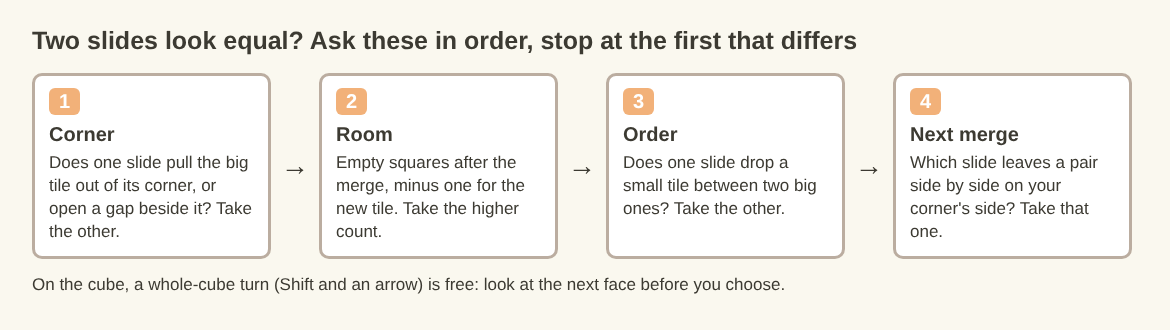
Check each question in turn; most ties break at the first or second.
- Corner. Does either move pull your biggest tile out of its corner? Reject it.
- Anchor row. Does either move open a gap next to your big tile? Reject it.
- Room. Count empty squares after the new tile. Take the higher count.
- Order. Does either move break the order of your anchor row? Take the other.
- Next merge. Which move leaves a pair ready, on your corner's side? Take that one.
In Evolved 2048, add one step before you commit: turn the cube to check the next face, since turning is free. Then turn back and slide.
Frequently asked questions
Should I always pick the move that merges the biggest tile?
No. A big merge that pulls your top tile out of its corner or fills your anchor row costs more than it scores. Check the corner and the empty squares first, then compare merges.
Is it better to slide toward my corner or along my anchor row?
Slide toward your corner when you can, since that keeps the big tile pinned. Slide along the anchor row when it keeps the row full and in order. Avoid the direction that pulls the big tile away from the corner.
What if both moves risk a bad tile spawn?
Pick the move whose empty squares sit farthest from your corner, so a new tile lands where it does the least harm. The new tile is a 2 about nine times in ten, so plan for a 2.
Does merging small tiles first change which way I should slide?
It can. If merging small tiles now fills your far side with fresh tiles and leaves no pair for next turn, waiting may be better. Use tiebreaker 4 to decide.
Get started: practice tiebreak decisions in Evolved 2048
Open the game, pick a mode, and follow the three first-game tips. Then practise the checklist on every slide where two moves look the same. On a front face of nine squares, you will see the difference within a few moves. The Edge mode adds merges across face edges if you want one more thing to weigh.
Play Evolved 2048: it is free and plays in your browser on a computer or a phone.
The 2048 puzzle on a Rubik's cube, and past 2048.
Visit evolved2048.vlvd.net↗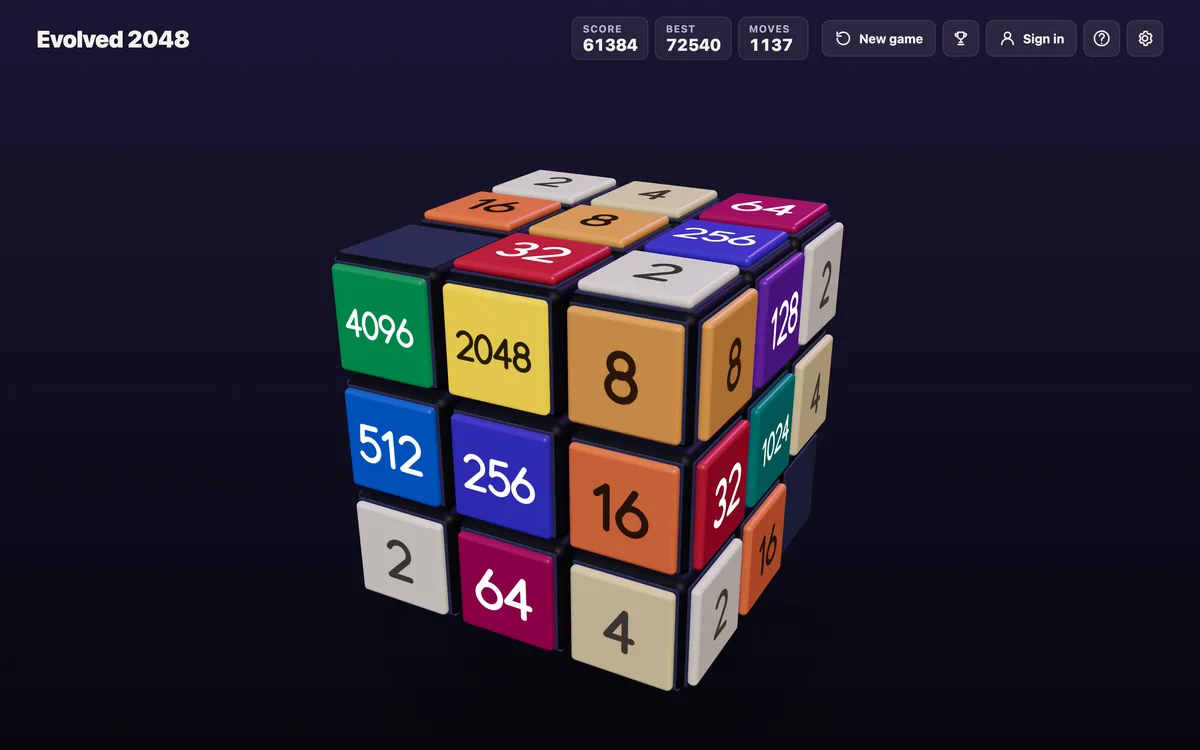
Comments
No comments yet.