Should You Merge Small Tiles First in 2048? When to Wait
Should you merge small tiles first in 2048, or wait? Most advice skips the second half. The short answer: merge small tiles early when they block squares you need, and wait when holding off for one swipe lets a whole chain fall into your corner. This post shows how to tell the two apart, one swipe at a time.
Should you merge small tiles first in 2048? The short answer
Yes, most of the time. Small tiles take up squares, and empty squares are what keep a game alive. But a merge is not urgent just because it is there. Say two 2s will still sit side by side after your next swipe, and that swipe builds something bigger. Then you can wait.
Here is the rule of thumb. Merge small tiles when the board is tight. Wait when the board is open and a chain is one move away.
To practise this on a small board, try Evolved 2048. It puts the 2048 puzzle on a cube you turn like a Rubik's cube, with nine squares on the face you slide, so every wasted square shows up fast.
Why small tiles clog the board when you ignore them
Every slide adds a new tile. In Evolved 2048 that tile lands on a random empty square of the front face. It is a 2 about nine times in ten and a 4 the rest of the time. So small tiles arrive at a steady rate, whatever you do. If you do not pair them off, they scatter.
On a 3 by 3 face this happens quickly. In one test, a script played slides only and never touched the rest of the cube. The front face was full and stuck at move 46, with a score of 332, while the other five faces sat empty. In a few more slides-only games, the front got stuck between move 28 and move 42, and the best tile was a 32 each time. Four stray 2s is nearly half a face.
The fix is not to merge everything on sight. Keep small tiles near each other, on the side away from your big tiles, so new ones pair off as they arrive.
When merging small tiles first is the right move
Merge the small pair now in these cases:
- You have one or two empty squares left. Room matters more than shape at that point. Take the merge that frees a square.
- A small tile sits in your big tile's row. A 2 wedged between a 32 and a 16 breaks the chain. Clear it before it gets a neighbour.
- The merge makes a tile that matches its neighbour. Two 4s that become an 8 next to an 8 set up your next merge.
- You need room for a twist. In Evolved 2048 a twist adds a new tile and needs one empty square for it. If there is none, the game tells you: "The cube is full. Merge two tiles on a face to make room before you twist."
When to wait: holding a merge for a bigger chain
Two merge rules decide when waiting pays. First, a tile made in a merge does not merge again in the same slide. Second, the pair nearest the wall you slide towards merges first.
Here is what that looks like in one row:
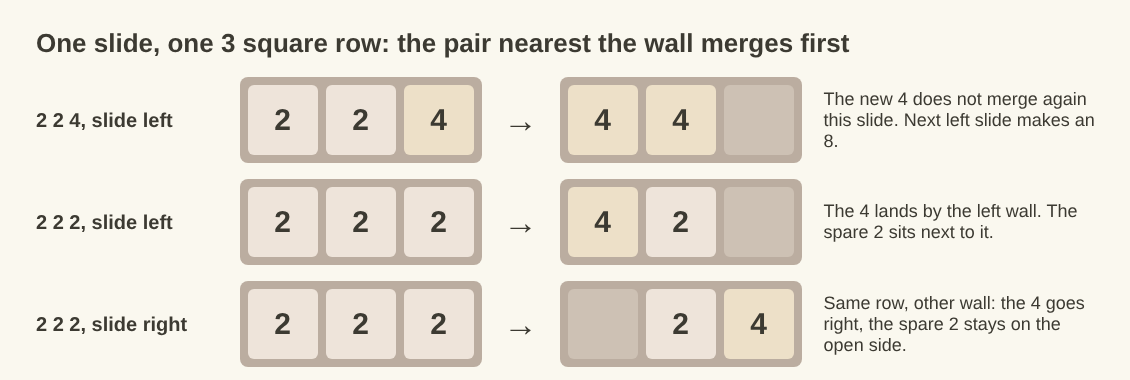
Which pair merges first in a 3 square row, and where the leftover tile ends up.
2 2 4slid left becomes4 4, not8. The new 4 cannot merge again on that swipe. Your next left swipe makes the 8.2 2 2slid left becomes4 2. Slid right, it becomes_ 2 4.
So the direction you pick decides where the leftover 2 ends up. If your corner is on the right, slide right. The 4 lands by the wall and the stray 2 sits on the open side, where the next new tile can find it.
Now a worked chain from a set-up board in Evolved 2048. The front face's top row read 64 32 16, the middle row 4 8 16, and the bottom row was empty.
- Up merged the two 16s into a 32 at the top right. Score 32.
- Left merged 32 and 32 into a 64, next to the 64. Score 96.
- Left again merged 64 and 64 into a 128 in the top left corner. On the same swipe, two 2s on the bottom row merged into a 4. Score 228.
Look at step 3. The small 2s merged as a side effect of a big move. No swipe was spent on them. That is what waiting is for. Let small merges ride along with moves you were going to make anyway.
Keep your corner and big tile safe while you choose
Pick one corner for your biggest tile and keep it there. In a corner test, a script started the same board with a fixed seed and played slides only, once per corner. With one seed, the bottom left corner reached a score of 432 and a 64 tile, while the top right stopped at 136 with a 16. With another seed, the top left did best at 600. These were single games, not averages. Still, they show the corner you play towards changes how far one start can go.
Use two directions most of the time and a third when you must. Merge small tiles with the swipes that keep the big tile in place.
Evolved 2048 gives you two more tools here. A turn of the whole cube (Shift and an arrow key, or a drag in the space around the cube) is free. It adds no tile and counts no move, so you can look at the other faces before you commit. A twist carries a row or column to the next face. In one test, Shift and 1 twisted the top row left and brought a 16 from the right face onto the front's top left square, just above another 16. One slide up then made a 32. A twist counts as a move and adds a new tile, so use it when it lands a match.
There is no undo. In testing, Control and Z, Backspace and other keys changed nothing. Twisting back with Shift and the same key works, but it counts as a second move and adds a second tile. Decide before you swipe.
A quick decision checklist for every swipe
Run through this before each move. There is no undo, so the pause is worth it. Where the big tile should sit is covered in where to keep your biggest tile on a cube.
- Count the empty squares. Two or fewer means merge for room.
- Ask whether this swipe moves your big tile out of its corner. If it does, look for another swipe.
- Find any merge next to your big tile's row. Do that one first.
- Check which wall each small pair merges towards. Pick the direction that leaves the stray tile on the open side.
- If a small pair will still be there after one more swipe, and that swipe builds the chain, wait.
- Stuck on the front? In Evolved 2048, turn the cube to look around for free, then twist a row that brings a tile next to its match.
If you keep making swipes that go nowhere, count them for a game. Once you see the wasted swipes, you stop making them. Why free squares matter more than one high tile is in 2048 empty squares.
Common mistakes with small tile merges (and what to do when the board fills up)
- Chasing every 2 and 2 in all four directions. You pull your big tile out of its corner to save one square.
- Merging towards the middle. The new tile ends up where it blocks both rows and columns.
- Waiting with one square left. The next new tile takes it, and your planned chain never happens.
- Forgetting a twist needs room. Keep one square open on the front so you can still bring tiles round.
When the front face fills up in Evolved 2048, the game is not over yet. In Evolved mode it ends only when all 54 squares are full and no face has two equal tiles side by side. In one test game that used slides and twists, all 54 squares were full at move 165, with a score of 1160 after 39 twists. The front had no slide left, but other faces still had equal pairs, so the game went on. Turn to the face with a pair and merge there. Our guide to what "the cube is full" means and what to merge covers this in more detail.
The test games above were played signed out by a script, one game each, so treat the numbers as examples, not averages. For more on how one slide can and cannot chain merges, see can one slide merge twice.
Frequently asked questions
Is it better to merge 2s and 4s right away?
Merge them right away when you are short of room or when they block your big tile's row. When the board is open and the pair will still be there after your next swipe, you can wait and let them merge along with a bigger move.
Does waiting to merge raise your score in 2048?
No. A slide adds the value of every tile its merges make, so your score follows what you build, not when you build it. In one Evolved 2048 test, the tiles on the board added up to 152 if each was built from 2s, one new tile had been a 4, and the score was 148. Waiting earns you room, and room lets you build more.
Should you merge toward the corner or the center?
Merge towards your corner. The pair nearest the wall you slide towards merges first, so the new tile lands by the wall and the leftover tile sits on the open side.
What if no merge keeps my corner tile in place?
Pick the swipe that moves the big tile least, and slide it back on the next move if you can. In Evolved 2048 you can first turn the cube for free to check the other faces, or twist a row to bring a matching tile onto the front.
Get started: practice merge timing in Evolved 2048
Pick Evolved mode, where slides work on the front face as in 2048. Slide with the arrow keys or W A S D, twist with 1 to 6, and turn the cube with Shift and an arrow key. Try the checklist for one game. Count how often you wait and how often you merge for room, then see where your next game gets stuck.
Play Evolved 2048: it is free and plays in your browser on a computer or a phone.
The 2048 puzzle on a Rubik's cube, and past 2048.
Visit evolved2048.vlvd.net↗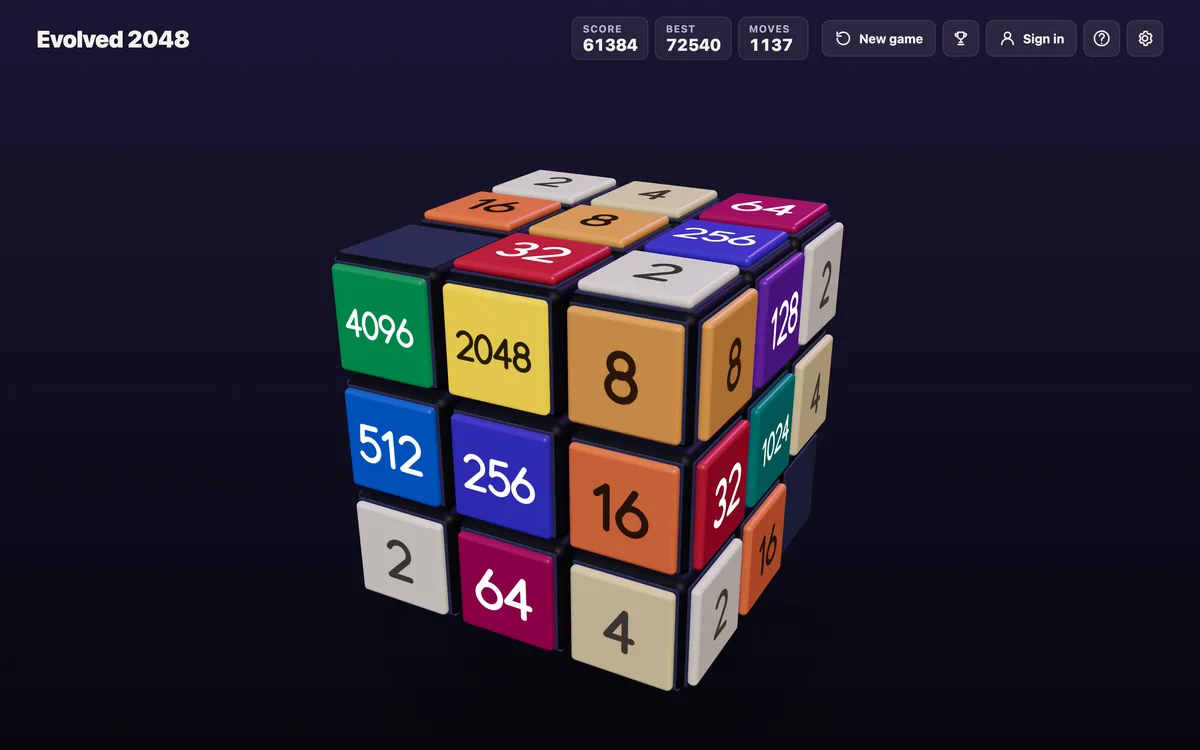
Comments
No comments yet.