Value Stream Map for a Daily Routine at Home
A value stream map for a daily routine at home is a simple diagram of every step between a start point and an end point, with the time each step takes and the time you spend waiting between steps. You draw it once, see where the minutes go, and change the steps that waste them. You need a pen and paper, or a note on your phone, and about 15 minutes.
If you want somewhere to keep the map and the fixes, Problem Graph is a journal that draws itself: you write a problem in one line, attach the solutions you try, and mark each one as worked, partly, or failed.
What a value stream map for a daily routine at home is
The idea comes from lean work, where a team maps how a thing moves from start to finish. The Lean Enterprise Institute says value stream mapping typically begins with a current state map, then a future state map, and that it is most commonly used in lean manufacturing but can be used in any industry. At home, the "thing" is you moving through a routine. Morning getting ready, the evening dinner and dishes cycle, the Sunday laundry loop, the school run.
A map has three parts:
- Steps. Each action in order, such as "shower" or "pack bag".
- Process time. How long you spend actually doing the step.
- Wait time. How long you stand around between or inside steps: for the kettle, for the hot water, for a family member to leave the bathroom.
Add the two together and you get the lead time, the full span from start to end. The gap between lead time and process time is where the easy gains are.
Why use lean mapping on your home routine
Most routines feel fine until you are late. Then you blame the alarm, the traffic, or yourself. A map moves the blame to the steps. You stop asking "why am I so slow" and start asking "why does step four wait nine minutes".
It also gives you something to measure. A fix like "get up earlier" is vague. A fix like "put the keys in one bowl so the search step goes from six minutes to zero" is a change you can check next week.
The same habit works for shared spaces. If a problem affects more than one person, one list beats scattered complaints, which is the point of keeping one list for the office. A household is a small office.
Pick one routine and define its start and end
Do not map "my day". Pick one routine and fix two edges.
- Start trigger. The event that begins it. For example, "alarm rings".
- End state. The moment it counts as done. For example, "door closed behind me with keys and bag".
Be strict about the edges. If the end is vague, the map keeps growing. Choose a routine that annoys you at least a few times a week, because that is where you will notice a change.
Map each step with time, wait, and effort
Run the routine once and write down what really happens, not what should happen. Use a phone timer or just note the clock at each step. For each step record:
- The step name, in two or three words.
- Process time in minutes.
- Wait or search time in minutes.
- Effort, as low, medium, or high. This is how much it drains you, not how long it takes.
Effort matters because a two minute step you dread can cost more than a ten minute step you enjoy. Mark it honestly.
Do the measuring on an ordinary day. A perfect day hides the waste you are looking for.
Find waste: waiting, rework, and extra motion
Go through your steps and tag each wasted minute with one of three labels.
Waiting
Time where nothing is happening and you are not moving forward. Snoozing, waiting for water to heat, waiting for a bathroom to free up.
Rework
Doing something twice because it was not right the first time. Going back for the charger. Rewashing a cup. Re-ironing a shirt that got crushed in the bag.
Extra motion
Walking, searching, or reaching that adds no value. Hunting for keys, crossing the flat three times for things that could sit in one place.
Some of this is not really waste. A shower is a shower. Keep the steps you want, and go after the minutes around them. If you are tracking a problem you have tried to fix before, write down what you tried. A log of what you tried at home stops you repeating the same failed fix.
Example: a morning routine value stream map
Here is a worked example with made up numbers, so you can see the shape. These are not real results from anyone.
Start: alarm rings. End: door closed with keys and bag.
- Get up: 1 minute doing, 9 minutes waiting (snooze). Effort: high.
- Shower: 8 minutes doing, 3 minutes waiting for hot water. Effort: low.
- Dress: 5 minutes doing, 4 minutes searching for a clean shirt. Effort: medium.
- Breakfast: 10 minutes doing, 5 minutes waiting for the kettle and toast. Effort: low.
- Pack bag and leave: 3 minutes doing, 6 minutes searching for keys and going back for the charger. Effort: medium.
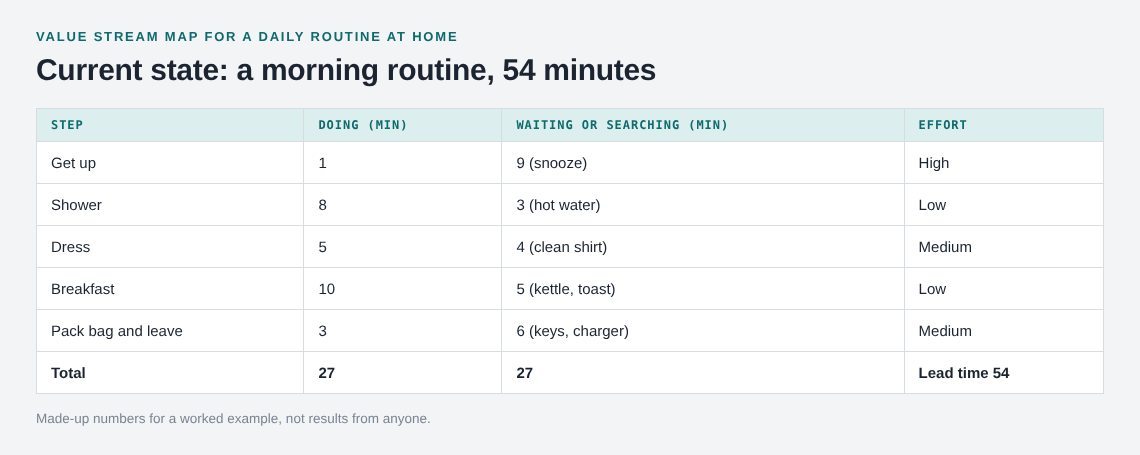
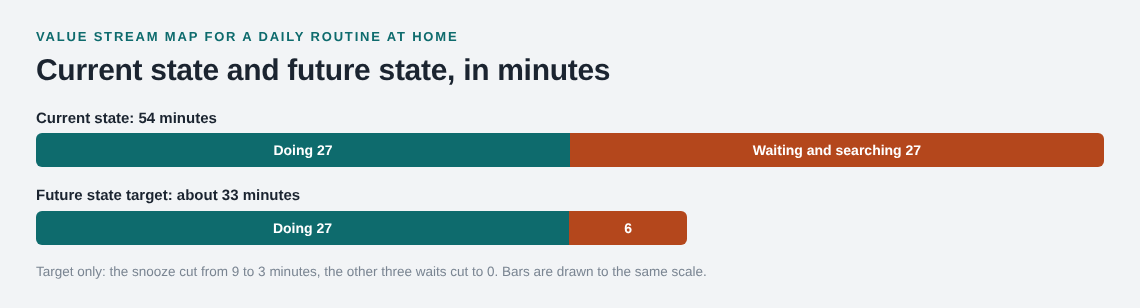
Add it up. Doing: 27 minutes. Waiting and searching: 27 minutes. Lead time: 54 minutes. Half the routine is not the routine at all.
The map points straight at three targets: the snooze, the kettle wait, and the two searches. The shower and the meal are fine. Leave them alone.
Turn the map into a future state with fixes
Now draw the same routine again, the way you want it to run. This is the future state. Change one thing per wasted block and keep each fix small.
- Snooze, 9 minutes. Put the alarm across the room so you must stand up. Target: 3 minutes.
- Kettle wait, 5 minutes. Switch the kettle on before the shower so it finishes while you wash. Target: 0.
- Shirt search, 4 minutes. Lay out clothes the night before. Target: 0.
- Key and charger search, 6 minutes. One bowl by the door for keys, charger packed in the bag at night. Target: 0.
If every target holds, lead time drops from 54 minutes to about 33. That is a goal, not a promise. Some fixes will fail, and that is useful information.
Record what happens in Problem Graph
This is where a journal beats a sheet of paper you lose. In the app, write the problem as one line in the personal lane, for example "Morning routine takes 54 minutes". Add each fix above as a solution. Mark the ones you are trying, then record the outcome as worked, partly, or failed.
You can link related problems too, such as "Late for the bus" tied to the morning routine. Links are useful when two problems share the same cause. The map shows patterns that a plain list hides.
Your problems are private by default, so only you see them. If you later want to share a fix with family, you can mark a problem as a main node and share it into a private network you set up. Only a main node can be shared, and its solutions and outcomes go with it.
A fix that failed stays on the map as failed. That is the point. Next month you will not wonder whether the across-the-room alarm was tried.
Frequently asked questions
How long does a value stream map for a daily routine take to make?
Plan on one ordinary run of the routine to collect times, then about 15 minutes to write the steps and tag the waste. Redraw it after a week of trying your fixes.
Do I need special software or a template?
No. A sheet of paper with columns for step, doing time, waiting time, and effort is enough. A journal like Problem Graph helps you keep the fixes and their outcomes in one place.
Should I map the whole day or one routine?
Map one routine with a clear start and end. A whole day has too many parts to compare, and you will not know which change made the difference.
What counts as waste in a home routine?
Waiting for something to finish, redoing a step, and extra walking or searching. Steps you value, like a meal you enjoy, are not waste even if they take time.
How do I know a fix worked?
Time the routine again and compare the wasted minutes to your first map. Mark each fix as worked, partly, or failed so you keep the honest result.
Get started
Pick one routine, set its start and end, and time it once. Then write the biggest block of wasted time as a single line and attach the first fix you will try.
Try Problem Graph: it is free, and you can look around the public network without an account. Write one problem down in a line and attach the first thing you will try.
Every problem you carry, on one map. Solved together.
Visit problemgraph.vlvd.net↗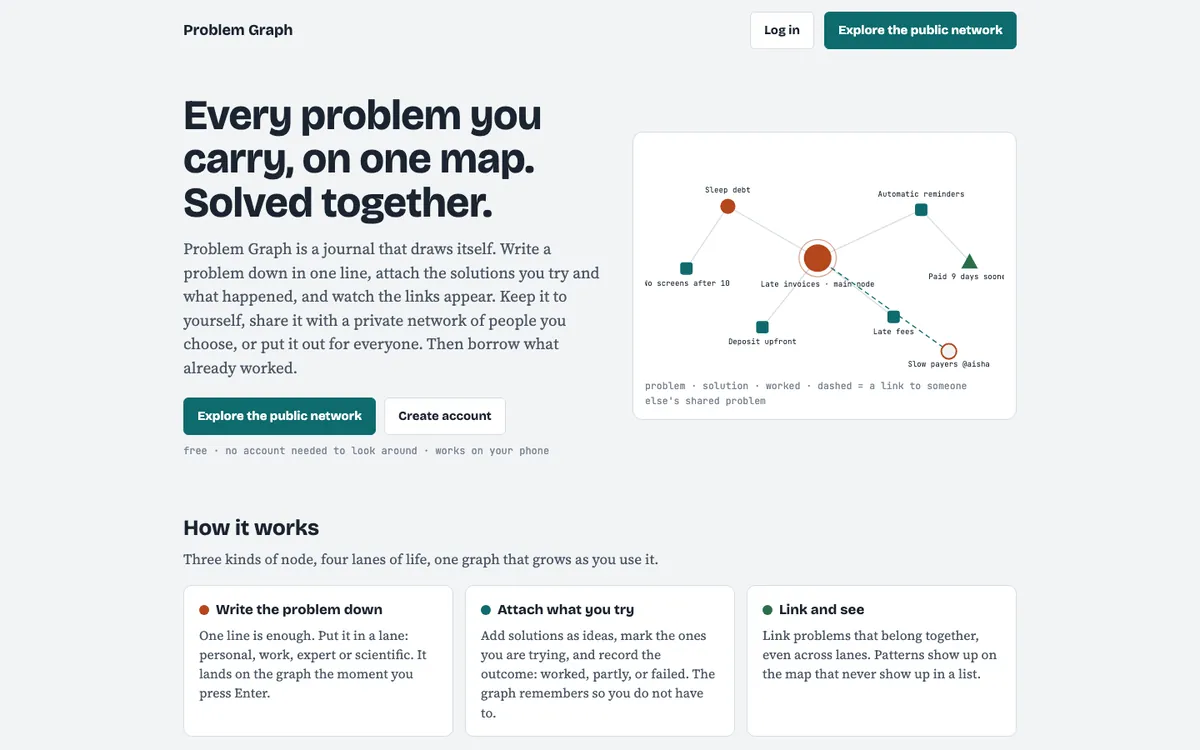
Comments
No comments yet.
Sign in or make an account to comment.