Noise Problems Log: What You Tried at Home
A noise problems log: what you tried at home, written down as you go, saves you from repeating the same failed fix three times. Noise rarely gets solved in one move. You try a rug, then a door seal, then a conversation, and a month later you cannot remember which of them did anything. A short, honest record fixes that.
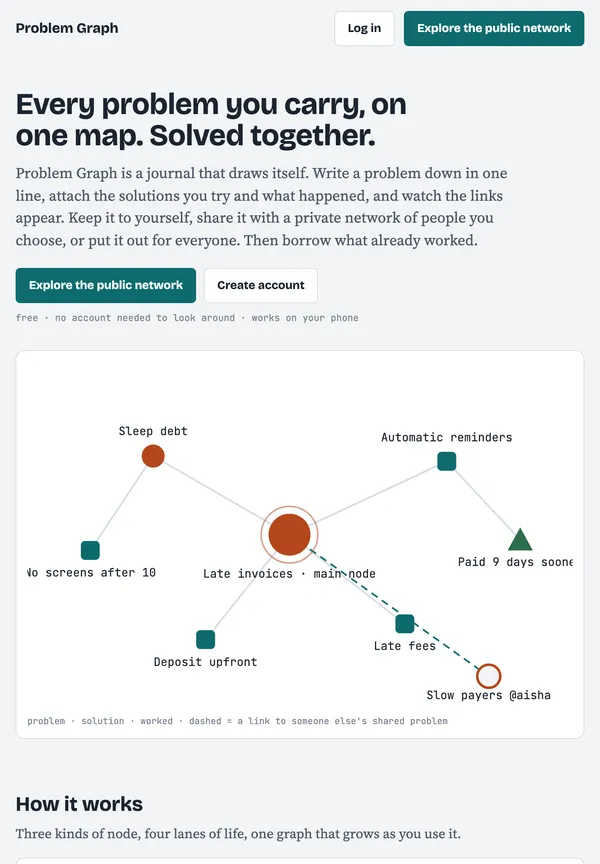
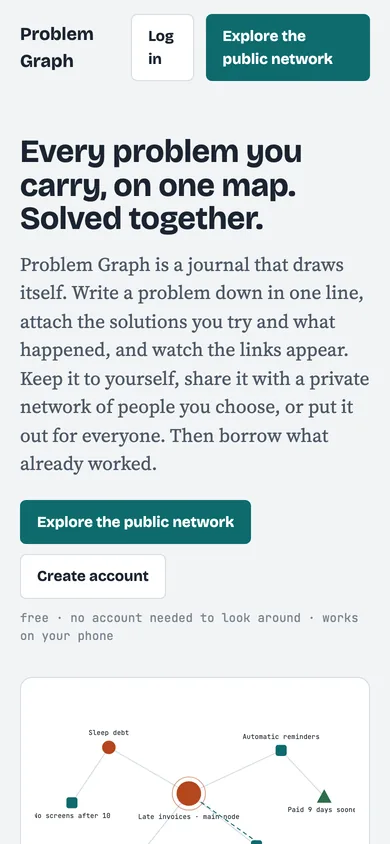
Problem Graph is a journal that draws itself as a map. You write the noise problem in one line, attach each fix you try with its outcome, and link related problems so you can see how they connect.
Why a noise problems log beats memory
Noise is a slow problem. It comes and goes by time of day, by weather, and by who is home. Your memory keeps the loudest night and drops the rest. After two weeks you will say "nothing helped" about a fix that took the edge off, or "that worked" about one that only worked on a quiet Tuesday.
A log gives you three things memory does not:
- Dates. You can see how long a fix had to prove itself.
- Failures kept on record. A failed fix stays visible, so you do not buy the same foam panels twice.
- Evidence. If you ever need to speak to a landlord, a building manager, or a neighbor, "here is what I already tried" is a stronger opening than "it is really loud."
The same habit works for other household friction. If you already keep a clutter log of what you tried to keep a room tidy, a noise log follows the same shape: one problem, several attempts, an honest result for each.
What to record for each noise problem
Keep the problem itself to one line. Make it specific enough that you would recognize it again. "Noise" is too vague. "Bass from the flat above, weeknights after 10pm, mostly in the bedroom" is useful.
Then, for the problem, note these details. You can put them in the problem line or in the text of each attempt:
- Source: what makes the sound, if you know.
- Where you hear it: which room, and where in the room.
- When: time of day, days of the week, weather if it matters.
- How it hits you: wakes you up, breaks concentration, makes calls hard.
Each attempt then gets its own entry with the date, what you did, what it cost you in effort or money, and what happened. Keep the entry plain. "Put a bookshelf against the shared wall, 3 May. Bass still audible, but the clatter is gone." That one sentence tells future you what to repeat and what to skip.
Noise problems log: what you tried at home, as a template you can copy
Here is a layout you can paste into any notes app or use directly as a structure in Problem Graph. Fill in one block per problem.
- Problem (one line): source, place, time. Example: "Bass through the bedroom wall, weeknights after 10pm."
- Lane: for home noise this is usually personal. If the noise is at your desk or office, work fits better.
- Attempt 1: what you did, the date, the outcome (worked, partly, failed), and one line on why you think so.
- Attempt 2: same fields.
- Attempt 3: same fields.
- Linked problems: other problems this one touches, such as poor sleep.
- Next step: the one thing you will try next, or who you will talk to.
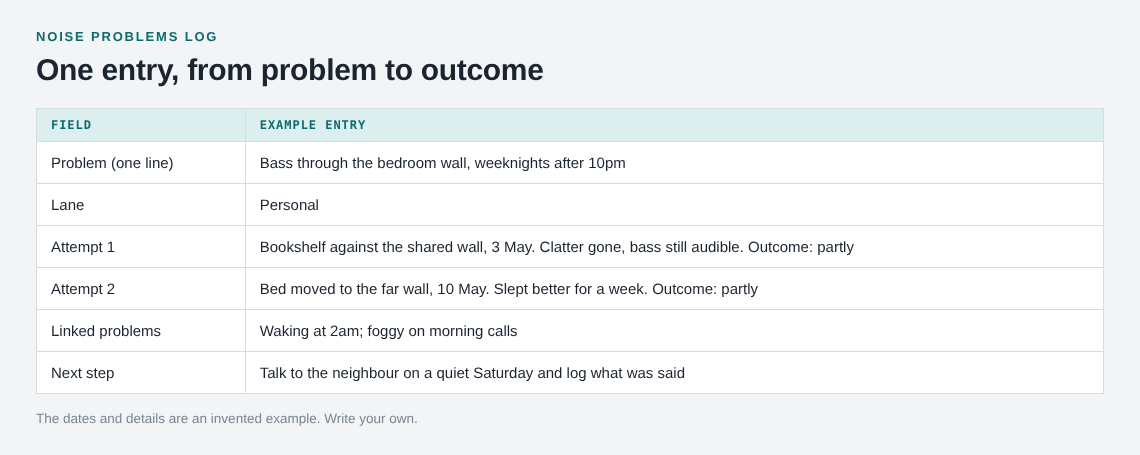
The three outcomes matter more than they look. Worked, partly and failed are the same three states Problem Graph uses on each solution, so your notes map straight across. "Partly" is the honest answer more often than people expect with noise, and it is worth keeping separate from a clean win.
Common home noise sources and fixes worth logging
These are ideas to try, not promises. Log each one as an attempt and let your own result decide whether it stays.
Neighbor noise through a wall or ceiling
- Move furniture, such as a full bookcase, against the shared wall.
- Add a thick rug or rug pad if the sound comes from above.
- Move your bed to the other side of the room for a week.
- Talk to the neighbor, calmly, at a time that is not mid-noise. Log what was said and what changed.
Street and outside noise
- Close gaps around windows and doors with seals.
- Hang heavier curtains.
- Try a steady background sound at low volume.
Appliance hum and rattle
- Check that the appliance is level and not touching a wall or cabinet.
- Put a mat under it.
- Note the exact time it runs, since a fridge compressor or a boiler often has a rhythm.
Noise inside your own household
- Agree on quiet hours.
- Try closing doors with a soft-close fitting.
- Swap which rooms are used for calls or practice.
If the noise is shared with other people, such as a loud space you all use, the same logging idea applies. The shared office kitchen problems list shows how a team can keep one list for a space everybody uses.
How to rate what helped and what did not
Rate each attempt after you have lived with it, not the same evening. A day or two for a small fix, a week for anything involving habits.
- Worked: the problem is gone or small enough that you stopped thinking about it.
- Partly: you notice an improvement but the problem still costs you something.
- Failed: you could not tell the difference, or it got worse.
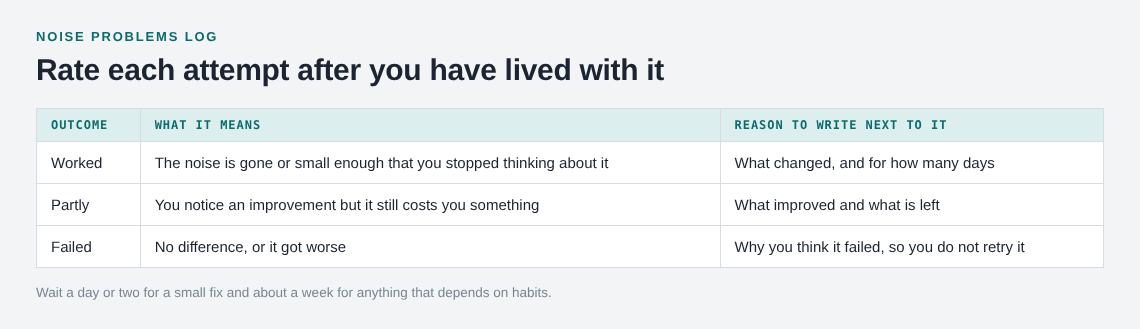
Add a short reason to each. "Failed: the seal is fine, but the sound comes through the wall, not the window." That reason is what stops you from retrying it later. Problem Graph keeps this on the map. Its own page puts it this way: a solution that failed three times stays on the map as a failed solution, and that is exactly what the next person needs to know. For a noise log, the "next person" is often you, in six months.
Try one thing at a time where you can. If you change three things on the same night and the noise drops, you will not know which one did it. Limiting how many fixes are in play helps here, and the post on a personal kanban for problems covers that idea.
Spotting patterns across your noise attempts
A list shows you attempts. A map shows you relationships. In Problem Graph you can link problems that belong together, even across lanes. Say you log three problems:
- "Bass through the bedroom wall, weeknights" (personal)
- "Waking at 2am and not getting back to sleep" (personal)
- "Foggy on morning calls" (work)
Link all three. Now the work problem is visibly tied to the noise one, and anything that helps the noise has a reason to be tried first. The app's own line is that patterns show up on the map that never show up in a list. You can still switch to the List view when you want a plain run of entries.
Look for these patterns once you have a few weeks of entries:
- Several fixes marked "partly" on the same problem. That often means the source is not where you think it is.
- Failures that share a cause, such as every window fix failing because the sound travels through the structure.
- One problem that quietly feeds many others.
If you want ideas when you are stuck, Problem Graph can show you similar problems other people have shared and which of their solutions worked, and you can borrow one into your own graph with a link back to where it came from. You can also ask the AI for suggestions. Treat those as proposals to test and rate, not as answers. How much is available to borrow depends on what people have shared, so see it as a way the feature works, not a promise of what you will find.
When your log says it is time to escalate
Your log tells you when you have run out of things you can do alone. Some signs:
- You have three or more attempts on the same problem and none is marked worked.
- The failures point to a cause you cannot change, such as a shared wall or building equipment.
- The noise is affecting your sleep or work week after week.
At that point, the next step is usually a person: the neighbor, the landlord, the building manager, or your local authority. This is a journal, not legal advice, so check what rules and rights apply where you live. What the log gives you is a clear account of dates, times, and what you already tried.
Escalating usually means waiting on someone else. Log that too, with who you contacted and when. The post on a waiting-on-someone log shows how to track fixes that depend on others, so a pending reply does not vanish from view.
Frequently asked questions
What should a noise problems log include?
Include the source, the room, the time it happens, and each fix you tried with a date and an outcome. Mark each fix as worked, partly, or failed, and add one line on why.
How long should I wait before rating a fix?
Wait a day or two for small physical changes and about a week for anything that depends on habits or other people. Rating the same evening tends to mislead you, because noise varies from night to night.
Can I keep my noise log private?
Yes. Private is the default in Problem Graph, so only you see your problems. If you want to share one, you can put a main node into a private network for people you choose, or make it public.
Do I need an account to try it?
No account is needed to look around, and the public network is open to browse. To add a problem, recommend a solution or borrow one, you create an account with a username and a password.
Is Problem Graph a replacement for talking to my neighbor or landlord?
No. It is a journal and a map. It helps you see what you have tried so that conversation is clearer.
Get started with your noise log in Problem Graph
Start small. Open the app, write your noisiest problem as one line, put it in the personal lane, and attach the first fix you will try. Come back after a few days and mark the outcome honestly. If you want a feel for the map first, the empty app offers a button to load an example set.
Try Problem Graph: it is free, and you can look around the public network without an account. Write one problem down in a line and attach the first thing you will try.
Every problem you carry, on one map. Solved together.
Visit problemgraph.vlvd.net↗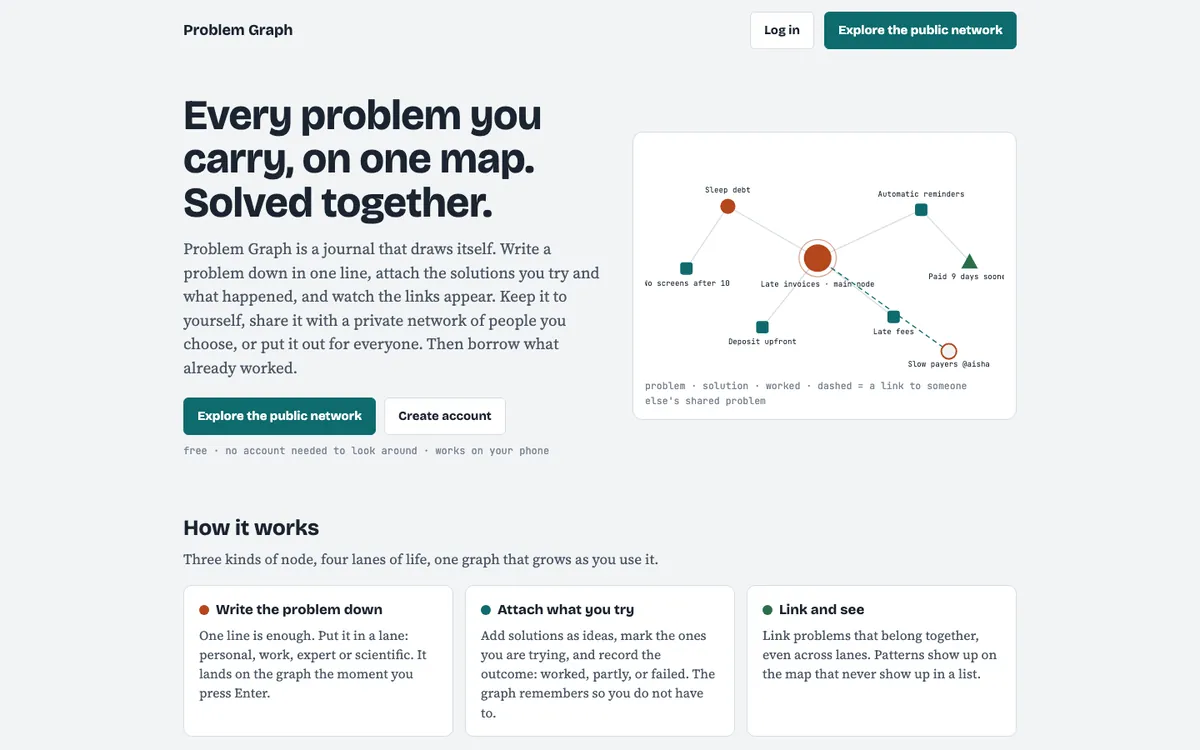
Comments
No comments yet.
Sign in or make an account to comment.