What Is a Knowledge Cutoff? Why AI Models Miss Recent News
What is a knowledge cutoff? It is the date at which the text used to train an AI model stops, so the model has learned nothing about anything that happened after it. Ask it about a later event with nothing else to go on, and it either says it does not know or, worse, answers from an older world as if nothing had changed.
This is one of the limits covered in What AI Gets Wrong, the third lesson of the How Modern AI Actually Works course on Age of AI Entrepreneur, a Basic course for founders with no background; sign in with your email and an emailed code to open it.
What is a knowledge cutoff, step by step
A language model is built in one long training run. Its makers gather a huge collection of text, then train the model to predict the next piece of text, billions of times. The collection has to be gathered and frozen before the run starts. The date of the newest text in it is the knowledge cutoff.
Three things follow from that order of events:
- The cutoff is earlier than the release. Training, tuning and testing take months, so a model is already behind on the day it launches.
- The gap grows while you use it. The model stays the same from release until it is retired, and the world does not.
- Chatting does not teach it. What you type sits in the context window for that one conversation. It does not change what the model learned.
Why a model cannot just keep learning
Everything a model learned lives in its weights, the numbers set during training. After training those numbers are fixed. Adding last week's news means more training, and a full run on a large model is slow and costly. The authors of the 2024 paper discussed below call retraining "prohibitively expensive", which is why providers ship a new model every so often and do not refresh an old one daily.
In Mind the Gap, a paper submitted in February 2021, Angeliki Lazaridou and colleagues trained language models on text up to one date and tested them on text written later. The models did worse on the later text, and the result grew "increasingly worse with time". Making the model bigger did not fix it. Updating the model with new text did help.
So staleness is not a defect of one product. It comes from how every model of this kind is made.
Reported cutoff vs effective cutoff
The most common mistake is to read the cutoff as a clean line: the model knows everything before it and nothing after. Neither half is true.
In March 2024 six researchers at Johns Hopkins University published Dated Data: Tracing Knowledge Cutoffs in Large Language Models. They separate two dates. The reported cutoff is the date the maker states. The effective cutoff is the date the model's knowledge of one source really matches, and it can be different for each source.
To find it, they took documents with many dated versions, such as heavily edited Wikipedia pages, and measured which version each model found least surprising. One open model had been trained on web crawls from 2019 to 2023 plus a 2023 copy of Wikipedia. Its knowledge of Wikipedia fitted best around mid-2019. The reason was in the data: over 80% of the Wikipedia pages in its training set were older versions that the web crawls had picked up.
The paper names two causes. A new web crawl holds a lot of old pages, and the steps meant to remove duplicates miss copies that differ only a little. Old versions pile up, the newest version appears once, and the model learns the old one best.
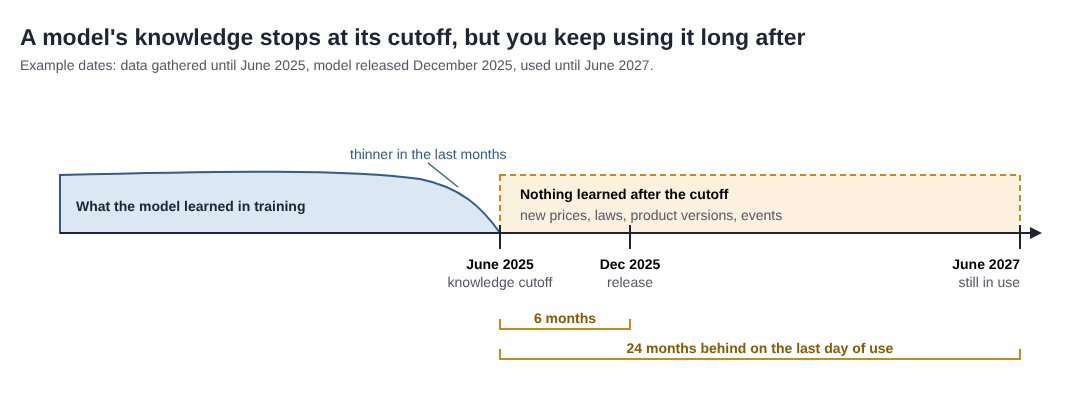
Knowledge thins out before the cutoff and stops at it, while use goes on for months or years.
Some providers now publish two dates for this reason. Anthropic's model documentation lists a "reliable knowledge cutoff", described as "the date through which the model's knowledge is most extensive and reliable", next to a broader training data cutoff.
How a stale model fails in a product
A missed headline is the failure people expect. Three others do more damage, because the answer looks normal:
- The outdated "latest". Ask for the newest version of a library, a phone or an AI model, and the model names the newest one it saw in training.
- The changed rule. Prices, tax rules, visa rules and API terms change. The model gives the old one with full confidence. The Dated Data authors give the example of a person who asks for tax advice and gets the 2022 tax code from a model advertised with a 2023 cutoff.
- The wrong "today". A model has no clock. Unless the app tells it the date, it tends to reason as if today were close to its cutoff, so "how many days until the deadline?" can go wrong.
None comes with a warning, which makes them close relatives of the hallucination cases founders already worry about.
A worked example: how far behind is your model?
Say you build a support assistant on a model with a cutoff of June 2025. The model is released in December 2025, you launch in March 2026, and you keep the same model until June 2027.
- On release day the model is 6 months behind.
- On your launch day it is 9 months behind.
- On its last day in your product it is 24 months behind.
- Across your 15 months of use, the average gap is between 16 and 17 months.
Your own pricing changed in October 2025, four months after the cutoff. Write 20 test questions whose answers changed after June 2025: your prices, your newest feature, the current version of a tool you integrate with, today's date. Ask them with no extra context and count the wrong answers. Then put two things in the prompt, today's date and the current pricing page, and ask again.
The consequence is a rule you can ship: every fact that changes more often than you change models must reach the model through the prompt, never from its memory. The 20 questions become a small test set that you run again each time you switch models.
How to build around the cutoff
- Tell it the date. Put today's date in the system prompt. This fixes the wrong "today" at almost no cost.
- Retrieve what changes. The 2020 paper that named retrieval-augmented generation called updating a model's world knowledge an open research problem, and answered it by pairing the model's memory with an outside store of documents it can look up. Keep your prices, policies and docs in that store. Our guide to RAG vs fine-tuning covers when this is the right tool.
- Give it search for open questions. A web search tool covers what your own store cannot.
- Ask it to flag old knowledge. Tell the model to say so when a question depends on something recent that is not in its context.
- Plan for the switch. A newer model moves the cutoff forward, and the old one will be retired anyway; see AI model deprecation.
Does search make the cutoff irrelevant?
This is the strongest objection, and builders answer it in two ways.
One view is that the cutoff no longer matters much. A model with search or retrieval reads today's page, so its memory only needs to supply language and reasoning.
The other view is that the cutoff still shapes every answer. The model decides when to search, and it will not look up something it believes it already knows. It also reads fresh results through old assumptions about which products, people and versions exist. On this view, retrieval reduces the problem and does not remove it.
Two things are still open. Researchers have argued since at least 2021 for models that keep themselves up to date, and the 2024 paper still describes that as a field of research, not a solved problem. And nobody outside a provider can check a closed model's effective cutoff with confidence: the Dated Data authors could only confirm their results on models whose training data was public, and offered their closed-model results as speculation.
Frequently asked questions
Does ChatGPT know today's date?
Only if the app tells it. A model has no clock. Anthropic, for example, says its chat apps start every conversation with a system prompt that gives the model up-to-date information, and that this does not apply to its API. Through a bare API call with no date given, a model can only guess.
How do I find a model's knowledge cutoff?
Look at the provider's model documentation, which lists it with details such as the context window. Do not rely on asking the model: its statement about its own cutoff is a prediction like any other.
Does fine-tuning move the knowledge cutoff?
Only for what your examples contain. Fine-tuning teaches a style or a task from your data. It does not bring the model's general knowledge of the world up to date.
Is a model with a newer cutoff always better?
No. A newer date means fresher training text, but the effective cutoff can lag the stated one, and facts that change often should come from retrieval whichever model you use.
Get started
What AI Gets Wrong is the third of three lessons in the How Modern AI Actually Works course on Age of AI Entrepreneur. Each lesson takes about 9 minutes and lists its sources, every attempt is graded, and you can retake a lesson any time. Sign in with your email and an emailed code to open the course.
Start Age of AI Entrepreneur: short hands-on lessons on how to build a business in the age of AI, with every side of the debate and the sources to read next.
Building a business in the age of AI, from a first project to a company.
Visit aientrepreneur.vlvd.net↗
Comments
No comments yet.