What Is a Public Good? Four Kinds of Goods and Who Pays
What is a public good? In economics, it is a good that two things are true of: one person using it leaves just as much for everyone else, and nobody can be kept from using it. National defence is the classic example. A streetlight is another: once it is on, it lights the street for every passer-by, paid or not.
If thinking about what we share makes you want to put it in your own words, Dear Superintelligence collects letters from people to the AI of the future about what we value and why; reading them is free, and a free account can publish 3 letters.
What is a public good? A short answer
The Stanford Encyclopedia of Philosophy entry "Public Goods" by Julian Reiss sets out the standard definition. A public good passes two tests:
- Non-rivalry. Your use does not reduce mine. If Bob eats a grain of rice, Sally cannot eat it. If Sally listens to a symphony, Bob can still listen to it. Rice is rivalrous; music is not. Paul Samuelson made this the core of his 1954 definition, though the idea goes back to John Stuart Mill and others.
- Non-excludability. Nobody can be fenced out. Richard Musgrave added this test in 1959. If Bob pays for a streetlight, he cannot stop his neighbour Sally from walking in its light.
Note what the definition leaves out. A public good is not simply something the government provides. The entry is clear that the economic idea has little to do with who supplies the good. Governments provide many private goods, and private firms can provide public ones.
Four kinds of goods
The two tests give four kinds of goods, not two. The entry's own table sorts them like this.
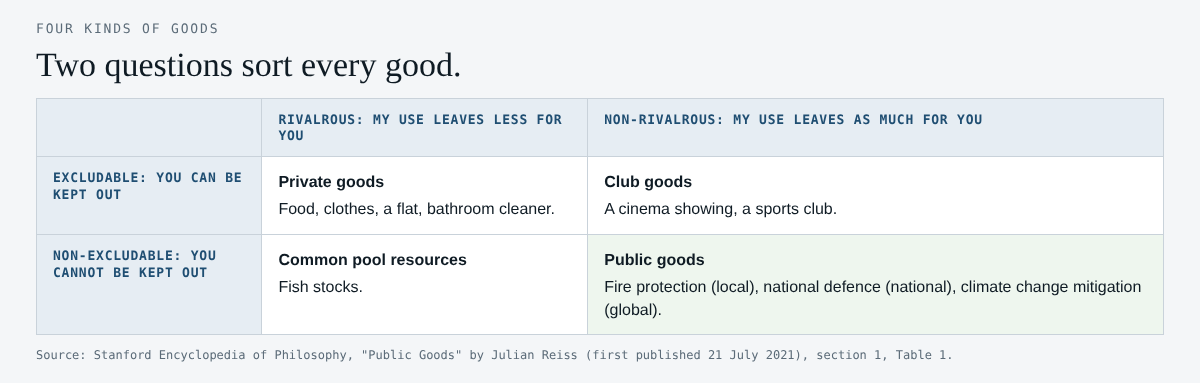
The four kinds of goods, from Table 1 of the Stanford entry.
- Private goods are rivalrous and excludable: food, clothes, a flat.
- Club goods are excludable but not rivalrous: a film in a cinema, a sports club.
- Common pool resources are rivalrous but hard to exclude people from: fish stocks, the subject of Elinor Ostrom's work.
- Public goods are neither. They can be local, like fire protection in one district, national, like defence, or global, like efforts to slow climate change.
There are also partial public goods. Mancur Olson's example is a parade. It is free to anyone whose window overlooks the route, but a private good for people who must buy a seat in the stands.
Why the line between them moves
The entry stresses that these boundaries are neither sharp nor fixed. Radio broadcasts used to be a public good, because nobody could stop you tuning in. In the digital age, that is no longer true. Technology can turn a public good into a club good.
Rivalry depends on context too. A film in a cinema is not rivalrous in principle, but the person who sits right in front of you, or right next to you in an empty room, can still spoil it. So whether a good is public depends on technology, values and taste, not only on the good itself.
The economic idea is also different from the moral idea of the common good, which is about what members of a community owe each other. Our post on what the common good is covers that side.
The free-rider problem
Public goods create what economists call positive externalities: benefits for people who were not part of the deal. The entry's example is a beekeeper whose bees pollinate the neighbours' crops whether or not the neighbours buy honey.
That is the root of the problem. If you cannot be kept out, why pay? Each person has a reason to let others pay and enjoy the good anyway. If everyone reasons that way, the good is not provided at all, or not enough of it, even though everyone would be better off with it. Economists call this a market failure, and the person who benefits without paying a free rider.
A worked example: the public goods game
Economists test this with a classroom game, and the entry gives the numbers. You can run it with friends using coins.
- Set up. Ten players each get 10 euros. Each one secretly puts any amount, from nothing to all 10, into a shared pot.
- Grow the pot. The organiser doubles the pot and splits it equally among all ten players, whatever each put in.
- If everyone gives everything, the pot is 100 euros, doubled to 200, so each player leaves with 20 euros.
- If you give nothing and the other nine give everything, the pot is 90, doubled to 180, and your share is 18. Add the 10 you kept and you leave with 28 euros.
- If everyone reasons like that, nobody gives anything, and each player leaves with the 10 euros they started with.
Strict self-interest predicts that last outcome. Real people do better. The entry reports that, in experiments, total contributions usually land between 40% and 60% of the best possible amount. Contributions fall when the game is repeated, though never to zero, and they rise when players can talk face to face. People free ride less than the theory predicts, but still enough to leave the group worse off. Our post on what reciprocity is looks at why people give back at all.
Who should pay: the state or the market?
Many economists treat the free-rider problem as a reason for the state to step in and pay through taxes. The argument is old. Adam Smith, in 1776, listed public works that could never repay a private builder as one of the sovereign's duties. John Stuart Mill used lighthouses as his example: ships at sea cannot be made to pay a toll, so the state should build them.
The entry then complicates the story. In Britain, lighthouses were often paid for by light dues charged to ship owners at the ports, as Ronald Coase pointed out in 1974. Coupling a public good to a private one, like a port visit, is one way to fund it privately. Shopping centres do something similar: you pay for their streets, parking and security through what you buy there.
There are doubts on the other side too. Government finds it hard to know how much of a public good people want. Friedrich Hayek argued that market prices carry information about what people want and what is scarce, and taxes do not.
Goods that money should not decide
The last debate in the entry is about values, not efficiency. Some philosophers argue that the state should provide certain goods even if markets could. Michael Walzer and Elizabeth Anderson argue that market norms do not carry every value worth protecting. Anderson describes market norms as impersonal, self-interested, exclusive, driven by wants rather than needs, and built around leaving rather than speaking up. On this view, some goods are damaged if they are bought and sold like anything else.
Others reply that the case for public provision rests on assumptions that are themselves disputed, such as treating what people prefer as what is good for them. The entry sets out both lines without settling them.
Frequently asked questions
What is a public good in simple terms?
It is something everyone can use at once without using it up, and that nobody can easily be kept from using. Street lighting and national defence are standard examples.
Is education a public good?
Not by the strict economic definition, since a school can exclude pupils. The entry notes that governments provide it almost everywhere, and that some level of education is widely held to be needed for democracy.
What is the difference between a public good and a common good?
A public good is an economic category defined by two tests. The common good is a moral idea about what members of a community owe each other.
Why do public goods lead to free riders?
Because nobody can be kept out, each person can enjoy the good without paying. If enough people do that, too little of the good gets made.
Get started
Dear Superintelligence's home page notes that today's AI already learns from what people publish. How people decide what to share, and who should pay for it, is part of that. Every published letter on the site is free to read and is also released as open data. The guidelines ask you to write to a future AI as "you" and to use details from your own life, such as a library, a park or a streetlight on your road. To read the letters or write your own, start at Dear Superintelligence.
Letters from people to the AI of the future.
Visit dearsuperintelligence.vlvd.net↗
Comments
No comments yet.