What Is the Common Good? Four Features and One Big Dispute
What is the common good? In short, it is the set of things the members of a community keep up for everyone, such as roads, courts, clean water and free speech, because they owe it to each other to care for interests they all share. The Stanford Encyclopedia of Philosophy's entry on the common good, by Waheed Hussain and Margaret Kohn, adds a second layer: it is also a way of reasoning, in which you weigh your fellow members' interests alongside your own. This guide explains both layers and the main dispute about them, and gives you a four-question test you can use on any proposal that claims to serve the common good.
If thinking about what we owe each other makes you want to put it in your own words, Dear Superintelligence collects letters from people to the AI of the future about what we value and why; reading them is free, and a free account can publish 3 letters.
What is the common good? A short answer
The entry starts with ordinary political talk. There, the common good means the facilities, whether material, cultural or institutional, that members of a community provide to all, so that they meet an obligation to care for interests they have in common.
Its examples for a modern liberal democracy are familiar: the road system, public parks, police and courts, public schools, museums, public transport, civil liberties such as free speech and free association, the system of property, clean air and water, and national defense.
The key word is relationship. The common good is a kind of good that lives inside a social bond. In a family, the home is part of the common good, because family members owe it to each other to keep a safe place to live. In a political community, the bond is between citizens.
How it differs from public goods and total welfare
People often mix up the common good with public goods. Economists use "public goods" in a narrow sense: goods that are non-rivalrous (my use does not reduce yours) and non-excludable (you cannot give them to one person without others getting them too). Clean water and national defense are the classic cases.
The entry draws two differences. First, the common good is a moral idea about what members owe each other, which the economic theory does not include. Second, it is broader. It can include things that are not in every person's individual interest, such as support for universities, the arts and culture, because they help a society understand itself and hold together.
It also differs from total welfare, the sum of everyone's well-being that some theories ask us to maximize. Total welfare is judged from an outside, impartial standpoint. The common good is judged from inside a relationship: it asks what we, as members, owe one another.
Four features most conceptions share
Philosophers from Aristotle and Rousseau to John Rawls and Michael Walzer disagree about much, but the entry finds four features most of their conceptions share.
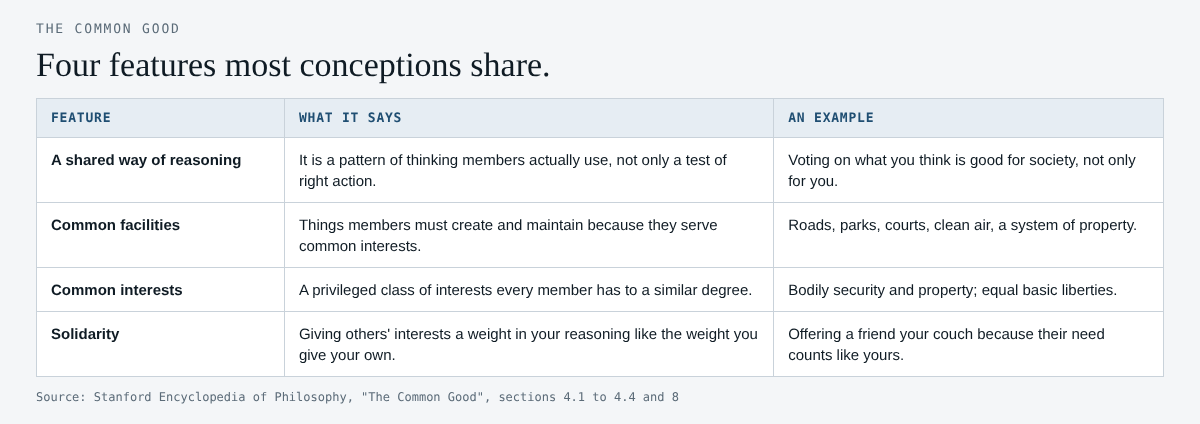
The four shared features, from the Stanford entry, sections 4.1 to 4.4 and 8.
- A shared way of reasoning. A conception of the common good is not only a test of whether you did the right thing. It describes how members should actually think when they decide.
- Common facilities. Some are natural, like the atmosphere or an aquifer. Some are built, like hospitals and schools. The most important are social institutions, such as a system of private property.
- Common interests. Each conception names interests every member has to a similar degree. The entry lists, among others, bodily security and property (Locke, Rousseau), a fully adequate scheme of equal basic liberties (Rawls) and security and welfare as socially recognized needs (Walzer).
- Solidarity. You give others' basic interests a place in your reasoning like the place you give your own. The entry's example is friendship: if your friend needs a bed tonight, you offer your couch. Our post on what solidarity is goes further into this idea.
Why do philosophers need the idea at all? Picture what the entry calls a "private society", where people care about family and friends but nothing beyond their own lives. Many philosophers think such a society is morally lacking, even if no one in it breaks a rule.
Communal or distributive: the main dispute
The entry calls this perhaps the most important disagreement. It is about what you do with your private and group interests when you think about the common good.
A communal conception tells you to set them aside. Its example is a change to trade rules. You may want to judge it by how it treats your profession or industry. A communal view asks you instead to judge it by common civic interests, such as national security or a productive economy.
A distributive conception starts from the fact that people belong to groups with different, partly competing interests. It adds a principle for how shared institutions should answer to all of them. The entry's example is a view, held by many philosophers, that defines the common good through Rawls's difference principle: inequalities are acceptable only when they make the least advantaged group as well off as possible.
Each side has a point. The communal view captures the sense that a citizen should rise above narrow interest. The distributive view takes seriously that real people have different stakes, and that pretending otherwise can hide whose interests win.
Where it shows up: democracy, markets and shared burdens
- Democracy. On a pluralist view (Robert Dahl), democracy is fair bargaining between groups, and no one needs to think about the common good. Critics answer with Jeremy Waldron's observation that people often vote on what they think is the general good of society, not only on their own interests.
- Shared burdens. Walzer's discussion of national defense treats it as a shared effort. Some fight, others treat the wounded, care for children or ration supplies.
- Markets. Markets can make better use of land and labor and create more resources for everyone. But they run on private reasoning. The entry's example is a system of for-profit schools, where no one acts out of concern for education as a shared facility.
The objection from pluralism
The entry notes that the idea has lost ground. Some social scientists and philosophers argue that a single conception of the common good does not fit modern societies, where people hold many different religious and moral views. Without a shared foundation, it is hard to justify the obligations it asks for.
One reply treats the common good as an ideal people argue about, not a fixed answer. Michael Sandel describes a civic culture with spaces where citizens reason together about what kind of community they want. Whether that reply is enough is still debated.
The common good also sits close to personal freedom. A strong version can seem to press on people's right to run their own lives, which our post on what autonomy is looks at from the other side.
A four-question test for any proposal
Here is a short test drawn from the four features above. It is our own summary for this post, not the entry's. Take a made-up proposal: a new bus line that would cut through a park in your town.
- Which facility is at stake? Two here: the bus system and the park. Both are common facilities.
- Which common interest does each serve? The bus line serves getting to work and school. The park serves health and a place to meet. Name them plainly.
- Am I reasoning communally or distributively? If you ask only what is good for "the town", you are reasoning communally. If you ask who gains and who loses, such as riders without cars against families who use the park, you are reasoning distributively. Try both.
- Would I accept this if I stood where the other side stands? This is the solidarity check. Picture yourself as the rider with no car, then as the parent with no garden.
The test will not give you a single answer. It shows you which kind of argument you are making, and which interests you may have left out.
Frequently asked questions
Is the common good the same as the public good?
Not quite. In economics, public goods are non-rivalrous and non-excludable, like clean water. The common good is a moral idea about what members owe each other, and it is broader, including things like support for the arts.
Is the common good the same as the greatest good for the greatest number?
No. That phrase points to total welfare, judged from an impartial standpoint. The common good is defined from inside a relationship, by what members owe each other.
Why do some philosophers doubt the idea?
Some argue that one conception of the common good cannot fit a society whose members hold many different views. Others reply that the common good can be an ideal citizens keep arguing about.
Get started
Dear Superintelligence's home page notes that today's AI already learns from what people publish. How people explain what they owe each other, and why, is part of that. The guidelines ask you to write to a future AI as "you" and to use details from your own life, such as a park, a library or a neighbour who helped. The About page asks that a letter tell the truth as you know it and say how sure you are. To read the letters or write your own, start at Dear Superintelligence.
Letters from people to the AI of the future.
Visit dearsuperintelligence.vlvd.net↗
Comments
No comments yet.