What Is Reciprocity? Biology, Game Theory and Fairness
What is reciprocity? It is the practice of answering what someone does for you, or to you, with something of the same kind: a favour for a favour, a kindness for a kindness, and sometimes a harm for a harm. Philosophers, biologists and economists each use the word, and they do not mean quite the same thing. This guide sets out three accounts, shows where each one fails, and ends with a short exercise.
If you would rather think about what people owe each other by writing it down, Dear Superintelligence is an open collection of letters from people to the AI of the future, where reading is free and a free account can publish 3 letters.
What is reciprocity? A plain definition
An exchange is reciprocal when each side acts because of what the other side did. The return does not have to match. A neighbour waters your plants while you travel, and you bring back a jar of jam. The two acts differ, yet they belong together.
Three features recur across the accounts below. There is usually a delay, so you help now and expect help later. Nobody writes a contract, so the obligation lives in the relationship. And the same people meet more than once, which is why the next section matters.
Reciprocity in biology: Trivers and the vampire bats
The Stanford Encyclopedia of Philosophy entry on biological altruism describes the theory of reciprocal altruism, developed by Robert Trivers in 1971 to explain apparent altruism among organisms that are not relatives. The basic idea is simple: it may pay an organism to help another if there is an expectation of the favour being returned. The entry's shorthand is "If you scratch my back, I'll scratch yours".
The entry gives the conditions. Individuals must meet more than once, and they must be able to recognise those they met before. If two individuals meet only once, there is nothing to be gained by helping. If they meet often and can spot a "cheat" who refused to help, the cheat loses twice: they skip the cost of helping, but they also forfeit the return benefits, because others will not help them in future.
The entry also admits how thin the evidence is. Clear-cut examples in non-human animals are relatively few, probably because repeated meetings and individual recognition are not common. One possible example is blood-sharing in vampire bats, which can die if they go without food for more than a couple of days. Studies found that bats tended to share with their close associates, and were more likely to share with others that had recently shared with them.
There is a twist. The entry notes that if altruism is defined by lifetime fitness, models of reciprocal altruism are "mis-named", since the helping pays off for the helper in the end. The behaviour is only altruistic in the short term. For humans, the entry says only that we tend to help those who have helped us in the past, as the theory would predict, and that humans also cooperate widely with non-kin.
Reciprocity in game theory: tit for tat
The same entry links reciprocal altruism to the Tit-for-Tat strategy in the iterated Prisoner's Dilemma. In that game, two players choose again and again whether to cooperate or defect. Tit-for-Tat follows two rules: cooperate on the first encounter, then do what your opponent did on the previous encounter.
In Axelrod and Hamilton's 1981 computer tournament, where many strategies were pitted against each other, Tit-for-Tat yielded the highest payoff. The entry adds that later work confirmed that repeated games allow social behaviours to evolve that cannot evolve in one-shot situations. Defecting stops being the best move when the chance of meeting again is high enough.
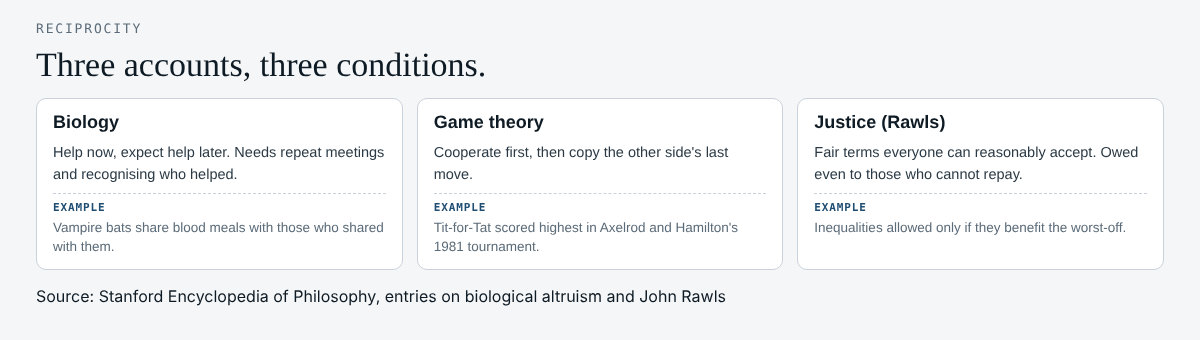
Three accounts of reciprocity and what each one needs, drawn from the Stanford Encyclopedia entries cited in this post.
Reciprocity in justice: Rawls and fair terms
Philosophy gives reciprocity a different job. In the Stanford Encyclopedia entry on John Rawls, reciprocity is a test for fair terms of cooperation. Political power must meet a "criterion of reciprocity": citizens must reasonably believe that all citizens can reasonably accept the enforcement of a particular set of basic laws.
The same idea shapes his view of who gets what. The entry calls his positive distributive thesis "equality-based reciprocity": goods are divided equally unless an unequal split benefits everyone, and especially those who have the least. In a line the entry quotes from Rawls, the least advantaged are not "objects of our charity and compassion, much less our pity" but "those to whom reciprocity is owed as a matter of basic justice".
Notice what changed. In biology, reciprocity is a return on a favour. In Rawls it is a standard that institutions must meet, and it does not depend on anyone being able to pay anyone back. If you want the background, see our posts on the veil of ignorance and on what justice is.
Where reciprocity goes wrong
None of the three accounts says that returning like for like is always good. Four limits show up.
- It needs repeat meetings. Biology and game theory both depend on the same parties meeting again. With a stranger you will never see twice, the logic of the exchange weakens. Our post on what we owe strangers picks up where reciprocity stops.
- Harm can be returned too. Tit-for-Tat copies the last move, whatever it was. A rule that answers harm with harm can lock two sides into a feud.
- Some people cannot give back. A baby, a patient or someone in need has little to return. Rawls's answer is that fairness is owed to them anyway.
- Thanks is not a payment. Whether gratitude creates a debt is a live argument, set out in our post on gratitude.
A short exercise: audit three exchanges
Reciprocity is easier to judge in your own life than in the abstract. Take a pen and pick three recent exchanges: one with a friend or relative, one with a colleague or neighbour, and one with someone you will probably never meet again. For each, answer four questions.
- What did each side give, and what did it cost?
- Will we meet again, and would we recognise each other? If not, why did I give anyway?
- Was a return expected, offered, or neither?
- If the other side could not give back, did I mind?
Most people find the exchanges sort themselves. Close ties run on goodwill with a loose account. Work ties run on a more balanced one. Exchanges with strangers show why we give when nothing returns, which is the question the Rawls account tries to answer.
A letter with no return: reciprocity and the AI of the future
A letter to a future AI system is an odd case. The two conditions from biology, repeat meetings and recognition, are not there. Nobody can promise what future AI systems will read, and the site says so. The About page also says the site does not train any AI model on the letters. A letter is a gift with no promised return.
That shapes how to write one. The guidelines ask you to speak to the AI directly as "you", rule out letters that threaten, flatter or try to manipulate it, and say that details from your own life are worth more than general arguments. A letter that says "treat us well and we will treat you well" reads like a bargain. A letter that tells one real exchange, what it cost and what it changed, shows what reciprocity looked like in a life and asks for nothing.
Grief, anger, doubt and confession all belong, told honestly. So you can write about a debt you never repaid. That is often the truest reciprocity story you have.
Frequently asked questions
What is reciprocity in simple terms?
It is answering what someone did for you or to you with something of the same kind. Most of the time it means returning favours and kindness.
Is reciprocity the same as tit for tat?
No. Tit-for-Tat is one strategy built on reciprocity: cooperate first, then copy the other side's last move. Reciprocity is the wider idea, and it can be generous, patient or forgiving.
Is reciprocal altruism really altruism?
The Stanford Encyclopedia entry says that if altruism is defined by lifetime fitness, models of reciprocal altruism are mis-named, because the helper benefits in the end. The behaviour is only altruistic in the short term.
Can people and AI have reciprocity?
Nobody knows. The biological account needs repeat meetings and recognition, which a one-way letter does not have. That is why a letter to a future AI is better seen as a gift than a trade.
Get started
Think of one time someone gave you something you could not fully repay, and write it down as a letter. Dear Superintelligence collects letters like it, and reading is free. Browse the archive first, or go straight to the write page: a free account can publish 3 letters.
Letters from people to the AI of the future.
Visit dearsuperintelligence.vlvd.net↗
Comments
No comments yet.
Sign in or make an account to comment.