What is a Siberian cat? Triple coat, history and nature
What is a Siberian cat? It is Russia's native forest cat: a medium to medium large, strong cat with a thick triple coat, a round look and a mix of calm and mischief. This guide follows the Cat Fanciers' Association (CFA), a cat breed registry, and its Siberian breed page, opened for this post, and then shows how Cat Go handles the question "Which breed is it?"
Cat Go is a game you play in your browser: walk anywhere, photograph a real cat, lure it with food and catch it, and pick its breed from a list that has a mixed breed answer too.
What is a Siberian cat? The short answer
The CFA lists the Siberian as a longhair breed. It describes it as a Russian native breed that is rare outside of Europe, and gives the personality as dog-like, intelligent and devoted.
The breed standard (the written description judges use) calls the Siberian Russia's native forest cat and says it hails from the unforgiving climate of Siberia. In its words, this is a cat that nature designed to survive, with no extremes in type. The general impression is one of roundness and circles, rather than rectangles and triangles.
Where the breed comes from
The CFA calls the Siberian the national cat of Russia. Its recorded history in its native land goes back to the year 1000, when farmers and tradesmen were its primary caretakers. Real Siberians earned their keep as what the CFA calls "Ministers of Rodent Control", while fantasy versions populated Russian fairy tales, protecting children and opening gateways to otherworldly realms.
For hundreds of years, the CFA says, these cats remained a Russian secret. With the advent of cat shows in England in the 1890s they began to become known in the outside world. The first breeding Siberians arrived in the United States in 1990, imported by Elizabeth Terrell for her Starpoint cattery. The breed was accepted for CFA registration in 2000 and achieved Championship status in 2007.
The look: round, strong and triple coated
The standard describes a medium to medium large cat with surprising heft for its size. Females are generally smaller than males, and size is secondary to type.
- Head: a modified wedge of medium/large size with rounded contours, broader at the top of the skull and narrowing slightly to a full-rounded muzzle.
- Ears: medium-large, rounded, wide at the base and tilting slightly forward, set as much on the sides of the head as on top.
- Eyes: medium to large and almost round. The CFA says there is no relationship between eye color and coat color, except in the color points, which have blue eyes.
- Body and legs: medium in length and well muscled, with a barrel-shaped, firm belly. The legs are medium with substantial boning, and the feet are big and rounded.
- Tail: medium in length, somewhat shorter than the body, wide at the base and tapering slightly to a blunt tip.
- Coat: moderately long to longhaired with a triple coat, and an abundant full collar ruff in adults. The hair may thicken to curls on the belly and britches, but the CFA says a wavy coat is not characteristic.
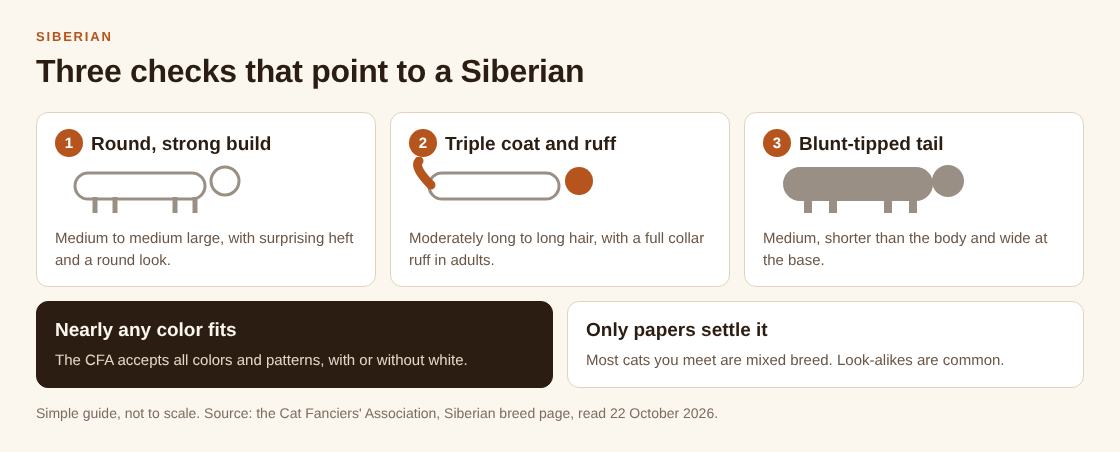
Three checks that point to a Siberian, from the CFA's description.
On color, the CFA says all colors and combinations are accepted, with or without white. The breed was once most popular in brown tabby and is now shown in virtually every color, including a new one called bimetallic, which has both gold and silver areas in the same coat. Our post on the tabby pattern explains the stripes you will see on many of them.
Temperament: 90% placid and 10% mischief
The CFA calls the Siberian extremely intelligent, as befits a natural hunter. It takes a keen interest in its surroundings and loves to investigate cabinets, cupboards and suitcases.
- Easygoing: the CFA says this does not mean the cat is overactive or intrusive. Siberians are simply sociable, curious and easygoing, and want to be near their owners and to know what is going on around them.
- Placid and mischievous: owners speak of their cats as "90% placid and 10% mischief". The CFA says they quickly learn the meaning of "no", though they may translate it as "okay to do when no one is looking".
- Moods: they become very attuned to their owners' moods, and the CFA says they are often sought after as potential emotional support animals.
- Other animals and children: they get along well with dogs and other animals, and can be wonderful companions for children.
- Voice: quiet cats that tend to prefer loud purrs to other forms of feline communication.
These are the CFA's words about the breed in general. Each cat is its own cat, and a rescued or mixed breed cat may act quite differently.
Grooming and health, as the CFA describes them
The CFA says Siberian coats vary enormously. Some need weekly grooming sessions to prevent mats, while others can go for weeks without one. Its advice is to handle the cat's underside, tail and britches several times a week, feeling for mats and tangles, because that is where they are most likely to develop. If you find clumps, gently pull them apart with your fingers, or pick them apart with the edge of a steel-toothed comb, then go through the coat with the comb to remove the rest.
On health, the CFA says breeders are typically scrupulous about genetic testing and choose breeding pairs with extreme care to keep a high level of diversity and minimize hereditary issues. It names hypertrophic cardiomyopathy, polycystic kidney disease and several other recessive conditions. Because of the cost of preventive testing, Siberians may be more expensive than some other breeds. For anything about your own cat, ask your vet.
How to check a long-haired cat on a walk
Here is a worked example. On a walk you see a medium-large cat with a thick coat and a full ruff, and you wonder whether it is a Siberian.
- Look at the shape. The CFA describes roundness: a rounded head, rounded ears, almost round eyes and a barrel-shaped body.
- Look at the coat. A thick, moderately long to long coat with a full collar ruff fits. A wavy coat is not characteristic.
- Look at the tail. It should be medium, somewhat shorter than the body, wide at the base and tapering to a blunt tip.
- Do not use color as proof. The CFA accepts nearly every color and pattern, with or without white, so color tells you little.
- Leave the cat alone. Look from a distance and let it go about its day. Our post on telling whether a cat is mixed breed gives the longer checklist.
At the end, you have a guess, not an answer. Many long-haired cats are mixed breed, and only papers can settle it. If you want to meet the breed for real, the CFA says kittens are typically reserved months in advance, and that visiting a show is the best way to connect with a breeder.
Cat Go and breeds
After a cat is spotted, Cat Go asks "Which breed is it?" and gives you a list with a search box, so you can type something like "Siamese" or "curly". The game also says "Most cats you meet are mixed breed" and "Mixed breed is always a safe pick."
That fits what you just read. A thick-coated cat can be a Siberian or a mixed breed cat, and you choose the breed yourself. The game counts 34 breeds in total, and every catch is saved to your Catdex with its breed and the place you found it.

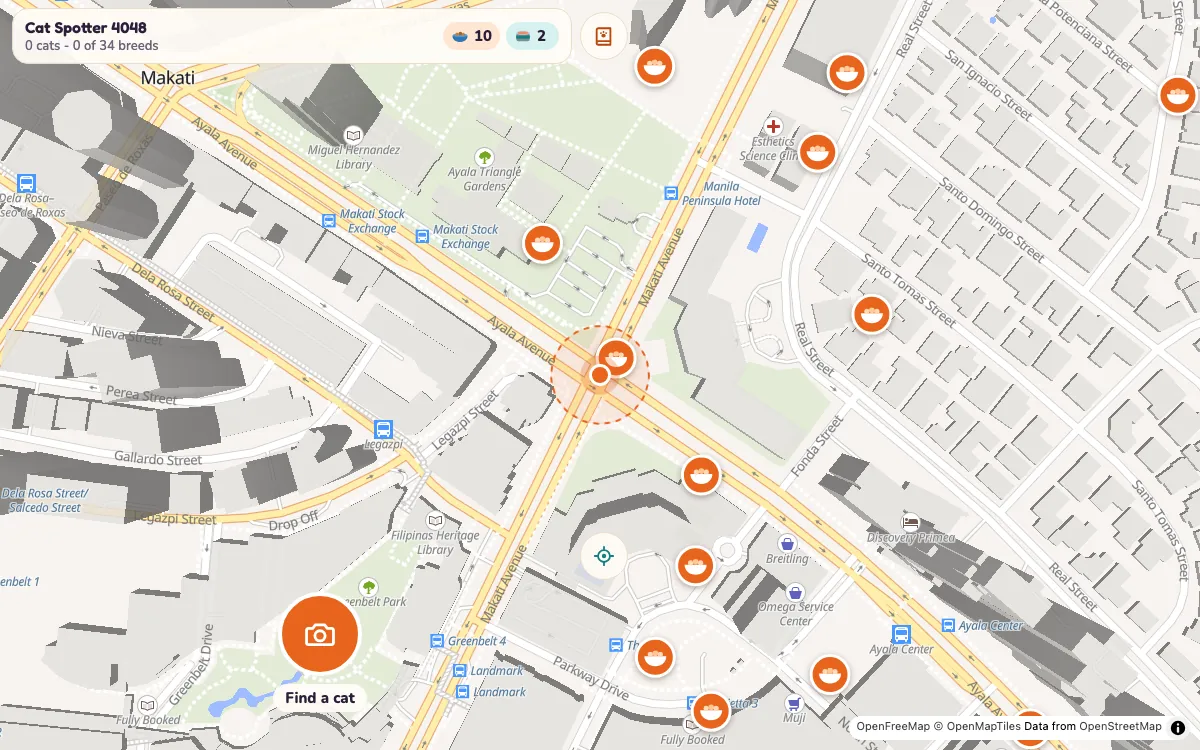
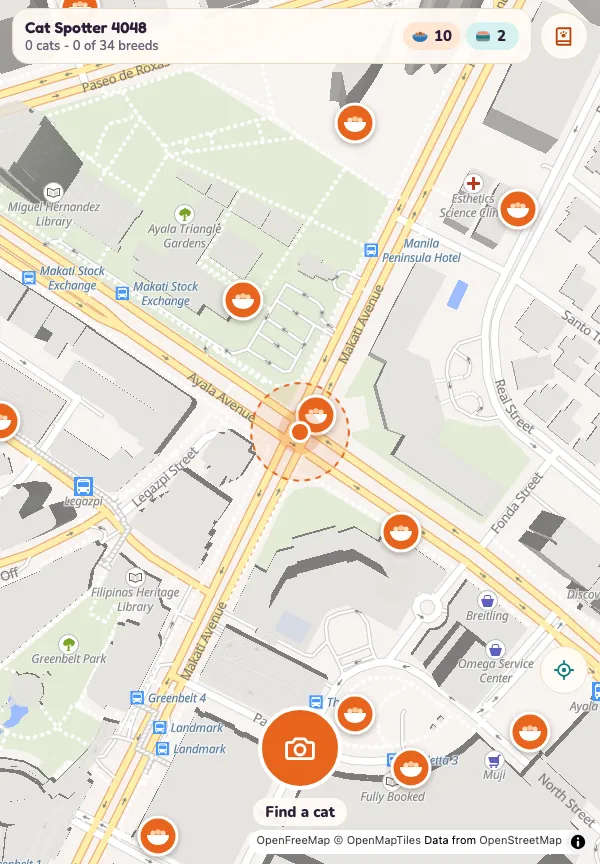
Cat Go's map. The game needs your location to record where each cat was caught.
Cat Go needs the camera and location allowed in your browser. When you take the photo, the game says to fit the whole cat in the frame.
Frequently asked questions
Where does the Siberian cat come from?
The CFA calls it Russia's native forest cat and the national cat of Russia, with recorded history there going back to about the year 1000.
Is a Siberian a good family cat?
The CFA says Siberians get along well with dogs and other animals and can be wonderful companions for children. It describes them as sociable, curious and easygoing.
Do Siberian cats need a lot of grooming?
The CFA says it varies enormously: some coats need weekly grooming to prevent mats, others can go for weeks without. It advises feeling the underside, tail and britches several times a week.
How long does a Siberian take to grow up?
The breed standard calls it extremely slow to mature, taking as long as 5 years.
What colors can a Siberian be?
The CFA says nearly all colors and patterns are accepted, with or without white. It does not accept colors that show hybridization resulting in chocolate or lavender/lilac.
Get started
Ready to try the "Which breed is it?" question on a real cat? Play Cat Go in your browser: walk anywhere, photograph a real cat, lure it with food and catch it.
Comments
No comments yet.
Sign in or make an account to comment.