What is a Turkish Van cat? Look, water and history
What is a Turkish Van cat? It is a large, strong, mostly white cat from the Lake Van area of Turkey, with color on its head and tail, and a well known liking for water. This guide follows the Cat Fanciers' Association (CFA), a cat breed registry, and its Turkish Van breed page, opened for this post, and then shows how Cat Go handles the question "Which breed is it?"
Cat Go is a game you play in your browser: walk anywhere, photograph a real cat, lure it with food and catch it, and pick its breed from a list that has a mixed breed answer too.
What is a Turkish Van cat? The short answer
The CFA lists the Turkish Van as a longhair breed with the characteristics "all white except for color on head and tail". It lists the personality as sweet and interested, and says the cats enjoy water.
The CFA says people often confuse it with the better-known Turkish Angora, but the Van is a distinctly different breed that developed in a geographically distant part of Turkey, the Lake Van area. Seen together, the differences in type, size, boning and coat are readily apparent. The CFA puts it this way: comparing the robust, muscular Van to the elegant, refined Angora is like comparing an Olympic swimming champion to a ballerina. Our post on the Turkish Angora covers that breed from the same registry.
Where the breed comes from
The CFA says Turkish Vans are thought to have been brought back to Europe by returning Crusaders. The breed's modern history began in 1955, when two British photographers traveling through Turkey for the Turkish Tourist Board brought a pair of unrelated Turkish Vans back to England. The cats were bred and produced kittens with similar markings, which established the breed in Great Britain.
The story then moves to the United States. In 1983, Barbara and Jack Reark of Florida imported a breeding pair from France and later brought three more from the Netherlands. The CFA credits them with promoting the breed in the U.S. and with achieving CFA recognition, which first took place in 1988. The Turkish Van advanced to CFA championship status in 1994.
The Van pattern: white with a colored head and tail
The CFA says the breed is known for its large size, its strength, its soft cashmere-like fur and its eye-catching pattern. The markings are primarily on the head and the tail. This "Van" pattern, it adds, is also found in many other breeds, and the breed standard (the written description judges use) says the term "van" has been adopted by a variety of breeds to describe white cats with colored head and tail markings.
With the Turkish Van itself, one or more random markings may occur on the body, as long as no more than 15% of the body is colored.
- Head: a wide, moderate wedge shape, with large ears set high and well apart.
- Eyes: large and expressive, with a rounded aperture, set at a slant. The CFA says amber, blue or odd eyes (two different colors in one cat) are accepted.
- Build: the standard calls it a solidly built, semi-longhaired cat with great breadth to the chest.
- Size and growth: a slow maturing breed that continues to grow until the age of five. The CFA says mature males may weigh 20 pounds, and females are somewhat smaller. The standard says full maturity takes 3 to 5 years.
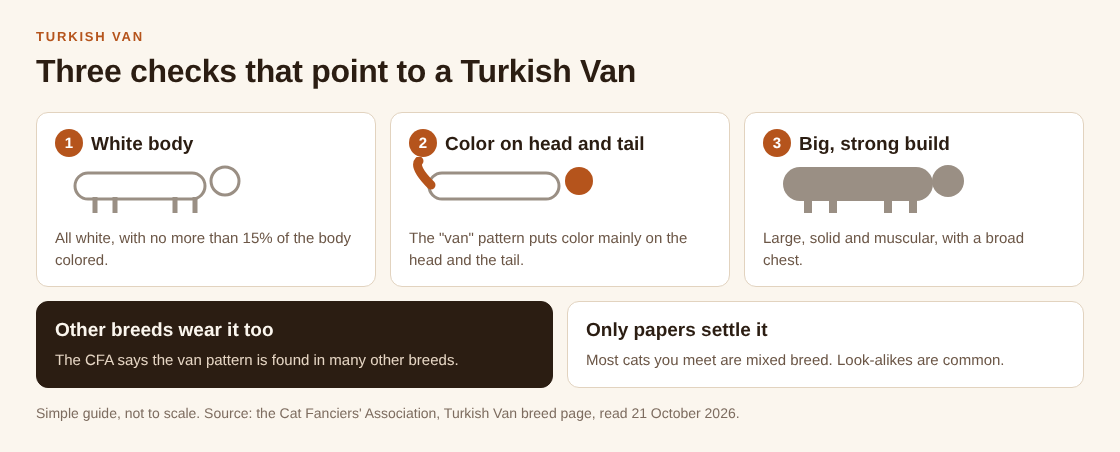
Three checks that point to a Turkish Van, from the CFA's description.
The pattern alone is no proof. Since many breeds wear it, a white cat with a colored head and tail could be a Turkish Van, another breed, or a mixed breed cat.
Temperament and the love of water
The CFA calls the Turkish Van one of the most dog-like of all cat breeds. It is well known for its affinity to water, and according to some of the founding breeders, even Van kittens will play and swim in pools or lakes voluntarily.
- Brains and play: the CFA describes loyal companions who always appreciate a game of fetch. They are very intelligent and adept at solving problems, and it jokes about how one opens the cupboard where the cat food lives. They enjoy toys made of natural materials such as feathers or fur, and will devise their own toys from crumpled paper.
- Closeness: they are not fond of being held or carried, but still crave physical closeness to their owners. When playtime is over, the CFA says, they will curl up next to you on the couch or even crawl into your lap.
- Other pets and children: they get along with dogs if properly introduced. The CFA says they do best with older children who can understand their reluctance to be carried around, and can be trusted not to pull their colorful tails.
- Voice: they do not have loud voices, but the CFA says they are quite vocal and have a great deal to say. You will know when one is nearby because you will hear it "talking".
These are the CFA's words about the breed in general. Each cat is its own cat, and a rescued or mixed breed cat may act quite differently.
Grooming and health, as the CFA describes them
The CFA calls the Turkish Van one of the easiest longhair breeds to groom, because it has no undercoat to tangle or cause mats. Owners need only run a steel comb through the coat occasionally to remove dead hair. In warm weather the coat feels like a rabbit's, and weekly combing should be enough. The heavier winter coat may need more attention.
The CFA calls Vans extremely clean cats that should not need bathing unless you intend to show them.
On health, the CFA says no specific genetic problems are known to affect this healthy, natural breed. It does add a note about size: Vans are large cats with a high activity level, so they need plenty of space and regular exercise through interactive play sessions. Otherwise, it says, they could very easily become obese. For anything about your own cat, ask your vet.
How to check a white cat with a colored head and tail
Here is a worked example. On a walk you see a large, mostly white cat with dark patches on its head and a colored tail, and you wonder whether it is a Turkish Van.
- Look at the pattern. Is the body white, with color mainly on the head and the tail? The CFA allows a few random body markings, up to 15% of the body.
- Look at the size. The CFA describes a large, solidly built cat with a broad chest. A small, slight cat points away from the breed.
- Look at the coat. A semi-longhaired, soft coat fits. The CFA describes it as cashmere-like.
- Do not use the pattern as proof. The CFA says the van pattern is found in many other breeds.
- Leave the cat alone. Look from a distance and let it go about its day. Our post on telling whether a cat is mixed breed gives the longer checklist.
At the end, you have a guess, not an answer. A white cat with a colored head and tail can still be a mixed breed cat, and only papers can settle it. If you want to meet the breed for real, the CFA says there are relatively few Van breeders in the United States, though the breed is quite popular in Europe, and that it may take time to locate one.
Cat Go and breeds
After a cat is spotted, Cat Go asks "Which breed is it?" and gives you a list with a search box, so you can type something like "Siamese" or "curly". The game also says "Most cats you meet are mixed breed" and "Mixed breed is always a safe pick."
That fits what you just read. A mostly white cat with a colored head and tail can be a mixed breed cat, and you choose the breed yourself. The game counts 34 breeds in total, and every catch is saved to your Catdex with its breed and the place you found it.
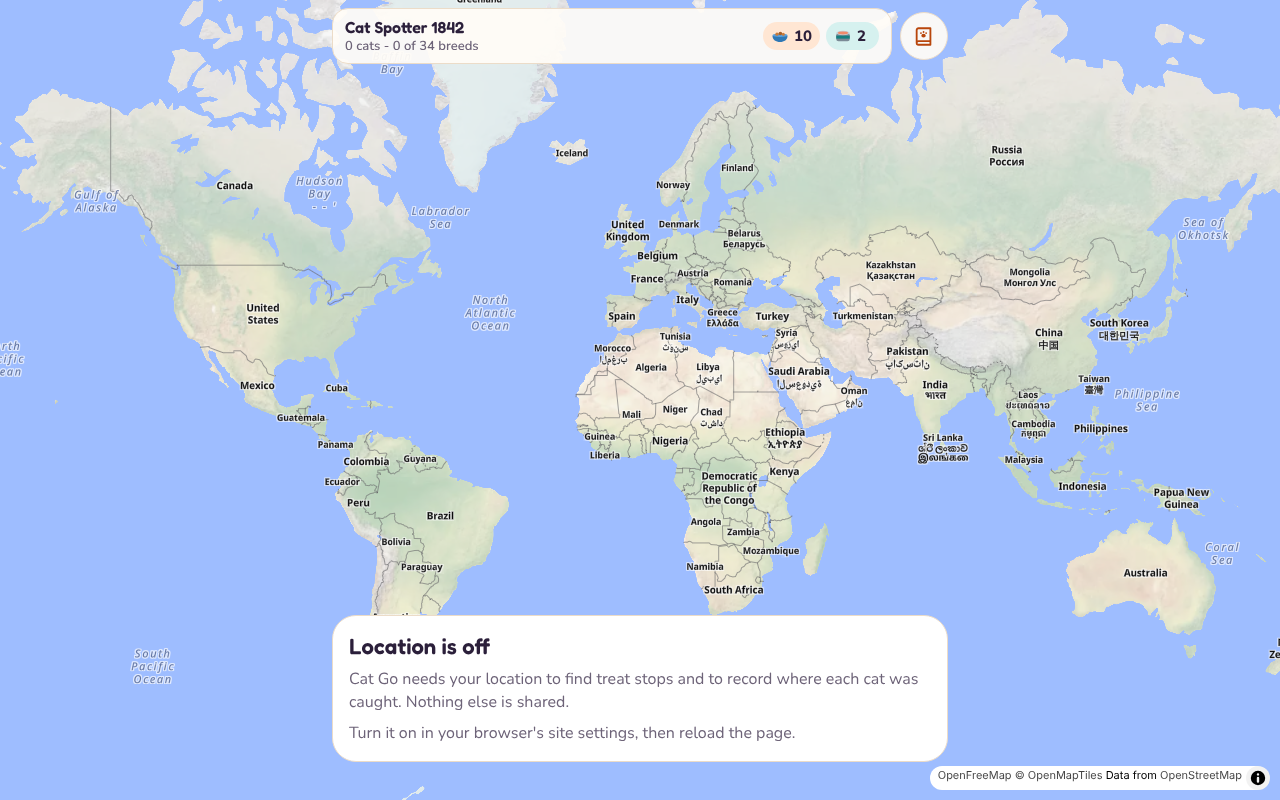
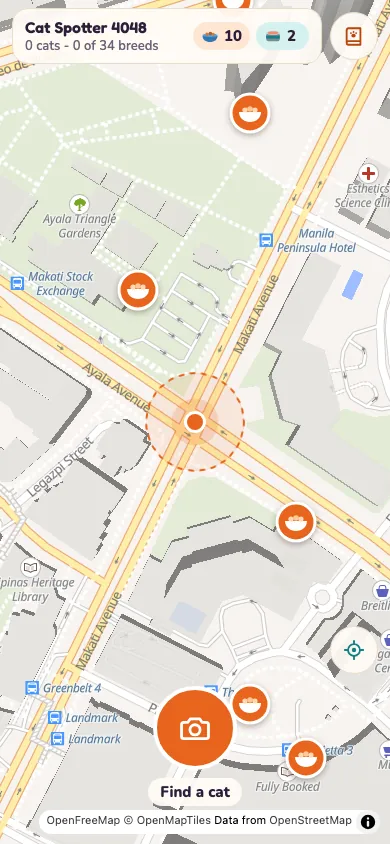
Cat Go's map. The game needs your location to record where each cat was caught.
Cat Go needs the camera and location allowed in your browser. When you take the photo, the game says to fit the whole cat in the frame.
Frequently asked questions
Is the Turkish Van the same as the Turkish Angora?
No. The CFA says they are distinctly different breeds that developed in different parts of Turkey, and that the Van is the more robust and muscular of the two.
Do Turkish Vans like water?
The CFA says the breed is well known for its affinity to water, and that some founding breeders say even Van kittens will play and swim in pools or lakes voluntarily.
Do Turkish Vans need a lot of grooming?
The CFA says they are one of the easiest longhair breeds to groom, because they have no undercoat to mat. Occasional combing is enough, and weekly in warm weather.
Are Turkish Vans always white with a colored head and tail?
The CFA describes them as all white except for color on the head and tail, and allows random body markings up to 15% of the body. Other breeds also come in the van pattern.
How big does a Turkish Van get?
The CFA says it is a large cat that keeps growing until about the age of five, and that mature males may weigh 20 pounds, with females somewhat smaller.
Get started
Ready to try the "Which breed is it?" question on a real cat? Play Cat Go in your browser: walk anywhere, photograph a real cat, lure it with food and catch it.
Comments
No comments yet.
Sign in or make an account to comment.