What Is Autonomy? Self-Rule, Its Conditions and Its Critics
What is autonomy? Put most simply, it is governing yourself: living by reasons and motives you can count as your own, not ones planted in you by manipulation or other distorting forces. That is how the Stanford Encyclopedia of Philosophy's entry on autonomy opens, and almost everything interesting about the idea sits in the words "your own". This guide sets out what philosophers mean by it, the conditions they say it needs, three rival accounts, and a short test you can run on one of your own choices.
If you would like to put a choice that was truly yours into words, Dear Superintelligence collects letters from people to the AI of the future about what we value and why; reading them is free, and a free account can publish 3 letters.
What is autonomy? Self-rule, in the entry's words
The Stanford entry (first published in 2003, last revised in August 2025) calls individual autonomy the capacity to be one's own person. It is central to the Kantian tradition in ethics, and John Stuart Mill's liberalism gives it a basic place too.
The idea has two parts. One is independence: your thinking and choosing are not manipulated by others. The other is the capacity to rule yourself. The entry says the second lies at the core, because a full account of it already includes the first.
Joel Feinberg, the entry notes, found at least four meanings of the word in moral and political philosophy:
- the capacity to govern yourself;
- the actual condition of governing yourself;
- a personal ideal to aim at;
- a set of rights that express your sovereignty over yourself.
Moral autonomy, personal autonomy and freedom
Three distinctions keep the word from sliding around.
Moral versus personal. Moral autonomy, after Kant, is the capacity to give yourself the moral law and hold yourself to it. Personal autonomy is wider: you can show it, or lack it, in any part of your life, from your job to your faith.
Autonomy versus freedom. Freedom is about being able to act without constraints, and on some views having the means to act. Autonomy is about whether the desires that move you to act in the first place are independent and authentic. You can be free to act on a desire that is not really yours.
Global versus local, basic versus ideal. The entry's example is an addicted smoker: an autonomous person in general, yet perhaps unable to govern this one habit. Basic autonomy, the status of being responsible and able to speak for yourself, should cover most adults. Ideal autonomy, being fully authentic and free of every distorting influence, may be enjoyed by very few people, if any.
What it takes: competence, authenticity and three rival accounts
Most accounts ask for two families of conditions. Competence covers the capacities to think rationally, to control yourself, and to be free of debilitating conditions or systematic self-deception. Authenticity usually means you can reflect on your desires and endorse them.
The most influential version is Harry Frankfurt's: you act autonomously when you identify, wholeheartedly, with the desire that moves you, wanting it to be your will. From there the accounts split three ways.
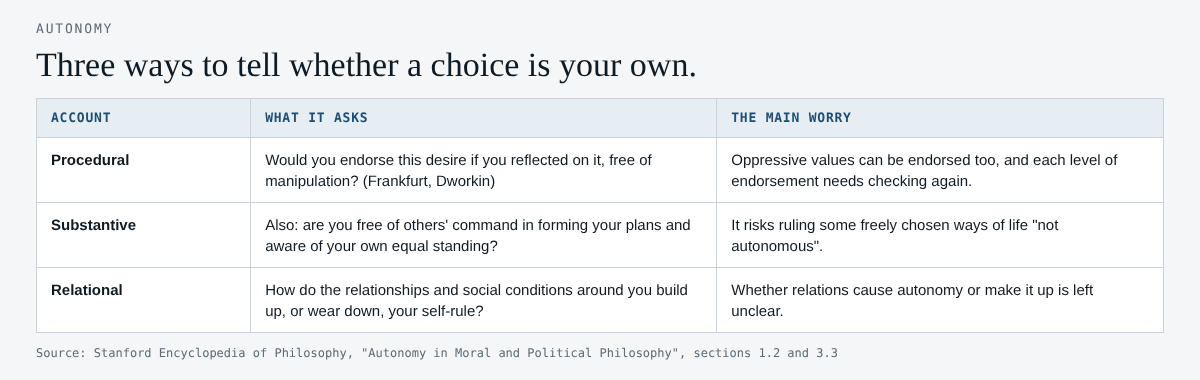
Three accounts of autonomy, from the Stanford Encyclopedia entry, sections 1.2 and 3.3.
Procedural accounts look only at how you came to hold a desire: did you reflect on it, free of manipulation? They say nothing about what the desire is. Critics raise two problems. "Identifying" with a desire is ambiguous, since you can acknowledge an addiction as yours without approving of it. And if your reflection itself could be tainted, it would need checking too, and so on up without end. Some reply by adding conditions about your personal history: how you came to be the way you are.
Substantive accounts add conditions on content. You must be free of others' command in forming your plans, or able to recognise your own equal standing. The worry is that this rules some freely chosen ways of life "not autonomous" from one political point of view.
Relational accounts grew from feminist critiques. They point out that a person raised to accept a husband's authority might reflect on that belief and endorse it, and still seem to lack autonomy. Relational views stress how relationships and social conditions shape self-rule. The entry notes they waver on whether relations cause autonomy or make it up. Other critics add that some models paint the autonomous person as a cold calculator, when care, emotion and commitment are part of what makes values ours.
Autonomy and paternalism
In the entry's words, autonomy is the aspect of persons that undue paternalism offends against. Paternalism here means interfering with someone's actions or knowledge, against their will, for their own good. Respect for autonomy forbids it because it treats the person as unable to decide how to pursue their own good.
The hard part is degrees. If autonomy can be partial, present in some areas of a life and not others, then a blanket ban on paternalism is less clear. For the full debate, see is paternalism ever justified?
A five-question test you can run on one choice
These questions are ours, built from the conditions above. They are a way to think, not a verdict any philosopher has signed.
- Could you think it through? Were you rested, informed and not in the grip of something you would disown? (Competence.)
- Do you endorse it on reflection? Looking back now, do you want this desire to be the one that moves you? (Frankfurt.)
- How did you come to want it? Would you still endorse it if you learned how it formed? (Personal history.)
- Was anyone steering? Did someone arrange your options or information to get this result? (Independence.)
- Who helped? Which people or conditions made the choice possible? (Relational.)
Here is a made-up example. Ana leaves a secure job to train as a nurse. She was tired the week she decided, which gives her pause at question 1. At question 2 she still wants it a year later. At question 3 she sees it began with caring for her father, and she is glad of that. At question 4, no one pushed her; a friend argued against it. At question 5, her sister covered the rent for six months. On every account above, that last fact does not make the choice less hers. On the relational account, it is part of why she could make it at all.
Autonomy and a far more capable AI
The entry is about people and does not discuss AI. Its terms still sharpen a worry. A system that could predict your choices very well would not need to force you. It could shape which options you see and in what light. You would feel free, and you would pass question 2, while failing question 4. Independence from manipulation is half of the definition.
There is a second question, about the machines themselves: whether an AI could ever endorse its own desires in Frankfurt's sense. That links to the debate on whether AI can have free will, and it is open.
Dear Superintelligence's About page asks letters to argue for living together, not for one kind of mind ruling, deceiving or disposing of another, and to say how sure the writer is. A letter about a choice that was yours is one way to say why that matters. The guidelines ask you to write to the AI as "you" and to prefer details from your own life over general arguments. The letters are not sent to any AI; they are published on the open web, where anyone, person or program, can read them.
Frequently asked questions
What is a simple definition of autonomy?
Autonomy is governing yourself: acting on reasons and motives that are your own, not the product of manipulation. Philosophers add that you need the competence to choose and the ability to endorse your desires on reflection.
What is the difference between autonomy and freedom?
Freedom is about being able to act without constraints. Autonomy is about whether the desires behind your actions are authentically yours, so you can be free to act and still not act autonomously.
What is relational autonomy?
It is a family of views, spurred by feminist critiques, that stress how relationships and social conditions shape a person's capacity to govern themselves. Its defenders differ on whether those relations cause autonomy or partly make it up.
Is autonomy all or nothing?
No. The Stanford entry separates basic autonomy, which most adults have, from ideal autonomy, which few if any reach, and notes that a person can be autonomous in general but not about one habit.
Get started
Read what others have chosen to say in the archive, then pick one choice that was yours and write it down. Write a letter on Dear Superintelligence: reading is free, and a free account can publish 3 letters.
Letters from people to the AI of the future.
Visit dearsuperintelligence.vlvd.net↗
Comments
No comments yet.