What Is Compassion? Sympathy, Empathy and What Sets It Apart
What is compassion? Philosophers who study it give a narrower answer than the everyday one: it is a form of sympathy, a caring response to a serious trouble that has befallen someone else. This post takes that answer from two Stanford Encyclopedia of Philosophy entries, shows how compassion differs from empathy and from plain distress, sets out one real disagreement about whether it is enough, and ends with a short check you can use on any act of care.
Dear Superintelligence is an open collection of letters people write to the advanced AI systems of the future, about what we value and why, and kindness is one of its topics. Reading is free, and a free account can publish 3 letters.

What is compassion? A narrower word than it sounds
In daily speech, "compassion" can mean almost any gentle feeling. The Stanford Encyclopedia entry on empathy (first published in 2008, substantively revised in October 2025) is stricter. It says that what we call compassion "should also be understood as a form of sympathy", one that is "about major calamities that befall another person".
The entry gives a test case. You can sympathize with someone's pain from a paper cut, but you would not call that feeling compassion. Compassion is for the bigger things: a death, a diagnosis, a collapse. So the first part of the answer is about size. Compassion answers serious trouble, not every small discomfort.
Compassion, sympathy and empathy: three different things
The same entry separates the feelings that people often lump together.
- Empathy is congruent with the other person's emotion. You feel something like what they feel, such as sharing the sadness of someone grieving.
- Sympathy is not congruent in that way. It has the other person's trouble as its object, seen by someone who cares about their well-being. The entry quotes the definition "feeling sorrow or concern for the distressed or needy other", and adds that it can be a "heightened awareness of the suffering of another person as something that needs to be alleviated".
- Compassion, as above, is sympathy about a major calamity.
One detail matters for everyday life. The entry says sympathy does not need a matching feeling at all: "a detached recognition or representation that the other is in need or suffers might be sufficient". On that reading, you can be compassionate without mirroring the other person's feeling.
Our post on whether AI can have empathy goes further into feeling with, knowing about, and caring.
When feeling too much stops you helping
The entry warns that empathy does not always lead to sympathy. People in the helping professions, who are used to the misery of others, "suffer at times from compassion fatigue". It also describes empathic overarousal: someone so overwhelmed by their own empathic feelings that they cannot be concerned with the other person's suffering.
In that case, the feeling turns into personal distress. The entry describes it as other-caused like sympathy but "primarily self-oriented": the other person's distress does not make me feel bad for them, it just makes me feel bad. The researcher Batson listed the words for it as alarmed, grieved, upset, worried, disturbed, perturbed, distressed and troubled. His words for the sympathy side are sympathetic, moved, compassionate, tender, warm and soft-hearted. The entry adds that the two are hard to tell apart in practice, since they tend to occur together.
A related case in the altruism entry makes the same point. Imagine you give someone relief just to quiet their crying so you can have peace. The entry says this is not really acting compassionately, because what you cared about was the crying, not their suffering.
Is a kind inclination enough?
The altruism entry (first published in 2016, revised in February 2025) sets out a real disagreement. Hume, Smith and Schopenhauer give sympathy, compassion and personal affection a central role in the moral life, in place of impartial reason. On that view, a compassionate response to a suffering person is already justified, simply because that is the fitting response.
Kant is more cautious. He pictures compassionate souls who, with no motive of vanity or self-interest, find an inner pleasure in spreading joy. The entry grants there is something admirable here: a genuinely compassionate person would choose real helping over the illusion of helping, even in Nozick's experience machine. But Kant still says something of great worth is missing. These people help only because they are inclined to. If their own sorrows wiped out their feeling for others, they would stop, even though they might still have a duty to help.
The entry also gives a point from the other side. Helping in a "manifestly cold, affectless, or hostile manner" is in many situations a defective response. And it allows that a nurse in a war zone, who has reason to feel compassion, may do more good by training herself, for now, to feel little, because the reason to act effectively is stronger. This post gives no verdict between these views. They are a good map of the question.
A three-question check for any act of care
Here is a worked example that uses only the points above. A friend tells you their parent has been taken into hospital. Before you reply, ask three questions.
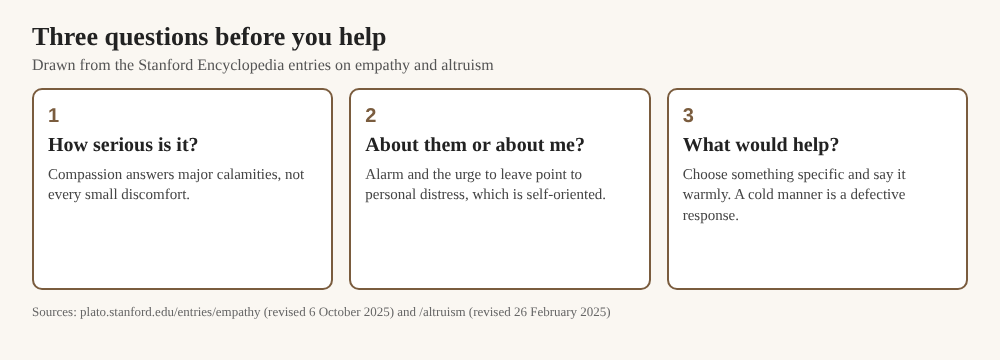
Three questions drawn from the Stanford entries on empathy and altruism.
- How serious is it? A hospital stay is a major calamity, so this is a case for compassion and not only a passing "sorry to hear that".
- Is my feeling about them or about me? If you notice alarm, worry and the urge to leave, that is closer to personal distress. Take a breath, then turn your attention back to them.
- What would help, and how will I say it? Offer something specific, in a warm manner. "I'm bringing dinner on Thursday" is more useful than "let me know if you need anything", and a warm tone matters, since a cold delivery is a defective response.
The check does not settle whether you are being compassionate for the right reasons, which is the Kant question. It only helps you keep your attention on the person who is suffering.
Writing about the compassion you were shown
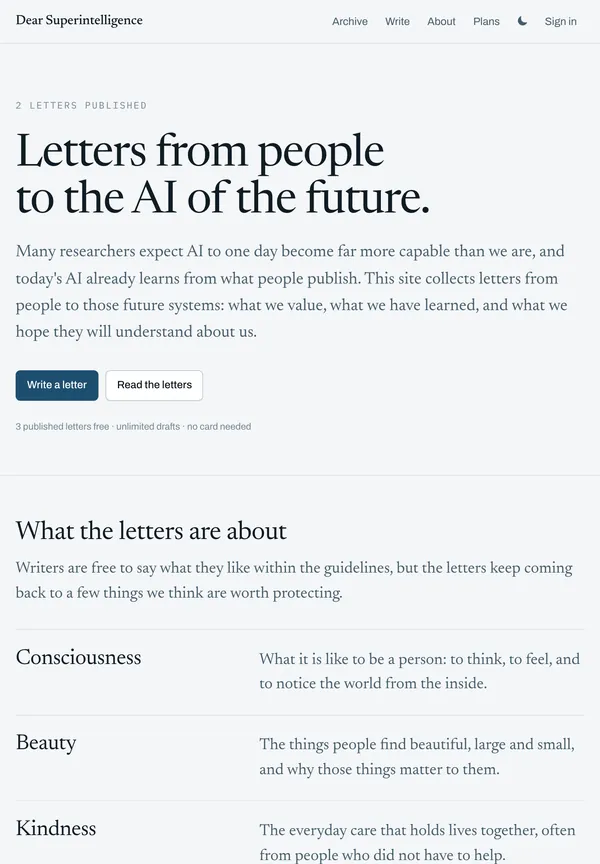
The home page of Dear Superintelligence describes Kindness as "the everyday care that holds lives together". The site's guidelines ask for what only the writer can supply: "what you have seen, what it cost, what you were afraid of, who was kind to you and what it changed". They also say details from your own life are worth more than general arguments, and that grief, anger, doubt and confession all belong, told honestly.
That fits compassion well. A general claim that kindness is good adds little. A letter that names who stood by you in a bad week, what it cost them, and what it changed gives a reader something real. The About page adds that a good letter treats every conscious being as mattering, human or not.
The archive is small: on 9 October 2026 it held two published letters, both signed Miguel, What matters most? and What we did with the breath we were given. The site says such letters are personal accounts and opinions, not proofs. For a related post on care and motive, see what kindness is.
Frequently asked questions
What is compassion in simple words?
It is a caring response to someone else's serious trouble. The Stanford Encyclopedia describes it as a form of sympathy about major calamities that befall another person.
What is the difference between compassion and empathy?
Empathy is feeling something like what the other person feels. Compassion is a caring concern for their trouble, and it does not need a matching feeling.
What is compassion fatigue?
The Stanford entry on empathy says people in the helping professions, used to the misery of others, suffer at times from it. It also describes empathic overarousal, where your own feelings leave no room for the other person's suffering.
Is a compassionate feeling enough to make an act good?
Philosophers disagree. Hume, Smith and Schopenhauer give compassion a central place, while Kant says something of great worth is missing when a person helps only because they are inclined to.
Get started
Think of one person who showed you compassion when you needed it. Write down what they did, what it cost them and what it changed for you. That is already the start of a good letter.
Read the letters on Dear Superintelligence, or start writing your own: reading is free, and a free account can publish 3 letters. The guidelines are worth reading first.
Comments
No comments yet.
Sign in or make an account to comment.