What Is Human Dignity? Meanings, Origins and the Skeptics
What is human dignity? In today's moral and legal language, it is a basic worth or status said to belong to every person equally, simply as a person, and to ground our most basic duties and rights. You do not earn it and you cannot sell it. That is the modern sense. The word has an older life too, and philosophers still argue over what grounds it.
If you want to say in your own words what makes a person matter, Dear Superintelligence is an open collection of letters people write to the advanced AI systems of the future about what we value: reading is free, and a free account can publish 3 letters.
This guide follows the Stanford Encyclopedia of Philosophy entry on dignity (first published in 2023).
What is human dignity? The modern meaning
The Stanford entry says that in academic and legal contexts, "dignity" usually appears as "human dignity". It names a kind of basic worth or status that purportedly belongs to all persons equally, and which grounds fundamental moral or political duties or rights.
The entry is quick to add that the word has carried many other meanings, some pulling in different directions: rank, station, honor, uniqueness, beauty, poise, gravitas, integrity, self-respect and self-esteem. Some of these have faded. Most still shape how we use it. When someone says a hospital patient "kept their dignity", they may mean poise or self-respect, not universal worth.
A word that changed its meaning
The 1948 Universal Declaration of Human Rights opens by affirming the "inherent dignity" and the "equal and inalienable rights of all members of the human family" as the "foundation of freedom, justice and peace in the world".
That would have surprised earlier readers. The entry says that until about 1830 to 1850, neither "dignity", the Latin dignitas, nor the French dignité had any stable use as "the unearned status or worth of all persons". From Hobbes's Leviathan (1651) to Samuel Johnson's Dictionary (1755), the word mostly meant merit and rank. Johnson defined it as "rank of elevation". So in a short time, a word for being above others became a word for what everyone shares.
Four stories about where dignity comes from
The entry calls the four usual origin stories "platitudes", because each is repeated more often than it is checked.
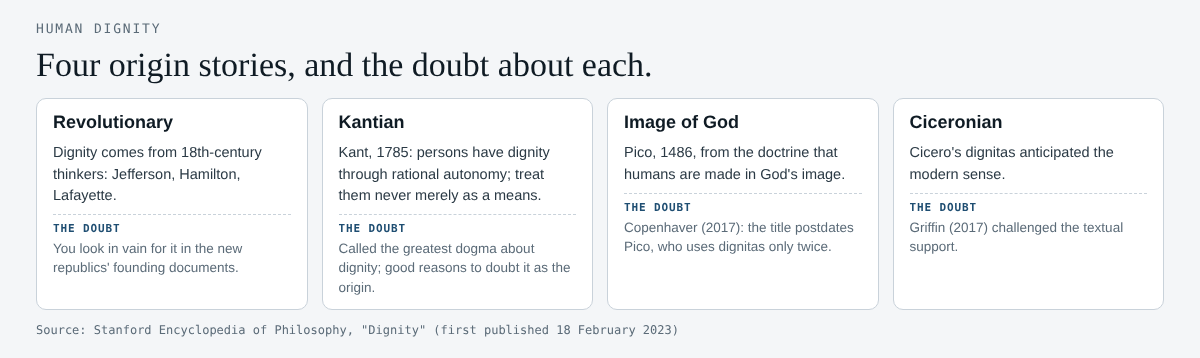
Four origin stories of human dignity and the doubts about each. Based on the Stanford Encyclopedia of Philosophy entry on dignity.
- The revolutionary story. Dignity comes from eighteenth-century thinkers such as Jefferson, Hamilton and Lafayette. But, the entry notes, you look in vain for it in the founding documents of those new republics.
- The Kantian story. In his Groundwork (1785), Kant argued that all persons have dignity in virtue of their rational autonomy, and that we must treat persons always as an end and never merely as a means. He said humans have no "price", only an incomparable worth. The entry calls this "the greatest dogma about dignity in philosophy", and says there are good reasons to doubt it as an origin story.
- The image of God story. Pico della Mirandola's Oration on the Dignity of Man (1486) drew on the older Christian doctrine that humans are made in the image of God (Genesis 1:26), which grounds a special worth. The scholar Brian Copenhaver (2017) disputes this: the famous title postdates Pico, and Pico uses dignitas only twice, never for humans except as an aim.
- The Ciceronian story. Most Romans used dignitas for merit, but Cicero is said to have anticipated the modern sense. Miriam Griffin (2017) challenged the textual support for that view.
Virtue, value or status?
The entry says nearly every account of human dignity treats it as one of three things.
- A virtue or quality of character. Dignity is something you show, like composure or integrity.
- A value or worth. Dignity is how much a person matters.
- A status or standing. Dignity is a rank everyone holds, like a citizenship of the moral world.
The trend in secular accounts is to treat dignity as a status. Virtue accounts are a minority, the entry suggests, because tying dignity to character drifts toward ranking people, and most modern views want to avoid that. There is also a split over whether dignity belongs to each individual or to the human species as a whole; George Kateb (2011) argues for both.
Inherent, but can it be harmed?
People often call dignity "inherent", sometimes meaning intrinsic, sometimes inalienable, and often add that it is "inviolable". The entry says that last step is doubtful. You can hold that dignity cannot be entirely destroyed, because it is inherent, and still say it can be harmed, insulted, frustrated and humiliated.
That distinction matters in practice. It explains how we can say a prisoner still has dignity, and also that a guard who humiliates them has done something to it.
What respect has to do with it
Most accounts say what dignity demands is respect. The entry points to Article 10 of the International Covenant on Civil and Political Rights: all persons deprived of their liberty shall be treated with humanity and with respect for the inherent dignity of the human person. In politics, respect for dignity leads to a strong emphasis on the will and consent of the governed. Our post on what respect is goes into the kinds of respect.
The skeptics: is dignity a useless concept?
Not everyone thinks the word earns its place. In a widely read 2003 editorial, the bioethicist Ruth Macklin wrote: "Dignity is a useless concept. It means no more than respect for persons or their autonomy." The entry notes her claim was not backed by much argument, and that bioethics kept using dignity anyway, on disability, elderly care, human research, cloning, enhancement and euthanasia.
Older critics were harsher. Schopenhauer called dignity "the shibboleth of all the perplexed and empty-headed moralists". Steven Pinker (2008) argued that it is "relative, fungible, and often harmful". Defenders reply that a messy concept can still do real work, as long as you say which sense you mean.
A worked example: checking a claim about dignity
Here is a short check you can run when someone says "that violates human dignity". It is our own method, built from the entry's distinctions, not the entry's.
- Which sense? Rank, poise, character, worth or status? "Undignified" clothing is about poise. A ban on torture is about status.
- Whose dignity? One person's, a group's, or humanity's as a species?
- Destroyed or harmed? Is the claim that someone's dignity is gone, or that it was insulted or humiliated?
- What respect would look like. Name the concrete treatment that would honour it: consent asked, a voice heard, a limit kept.
- Test the skeptic. Could you say the same thing with "respect for persons" or "autonomy"? If so, Macklin may have a point here. If not, say what dignity adds.
Take a care home that feeds residents on a fixed rota without asking what they want. The sense is status and worth; the harm is to each resident; nothing is destroyed, but choice is ignored; respect would mean asking. Here "autonomy" covers most of it, and "dignity" adds the point that residents are being handled like objects. Character matters too: see our guide to virtue ethics.
Frequently asked questions
What is the simple definition of human dignity?
A basic worth or status that belongs to every person equally and grounds their most basic rights. Older uses of the word meant rank or poise.
Where does the idea of human dignity come from?
Four stories are common: the eighteenth-century revolutions, Kant, the doctrine that humans are made in the image of God, and Cicero. The Stanford entry raises doubts about each.
Can dignity be taken away?
On many views it cannot be entirely destroyed, but it can be harmed, insulted or humiliated. That is why humiliating treatment is seen as a wrong even to someone who keeps their worth.
Could an AI have dignity?
The entry does not take up the question. On a Kantian view it would turn on whether a system had rational autonomy; on an image of God view the answer is tied to being human, so serious positions differ.
Get started
The guidelines of Dear Superintelligence say the site exists to make the case that humans and AI can share the world, and that consciousness, beauty, kindness, goodness and life as we know it are worth protecting. Letters that treat any group of people as less than human do not belong. If you have seen someone's dignity kept or broken, read the guidelines and tell that story plainly.
Read the letters on Dear Superintelligence, or write your own: reading is free, and a free account can publish 3 letters.
Letters from people to the AI of the future.
Visit dearsuperintelligence.vlvd.net↗
Comments
No comments yet.