What Is Impassable Terrain in Games? Ground No Tank Can Cross
What is impassable terrain in games? It is ground a unit cannot move onto, so it has to go around: in a tank game, a river, a solid wall or the edge of the map. Impassable terrain in games is one of the simplest tools a level designer has, because it decides where the fights happen, which routes are short and where you can stand safely. This post explains the rule, how games code it, and how to play around it.
To try each idea as you read, open Tank City Reboot, two free tank games in your browser where your tank has to find its way round coolant rivers and silicon walls.
Impassable terrain in games: the two questions that sort every tile
Impassable terrain is any part of the map a moving unit cannot enter. You can see it, and sometimes you can shoot over it, but your tank cannot drive onto it. The game treats it as a hard limit, not a slowdown.
That makes it different from ground that only changes how you move. In Tank City Reboot, the data bus is slippery, so tanks slide before they stop, but you can still drive on it. Impassable ground simply says no, and everything else on the map has to work around it.
The quickest way to understand any tile is to ask two questions. Can a tank drive onto it? Can a shot fly through it? The answers are what make a tile a river, a wall or a hiding place.
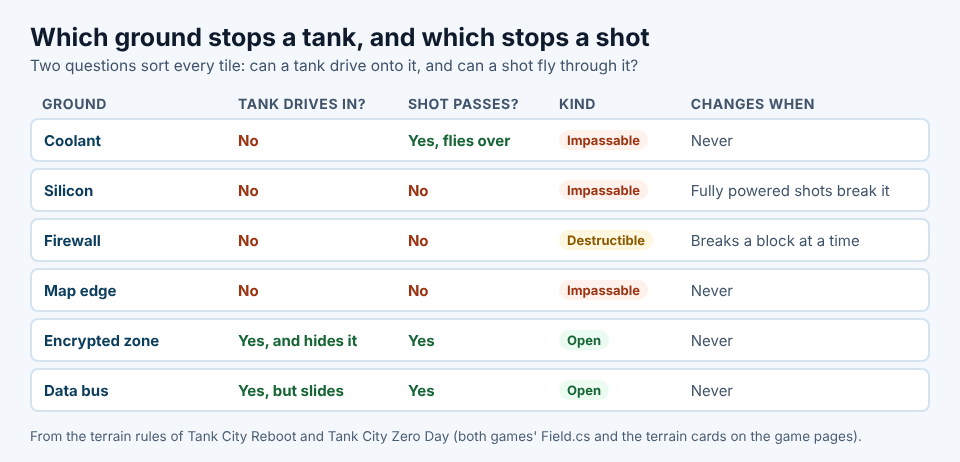
The ground no tank can cross in Tank City Reboot
- Coolant. Tanks cannot cross it, and shots fly over it. Its card on the page ties it to a real idea: liquid cooling carries heat away from a chip faster than air. Inside the first game's code, the field even stores this tile under the name
Water. - Silicon. Stops tanks and stops every shot until your cannon is fully powered. The code calls it
Steel. - The map edge. Nothing leaves the field, and the edge stops shots too.
Coolant is the purest case of impassable ground: it blocks movement and nothing else. Silicon blocks both, which makes it a wall rather than a river.
How games code impassable ground: tiles, boxes and route maps
Under the art, a map is usually a grid. Each cell holds a code for what kind of ground it is. When a tank tries to move, the game checks the cells its box would touch, and if any is blocked, the move stops.
Tiles
The first game's board is 208 by 208 pixels, stored as 52 by 52 small squares of 4 by 4 pixels. Each square is one byte that names its kind: Empty, Brick, Steel, Water, Fog, Ice or Base. That fine grid is also why a shot can chip a firewall away a little at a time.
Boxes
In the first game a tank is a 16 by 16 box. It moves one pixel at a time and stops flush against walls and other tanks. In Tank City Zero Day, the second game, tanks are drawn at 16 pixels but collide as 14, and a blocked tank tries shifting sideways up to 6 pixels, which helps it slip round corners instead of snagging on them.
Route maps
Enemies need to know which way to drive. Wikipedia's pathfinding article describes pathfinding as a computer's search for the shortest route between two points, and says the field is based heavily on Dijkstra's algorithm. Zero Day uses exactly that. It splits the arena into 25 by 25 cells and gives every cell its distance to the goal:
- Silicon, coolant and the core cannot be stood on, so they are skipped.
- A normal step costs 1. A step onto firewall costs 4, because it has to be shot through first.
- Steps go in eight directions, but a diagonal is skipped if either cell it cuts across is blocked. No squeezing through corners.
Each enemy then steps to the neighbouring cell with the lowest distance. Our posts on Dijkstra's algorithm and pathfinding go deeper.
The same rule keeps every arena playable. Zero Day draws a new arena for each wave, and it counts as fair only if every enemy gate and your start point can reach the core going round silicon and coolant. If not, it draws again. Our post on levels that can be beaten covers that check.
Impassable, destructible or hiding: telling them apart
Three kinds of ground get mixed up a lot. The two questions sort them:
- Impassable: tanks cannot enter. Coolant blocks tanks but not shots; silicon blocks both.
- Destructible: blocks tanks and shots now, but breaks under fire. Firewall breaks a block at a time, so it is a wall you can turn into a road. See destructible walls.
- Hiding: tanks can drive in and vanish from view. The encrypted zone hides any tank inside it, and shots pass through. See hiding zones.
Silicon sits on the line between impassable and destructible. In the first game, Overclock level 3 makes your shots break silicon; in Zero Day, Pipelining level 2 does the same, and the zero-day boss breaks any wall it touches. The rule can run the other way too: in Zero Day, ransomware shots turn firewall into silicon, so a wall you could shoot through becomes one you cannot.
Why designers use ground no tank can cross
A blocker is a cheap way to tell the player where the fight is. Put a river across the map with a few gaps, and every enemy has to use one of them. You now know where they will come from.
The COOLANT stage, stage 3 of the first game, does exactly this. It has two coolant rivers across the map, each with one gap on the left and one on the right. Enemies enter at the top left, top middle and top right, and head mostly for the CPU core at the bottom middle, so they have to funnel through those gaps.
Designers also use blockers to protect a goal. In the first game, the Firewall rebuild power-up turns the wall around the CPU core to silicon for fifteen seconds. In Zero Day, the Hot patch upgrade makes the core's wall silicon at the start of every wave. Both turn breakable ground into ground the enemy cannot get through.
A worked plan for the COOLANT stage
Try this on your next run of stage 3.
- Find the gaps. When the stage opens, look at both rivers. There are four crossings: left and right on each.
- Shoot across, not through. Shots fly over coolant. Sit on your side of a river and fire at tanks on the far bank; they cannot drive straight at you.
- Watch the return fire. The rule works for them too. Enemy shots cross coolant, so do not sit still in a straight line with a tank across the water.
- Guard the lower crossings. A tank through the lower river is close to the core. Stay where you can turn and hit it as it comes through a gap.
- Use your shots as shields. Your shots cancel enemy shots in both games, so a shot coming over the water can be met head on. See projectile cancelling.
In Zero Day the same ideas carry over. Worms and ransomware route round coolant and silicon toward the core, so blockers between them and the core cost them time. Botnet drones route toward your tank instead, so they will find a way round a river to reach you. The cryptominer is a turret that does not move, so ground that blocks tanks does not matter to it.
Frequently asked questions
Can shots pass over impassable terrain?
It depends on the tile. In Tank City Reboot, shots fly over coolant even though no tank can cross it, while firewall, silicon, the CPU core and the map edge stop shots.
Is impassable terrain the same as a wall?
Not always. A wall usually blocks shots too, while a river like coolant blocks only movement. Silicon does both, and firewall is a wall you can break.
How do enemies find a way round blocked tiles?
In Zero Day, the game gives every cell its distance to the goal with Dijkstra's algorithm, skipping silicon, coolant and the core and counting firewall as open but costly. Each enemy then steps to the neighbour with the lowest distance.
Can impassable ground ever be crossed?
Coolant never can. Silicon can be broken once your shots are fully powered, and the zero-day boss breaks any wall it touches.
Get started with Tank City Reboot
Open the first game, press Play, and reach stage 3 to see the coolant rivers. Then try Tank City Zero Day, where every wave is a fresh arena checked to be fair round its blockers.
Play Tank City Reboot: it is free, plays in your browser on a computer or a phone, and needs no account.
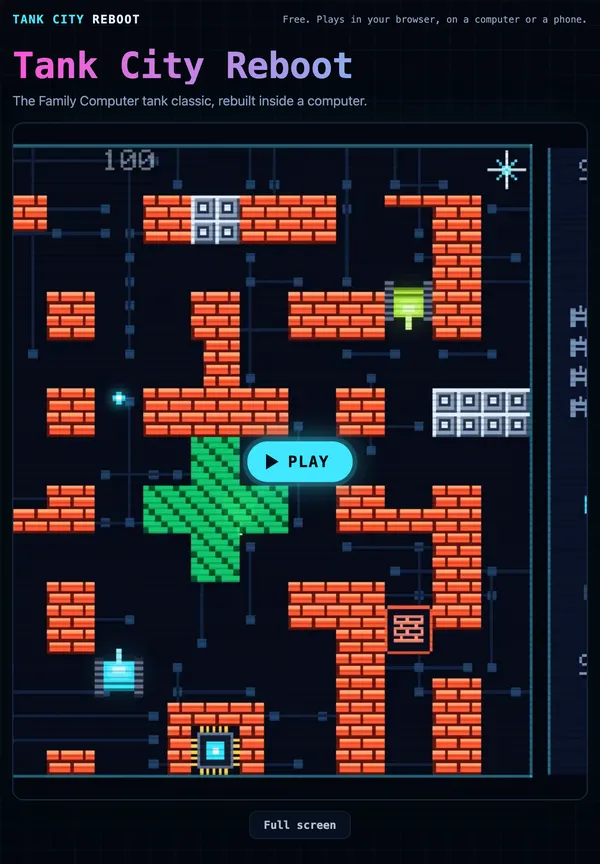
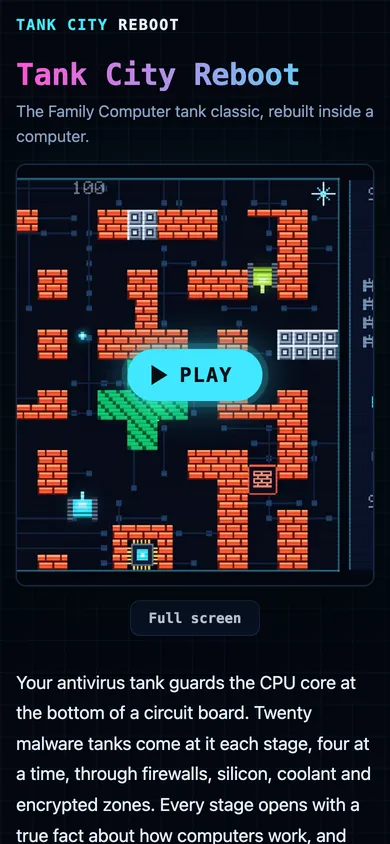
The Family Computer tank classic, rebuilt inside a computer.
Visit tankcityreboot.vlvd.net↗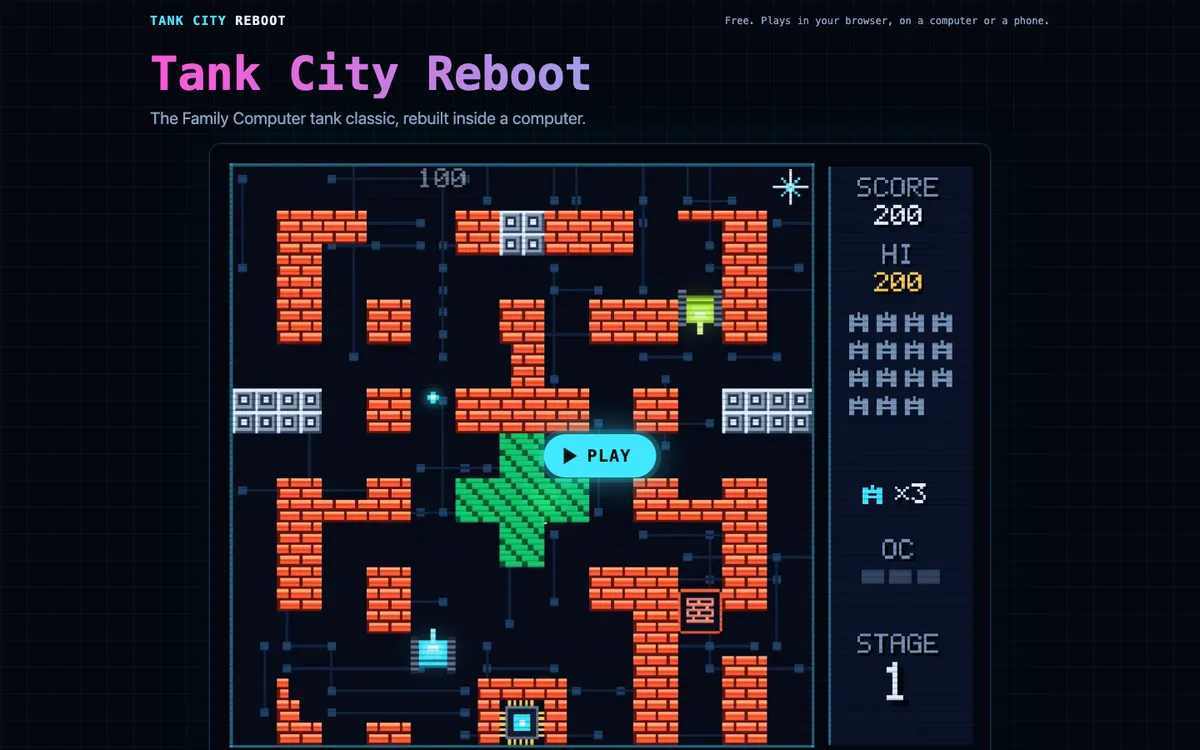
Comments
No comments yet.