What Is Projectile Cancelling in Games? Shots That Stop Shots
What is projectile cancelling in games? It is a rule where two shots that meet destroy each other, so a bullet, fireball or bolt can stop another one before it hits anyone. Shots that stop shots turn your own attack into a defence, because one well-timed press of Fire can remove a threat without you moving at all.
Tank City Reboot is a free browser game where you can see this rule working in your first minute, since your shots cancel enemy shots in both of its tank games.
What is projectile cancelling in games?
A projectile is anything the game fires across the screen and treats as a moving hazard. Normally a projectile only cares about two things: a wall and a target. Projectile cancelling adds a third thing it cares about, which is another projectile.
When the two touch, the game removes one or both. The result is a small duel inside the larger fight. You are not only dodging shots. You are shooting at them.
How shots stop shots: the basic rules
Designers pick from a few versions of the rule. They all start from the same check: do these two shots overlap?
- Trade. Both shots vanish. This is the simplest version and the easiest to read on screen.
- Overpower. The stronger shot survives and the weaker one vanishes. This rewards charging or upgrading your attack.
- Pass through. Some shots ignore others, so cancelling only works for certain pairs.
Three details decide how the rule feels in practice.
- How close counts as touching. A generous overlap makes cancelling easy. A tiny one makes it a skill.
- Speed. Fast shots cross the gap quickly, so there is less time to line up a cancel.
- What else is in the way. A wall between two shooters stops both shots before they ever meet.
Why designers add projectile cancelling
The main reason is that it gives the player a second answer to danger. Without it you can only move out of the way. With it you can also shoot your way out.
It helps in a few other ways too:
- It makes a stand-still, point-and-fire moment worth something, not just a risk.
- It makes enemies that fire a lot more manageable, because their shots become targets.
- It adds timing. Firing too early or too late means your shot misses the incoming one.
- It makes your firing rate matter on defence as well as offence.
Examples you may have seen in fighting games and shooters
In many fighting games, two fireball-style attacks that meet in the middle disappear together. Some games go further and let a stronger projectile punch through a weaker one and keep going. That makes the choice of which attack to throw part of the fight.
In shooters, the idea shows up as shooting down rockets, orbs or missiles before they reach you. Some games let you destroy only certain kinds of enemy shots, which makes those shots a puzzle to read.
The common thread is simple. When shots can be removed, the screen is less of a wall of danger and more of a fight you can take part in.
Projectile cancelling in tank games
Tank City Reboot uses the trade version. In both games your shots cancel enemy shots, and the page lists it as a tip: "Your shots cancel enemy shots."
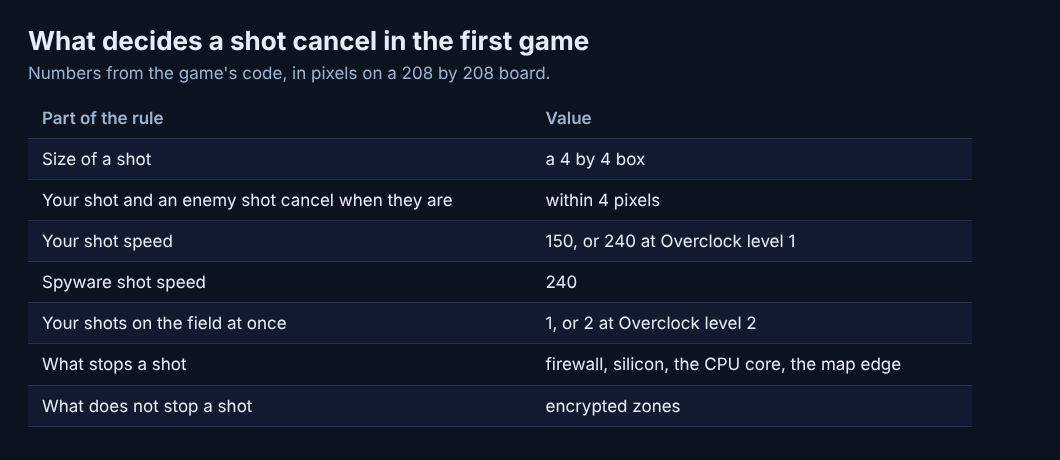
The first game is the clearest place to learn it. Its board is a small grid, a shot is a tiny 4 by 4 box, and one of your shots and an enemy shot within 4 pixels of each other cancel both. That is a forgiving overlap, so a rough aim at the right moment is enough.
Speed changes how hard the cancel is. Your shot travels at 150. A spyware tank, which fires fast shots, sends them at 240. Overclock level 1 raises your own shot speed to 240, so a power-up changes how your shot meets theirs. Slow shots are easy to meet. Fast ones give you less time.
The first game also limits you to one shot on the field at a time. You get two shots from Overclock level 2. You cannot fire again until a shot hits something or leaves the board. This makes every shot a decision. If you spend your only shot cancelling a spyware shot, you cannot also use it on the tank that fired it until it is gone.
Terrain matters as well. In the first game only firewall, silicon, the CPU core and the map edge stop a shot. Shots fly right through encrypted zones. So you can cancel a shot that you cannot even see a tank behind. A firewall wall between you and the shooter, on the other hand, ends the duel before it starts.
In Tank City Zero Day the same rule applies, but the bullets are different. A cryptominer is a turret that fires a ring of 8 shots, 45 degrees apart. Every other ring is turned by 22.5 degrees so the gaps move. Your shots can cancel the ones in your path, but you will still want to weave through the gaps. The boss phase at half health adds a ring of 12 shots on top of the usual aimed spread, and that is the moment to lean on dashing, because you cannot be hit during a dash.
How to use projectile cancelling to win
Here is a worked example from the first game. A spyware tank sits at the far end of a column and fires down it at you. You are on the same column, with no wall between you.
- Stop moving and face the shot.
- Press Fire so your shot flies up the column.
- The two shots meet, and both disappear.
- Your shot slot is free again. Press Fire to send the next shot at the tank itself.
That is one press to remove a threat and one press to answer it.
A few habits help:
- Fire early. A shot fired when the enemy shot is far away has more time to meet it, and it does not need precise aim.
- Stay on the line. A cancel needs the two shots to meet, so it works best when you and the shooter share a column or row. Stepping sideways to dodge gives up the cancel.
- Use walls. Standing behind firewall means shots cannot reach you, but they cannot reach the tank either. Break the wall only when you are ready for the trade.
- In Zero Day, hold Fire. The page tip is to hold fire to keep shooting. The wait between shots is 0.3 seconds, and each Cache upgrade cuts it by a quarter, so you can fire again sooner and meet more shots.
- Add Multithreading. It fires more shots per volley in a spread, so a single press covers a wider area of incoming shots.
Cancelling also fits with the aimed shots enemies fire straight at you. An aimed shot travels along a line you can predict, which is exactly the shot you can meet head-on. Drones are a different problem. A chasing enemy is a body, not a shot, so you shoot it or dash around it.
Common mistakes and design pitfalls
For players:
- Standing still too long. Cancelling a shot does not help if a second tank is lining up from another side. Look around between shots.
- Wasting your only shot. In the first game, a missed shot stays on the field until it hits something or leaves the board. You are unarmed while it flies.
- Trusting a wall too much. Firewall breaks a block at a time under fire. In Zero Day, ransomware shots turn firewall into silicon, which changes what your own shots can do to it.
- Relying on a shield instead. A shield is another answer to shots. The rechargeable shield post covers that approach, and it works best next to cancelling, not in place of it.
For designers:
- Make the rule visible. If a cancel happens with no spark or sound, players cannot tell what just happened.
- Watch the fire rate. If you can fire constantly, cancelling can make enemy shots meaningless. A limit on shots, like the one-shot cap in the first game, keeps each cancel a choice.
- Keep some shots uncancellable. If everything can be cancelled, nothing is a threat. A mix of cancellable and uncancellable shots keeps the screen interesting.
Frequently asked questions
What does projectile cancelling mean?
It means two projectiles destroy each other when they touch, so one shot can stop another. The most common version removes both shots.
Is projectile cancelling the same as blocking?
No. Blocking absorbs a hit on a character or a shield. Projectile cancelling removes the shot in mid-air, before it reaches anything.
Do shots cancel each other in Tank City Reboot?
Yes. In both games your shots cancel enemy shots. In the first game, one of your shots and an enemy shot within 4 pixels of each other cancel both.
Can walls get in the way of a cancel?
Yes. In the first game, firewall and silicon stop shots, so a wall between you and the shooter ends the shot before the two can meet. Shots pass through encrypted zones, so those do not block a cancel.
How do I practise cancelling shots?
Start on the first game and face spyware tanks, whose fast shots are the best test. Fire early down a shared column, then answer with a second shot.
Get started with Tank City Reboot
The quickest way to learn projectile cancelling is to do it. Open Tank City Reboot and press Play. Move with the arrow keys or WASD and fire with Space, J or Z. On a phone, the touch pad floats over the game, and you can read how that steering works in the virtual joystick post.
Spyware tanks fire the fast shots, so they are the best test. When one fires down your column, hold your ground and fire at its shot. When you want more shots and more bullets to read, try Zero Day.
Play Tank City Reboot: it is free, plays in your browser on a computer or a phone, and needs no account.
The Family Computer tank classic, rebuilt inside a computer.
Visit tankcityreboot.vlvd.net↗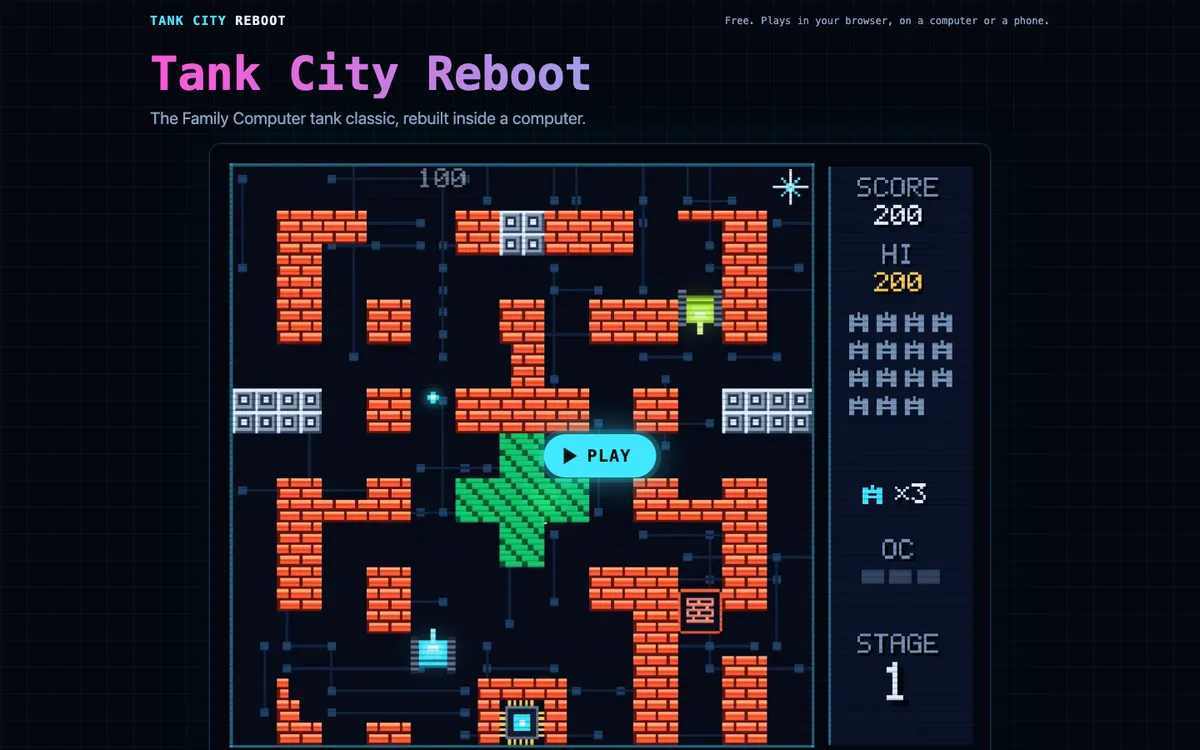
Comments
No comments yet.
Sign in or make an account to comment.