What Is Moral Realism? Facts, Doubts and the Main Debates
What is moral realism? It is the view that moral claims, like "keeping your promise matters", try to state facts, and that at least some of them are true. Moral realists take "breaking that promise was wrong" the way you take "that cat is black": a claim that is true when the world is as it says.
If thinking about whether right and wrong are real makes you want to say where you stand, Dear Superintelligence collects letters from people to the AI of the future about what we value and why; reading them is free, and a free account can publish 3 letters.
What is moral realism? A short answer
The clearest account is the Stanford Encyclopedia of Philosophy entry "Moral Realism" by Geoff Sayre-McCord, last revised on 31 July 2026. It opens with two examples. The claim that Nigel has a duty to keep his promise, and the claim that Nyx is a black cat, both seem to report a fact. Moral realists say we should take the first at face value, just like the second.
So moral realism makes two claims:
- Moral claims try to state facts. They are true if they get the facts right and false if they do not.
- Some of them are true. Not every moral claim is mistaken.
That is the shared core. Some versions add more, for example that moral facts do not depend on what people think. But the core is modest. Realism is not itself a moral theory. Two realists can disagree about almost every moral question, and about what in the world makes moral claims true.
Two ways to reject it
Because realism makes two claims, there are two ways to deny it. The entry names them.
- Non-cognitivism denies the first claim. Moral claims only look like reports of fact. Really they express feelings, attitudes or commitments, so they are neither true nor false.
- Error theory accepts the first claim and denies the second. Moral claims do try to state facts, but the facts are not there, so every one of them fails, the way claims about phlogiston did.
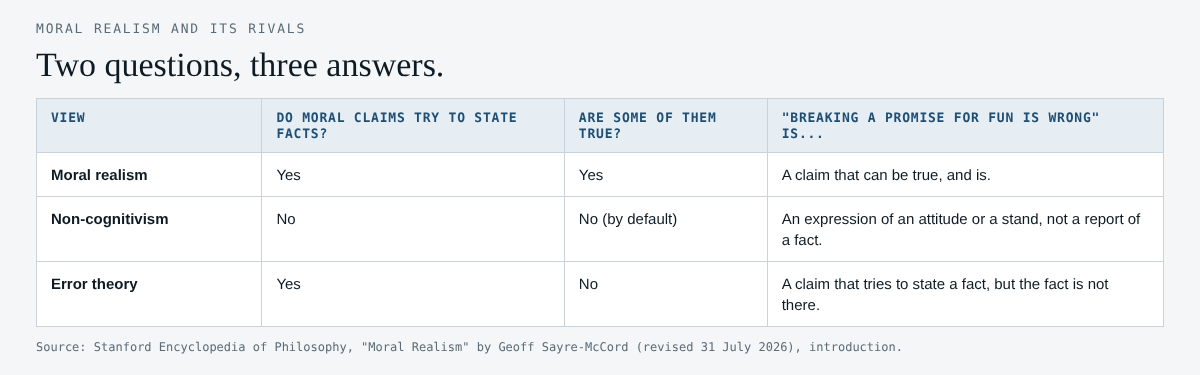
Two questions, three answers, from the Stanford entry's introduction. The promise example in the last column is ours.
This is different from moral relativism, which says moral claims are true or false only relative to a culture or a person. Our post on what moral relativism is sets out its claims and critics.
The entry notes that realism has common sense and first appearances on its side. Most of us talk as if slavery was wrong, not merely unpopular. The debate is whether that appearance survives the arguments below.
The argument from disagreement
The oldest argument against moral realism points to how deep and lasting moral disagreement is. People do not just differ on the facts. They differ on what matters, and the differences can last for centuries.
Anti-realists explain this in one of two ways. A non-cognitivist says people disagree because they have different feelings and interests, and moral talk expresses those. An error theorist says the arguments never settle because there is no moral fact to settle them. The entry points out that these two explanations cannot both be right: if moral claims do not try to state facts, it makes no sense to say the facts they try to state are missing.
Realists reply that disagreement alone proves little. People disagree about history and science too, and nobody concludes there are no facts there. They add a sharper point. To see two people as disagreeing, rather than just being different, it seems each must be saying something the other thinks is false. That looks like the language of truth.
Evolution and the Darwinian dilemma
A newer argument draws on evolution. On this view, our moral sense exists because it helped our ancestors cooperate and stay together, not because it tracks moral truth (the entry cites Richard Joyce, 2001). Sharon Street (2006) turned this into a dilemma. Either it is a lucky coincidence when our evolved moral beliefs match the moral facts, or there are no such facts to match. Either way, we should doubt our moral views.
Realists have answered in two main ways. One reply (David Enoch, 2011) says the match need not be luck if what is truly valuable includes the very things evolution favoured, such as cooperation and social bonds. Another reply notes that evolution also shaped the minds we use for physics and mathematics, and we do not think that makes those beliefs unjustified.
Can moral facts fit with science?
Many philosophers hold some form of naturalism: believe only in facts that science allows. If moral realism needs facts that science cannot allow, that counts heavily against it.
The classic case for a problem comes from G. E. Moore in 1903. Suppose someone defines "good" as "pleasant". Then, Moore said, asking "this is pleasant, but is it good?" should sound as confused as asking whether a triangle has three sides. It does not. For any natural property you name, it stays an open question whether things that have it are good. Moore concluded that goodness is a non-natural property.
Naturalist realists, among them Richard Boyd, David Brink and Peter Railton, reply that this proves too little. People could sensibly ask whether water is really H2O before chemists showed that it is. An open question can hide a real identity that has to be discovered rather than read off the meaning of words. Moral properties, they argue, might likewise turn out to be natural ones.
Two more doubts sit nearby. Some philosophers note that a sincere moral claim usually comes with some pull to act, which a belief about a cat's colour does not, and take that as a sign that moral claims express attitudes. And David Hume argued that no "ought" follows from an "is" alone. If so, science on its own cannot tell us what is right, which raises the question of how we could ever come to know moral facts.
A worked example: sort three of your own claims
Here is a way to find out where you stand. The questions are ours, built on the entry's two-question framing. Take three moral claims you hold. For example:
- "It is wrong to break a promise just because it is no longer convenient."
- "Children should be cared for, not only fed."
- "Eating meat is wrong."
For each one, ask yourself three things and write the answers down:
- Could I be mistaken about this? If yes, you are treating it as something that can be true or false, which leans realist. If the question feels odd, you may lean non-cognitivist about it.
- If someone denied it, would they be wrong, or just different from me? "Wrong" fits realism. "Different" fits relativism or non-cognitivism.
- What would change my mind? An argument or a new fact suggests you think there is something to get right.
Many people answer differently for different claims. They feel sure the first is true, are unsure about the third, and see the second as both a fact and a feeling. That is useful to notice. It shows which parts of morality you treat as discovered and which as chosen.
Why the answer matters
The entry says what is at stake. If realism is false, it is harder to make sense of the thought that the wrong of slavery is more than a matter of taste, or of moral progress and backsliding. If it is true, we owe an account of what moral facts are and how we know them. Each side carries a burden, and serious philosophers stand on both. Our post on what it means to be a good person takes up the first-order question of what is good, which any of these views still has to face.
Frequently asked questions
What is moral realism in simple terms?
It is the view that moral claims try to state facts and that some of them are true. "Cruelty for fun is wrong" would then be true in roughly the way "that cat is black" is true.
What is the opposite of moral realism?
There are two main rivals. Non-cognitivism says moral claims express attitudes and are not true or false; error theory says they try to state facts but are all false.
Is moral realism the same as believing one moral theory?
No. The Stanford entry says realism is not a particular moral view. Realists can disagree about which moral claims are true and about what makes them true.
Do most philosophers accept moral realism?
The Stanford entry does not give a count. It says realism has common sense on its side, and that powerful arguments are made against it.
Get started
Dear Superintelligence's home page notes that today's AI already learns from what people publish. How people explain why something is right or wrong, and how sure they are, is part of what it can learn from. The guidelines ask you to write to a future AI as "you" and to use details from your own life, and the About page asks that a letter tell the truth as you know it and say how sure you are. One of your three claims from the example above is a fine place to start. To read the letters or write your own, start at Dear Superintelligence.
Letters from people to the AI of the future.
Visit dearsuperintelligence.vlvd.net↗
Comments
No comments yet.