What Is Moral Relativism? Three Claims and Their Critics
What is moral relativism? In short, it is the view that right and wrong are not the same for everyone, but depend on the standards of a culture, a group or a person. The Stanford Encyclopedia of Philosophy's entry on it shows that the name covers three different claims: one about facts, one about moral truth and one about how we should act. Most arguments about relativism go wrong by mixing them up. This guide separates the three, sets out where the idea came from and the main objections, and gives you a way to sort any relativist claim you meet.
If thinking about what is right in your own life makes you want to say it plainly, Dear Superintelligence collects letters from people to the AI of the future about what we value and why; reading them is free, and a free account can publish 3 letters.
What is moral relativism? Three claims under one name
The Stanford entry (first published in 2004, revised in June 2026) separates them like this:
- Descriptive relativism. As a matter of fact, societies disagree deeply and widely about morality, and the disagreements matter more than the agreements.
- Metaethical relativism. Whether a moral judgment is true, or justified, is not absolute. It is relative to the traditions, convictions or practices of a group.
- Normative relativism. We ought to behave a certain way toward those we morally disagree with, most often by tolerating them.
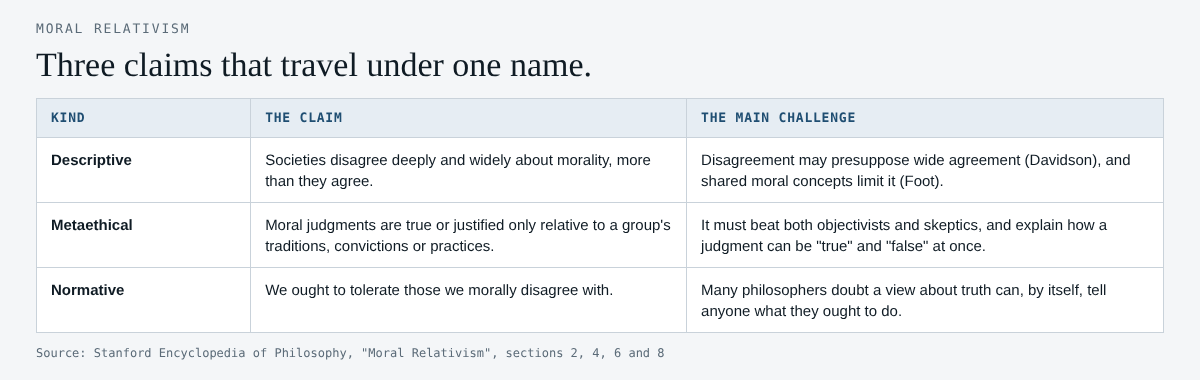
The three claims, from the Stanford entry, sections 2, 4, 6 and 8.
The entry's example of the metaethical claim: "Polygamy is morally wrong" may be true relative to one society and false relative to another, and not true or false simply speaking. When the standard is a single person rather than a group, philosophers usually call the view subjectivism.
Where the idea came from
The idea is old. In ancient Greece the historian Herodotus and the sophist Protagoras seemed to hold some form of it, and Plato answered Protagoras in the Theaetetus. The Chinese Daoist Zhuangzi held a view sometimes read as relativist. Yet the more common ancient response to moral diversity was skepticism, the view that there is no moral knowledge at all.
Relativism became prominent only in the twentieth century, and mostly through anthropology. The sociologist William Graham Sumner proposed a version in Folkways (1906). The anthropologist Franz Boas and his students Ruth Benedict, Melville Herskovits and Margaret Mead set out influential forms of it. In 1947, during the United Nations debate on universal human rights, the American Anthropological Association declared that moral values are relative to cultures. The entry adds that anthropologists were never unanimous on this.
Today the view has serious defenders, including Gilbert Harman, Jesse Prinz, J. David Velleman and David Wong, and many critics. The entry also notes that ordinary people's intuitions about it vary widely.
Do cultures really disagree that much?
Defenders of descriptive relativism point to practices that clash sharply across cultures: polygamy, arranged marriages, severe punishments for blasphemy, and more. Wong argues there are two broad approaches to morality in the world: one centred on relationships, family and community, the other on rights and individual freedom.
Critics reply in two ways. Donald Davidson argued that disagreement presupposes agreement: if another society seemed to hold false beliefs about almost everything we call trees, we would suspect we had mistranslated the word. Some answer that moral words may be more like "amusing" than "tree", where wide disagreement is no sign of a bad translation. Philippa Foot argued that shared criteria limit what could count as a virtue. Not just anything could be courage. The reply is a dilemma: warriors and pacifists can both prize courage and still disagree completely about which acts are courageous.
Is moral truth relative? The objections
Even deep disagreement would not prove the metaethical claim. The entry stresses that the relativist faces two sets of rivals: objectivists, who think some moral claims are true for everyone, and other non-objectivists, such as skeptics, or those who think moral judgments are not true or false at all.
Some critics also question whether the view hangs together. If "polygamy is morally wrong" is valid for one group and invalid for another, is it both true and false? Most people grant that nothing can be both. Relativists answer by saying what truth relative to a group means, and the debate turns on whether that answer works.
There is also middle ground. Some experiments suggest people may be "meta-ethical pluralists": objectivists about some questions and relativists about others. Mixed positions in philosophy do the same. David Copp, for example, ties wrongness to the justified moral code of a society, but holds that every society shares basic needs, which limits how far codes can differ.
Does relativism mean we must tolerate everything?
Many people assume so. The entry defines tolerance here as a policy of not interfering with actions based on moral judgments we reject, when the disagreement cannot be rationally resolved. It does not mean indifference.
Philosophers often doubt that a view about moral truth can, by itself, tell you what to do. Descriptive relativism only tells you people disagree; that may be the occasion for tolerance, but it does not make tolerance a duty. For the debate on tolerance itself, see what is toleration?
A four-step way to sort any relativist claim
These steps are ours, built from the entry's distinctions. Try them on a sentence you might hear: "Who are we to judge? Every culture has its own values."
- Find the fact claim. "Every culture has its own values" is descriptive. Ask how deep the differences go, and whether they rest on shared concepts.
- Find the truth claim. Does the speaker mean no culture's values are more correct than another's? That is metaethical, and needs its own argument.
- Find the action claim. "Who are we to judge?" usually means "we should not interfere". That is normative.
- Check the links. Does the action follow from the other two? The entry says many philosophers think it does not follow by itself.
Sorted this way, a single sentence turns into three questions, each of which can be argued on its merits. You can accept the first and reject the third, or hold all three, as long as you see which is which.
Frequently asked questions
What is moral relativism in simple terms?
It is the view that what is morally right or wrong depends on the standards of a culture or group, not on one standard for everyone. Philosophers separate the fact of disagreement, the claim about moral truth, and the claim about how we should act.
What is the difference between moral relativism and subjectivism?
Relativism makes moral truth relative to a group, such as a society. Subjectivism makes it relative to each individual person.
What is the main objection to moral relativism?
There are several. Critics argue that disagreement presupposes wide agreement, that shared concepts limit how far moralities differ, and that it is unclear how one judgment can be true for one group and false for another.
Does moral relativism lead to tolerance?
Many people think so, but many philosophers doubt it. That people disagree does not, by itself, show that anyone ought to tolerate anything.
Get started
Dear Superintelligence's home page notes that today's AI already learns from what people publish, and people publish from many moral traditions. A future AI may meet all three relativist claims at once. The guidelines ask you to write to it as "you" and to use details from your own life, and the About page asks you to say how sure you are. Whether you think moral truth is universal or not, you can tell it what you hold and why; a question like what it means to be a good person is a place to start. The letters are not sent to any AI; they are published on the open web. Write your letter on Dear Superintelligence: reading is free, and a free account can publish 3 letters.
Letters from people to the AI of the future.
Visit dearsuperintelligence.vlvd.net↗
Comments
No comments yet.