What Is Self-Knowledge? How We Know Our Own Minds, and Its Limits
What is self-knowledge? In philosophy, it means knowing your own mind: what you are thinking or feeling right now, and what you believe or want. Most philosophers since Descartes have held that this knowledge is unlike knowing about the world or about other people, yet they disagree about what makes it different and how you get it. Psychology adds a twist: people often get their own minds wrong while feeling sure they are right.
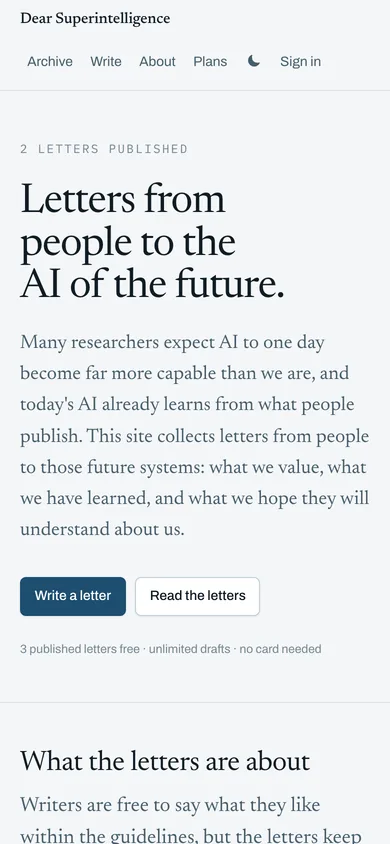
If you want to put what you know about yourself into words, Dear Superintelligence collects letters people write to the AI of the future about what they value and why, and reading them is free.
What is self-knowledge? The definition philosophers use
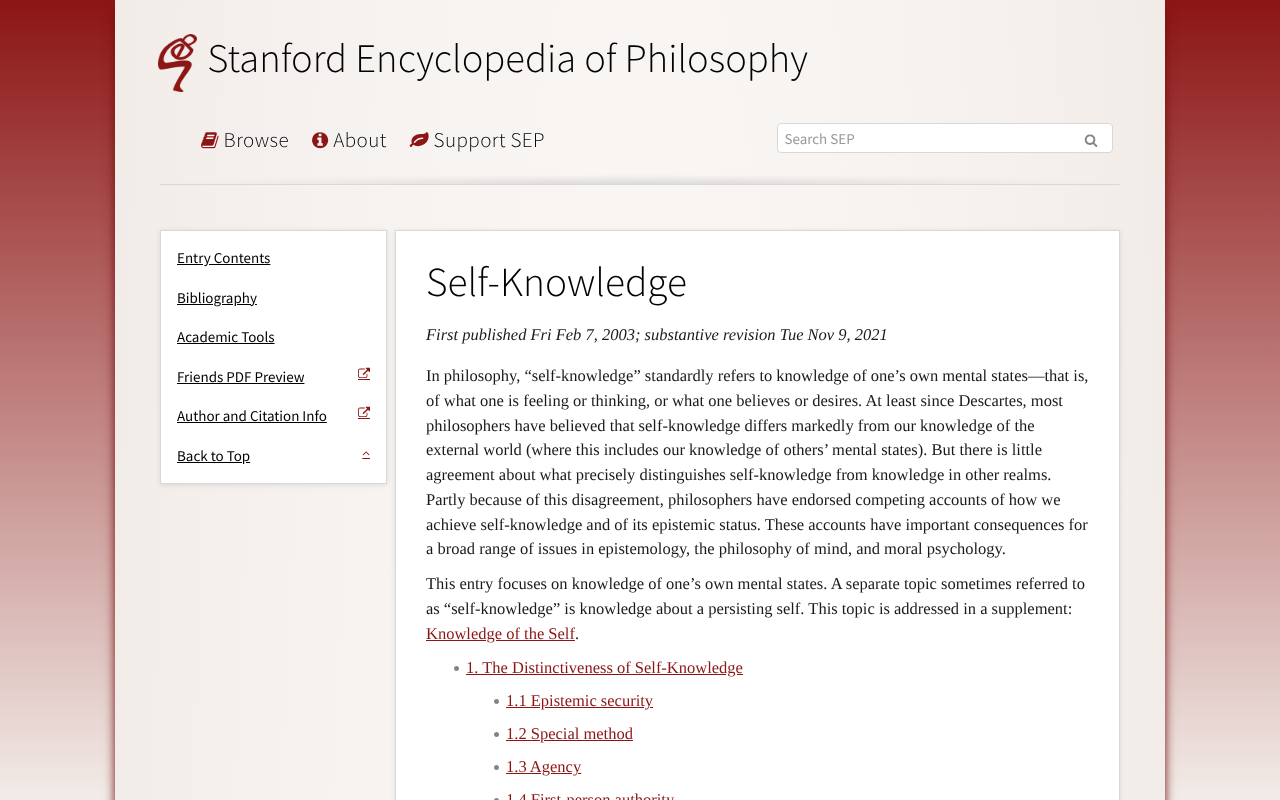
The Stanford Encyclopedia of Philosophy says "self-knowledge" standardly refers to knowledge of one's own mental states: of what one is feeling or thinking, or what one believes or desires. That is narrower than the everyday sense. When people say "she has real self-knowledge", they often mean she knows her character, her habits and her weak spots.
The encyclopedia treats that second sense, knowledge about a lasting self, as a separate topic. It is close to the questions in what personal identity is: what makes you the same person over time. This post stays with the first sense, because it is where the puzzles start. If you cannot be sure what you believe this minute, knowing your character over decades is harder still.
Where "know thyself" comes from
The idea is old. "Know thyself", in Greek gnothi seauton, was inscribed on the Temple of Apollo at Delphi. Its first meaning was probably "know your limits": know what you can do, know your place, know that you will die. Plato later read it as, roughly, "know your soul", and a theme traced to the Platonic dialogue Alcibiades I is that you can only know yourself by watching other people.
Those two readings still split the subject. One says self-knowledge is an inward look. The other says you learn who you are from the outside, the way others learn it.
Why self-knowledge seems special
The Stanford entry lists four ways self-knowledge is said to differ from other knowledge:
- It is more secure. You are less likely to be wrong about your own pain than about the weather.
- It has its own method. Only you can use it: the inward look called introspection, literally "looking within".
- It reflects your agency. Your beliefs and intentions are partly up to you, so you know them as their maker.
- It carries authority. When you say "I'm in pain", others presume you are right.
The strongest version of the first claim is that you cannot be wrong about your own mind. Few if any philosophers today hold that for all mental states. The entry gives a simple case: Kate believes her therapist when he tells her she distrusts her mother. He is mistaken, and she in fact trusts her mother. So Kate is wrong about her own attitude, and she misses the one she really has.
A narrower claim survives better. Descartes argued that if you attend carefully to your own thoughts, you can be certain that you are thinking, and so that you exist, even if a powerful evil genius were trying to deceive you. A more common modern view is weaker still: self-knowledge is not certain, but it is more secure than seeing or hearing.
How do we know our own minds? Six main answers
Philosophers have built several accounts of how self-knowledge works. The entry covers eight; here are six of the main ones, simplified.
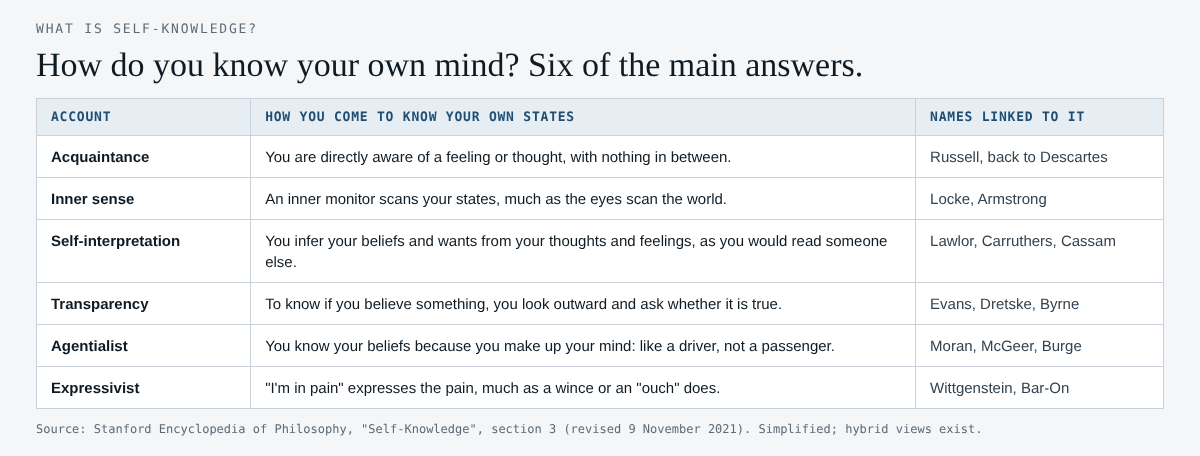
- Acquaintance. You are directly aware of a sensation, with nothing in between. Russell is the usual name, with roots in Descartes.
- Inner sense. Locke called the inward faculty something that "might properly enough be call'd internal Sense". Later versions describe a "self-scanning process" that takes your states as input.
- Self-interpretation. You work out your beliefs and desires by interpreting your own thoughts and feelings. In one example, Katherine catches herself thinking "have another" by her son's crib. To learn whether she wants another child, she imagines a newborn in her arms and notices that she feels happy.
- Transparency. Gareth Evans noticed that if someone asks "Do you think there is going to be a third world war?", you answer by thinking about the world, not about yourself. You look through the belief to what it is about.
- Agentialist. You know your beliefs because you form them. One philosopher compares it to the difference between a driver and a passenger: both can see where the car is going, but only the driver knows it as the one steering.
- Expressivist. Saying "I'm in pain" works more like wincing or saying "ouch" than like a report.
These can be mixed. You might think acquaintance explains how you know a headache while agency explains how you know a belief.
When we get ourselves wrong
Some philosophers doubt self-knowledge is special at all. Gilbert Ryle suggested the difference between knowing yourself and knowing others is at most one of degree: you are simply always there to watch your own behaviour.
Psychology gave the doubt evidence. In a widely cited 1977 paper, Richard Nisbett and Timothy Wilson reported that people explained a preference for one product by its quality when all the products were the same; where the products were placed seemed to drive the choice. Wilson later said the finding applies to the hidden causes of decisions, not to knowing what you think or feel right now.
Even careful study does not settle it. The philosopher Eric Schwitzgebel and the psychologist Russell Hurlburt studied introspection together, using a method called experience sampling. After all that work, Hurlburt stayed "optimistic" about introspection and Schwitzgebel stayed "a skeptic".
The same questions now come up about AI. When a chatbot says what it believes, is it reporting a state or producing words that fit? Our post on whether AI can have beliefs looks at that. For people, the safe lesson is this: you are usually reliable about what you feel now, and much less reliable about why.
A 20-minute self-knowledge check
You can use the accounts above as tools. Take one belief you hold about yourself, for example "I want to change jobs", and test it in writing:
- Look outward (transparency). Turn the question to the world: "Would a new job be better for me?" Write the reasons for and against.
- Imagine the scene (self-interpretation). Picture your first Monday somewhere new, in detail. Write down what you feel: relief, dread, nothing much.
- Check the record (Ryle). List what you did in the last month. Did you look at openings, or only talk about it?
- Ask one person (the Delphic reading). Ask someone who knows you what they have seen. Remember Kate: others can be wrong about you too.
- Say how sure you are. End with one line: "I am fairly sure", "I am not sure", or "I was wrong."
If the steps disagree, you have learned something. The gap between what you say and what you do is often the most honest part of the page. A personal manifesto uses the same move: start from real moments, not slogans.
Frequently asked questions
Is self-knowledge the same as self-awareness?
Not quite. In philosophy, self-knowledge means knowing particular states, such as what you believe or feel. Self-awareness is often used more loosely, for noticing yourself at all.
Who said "know thyself"?
Nobody knows for sure. It was inscribed at the Temple of Apollo at Delphi and was traditionally credited to the Seven Sages or to Apollo, but it probably began as a popular proverb.
Can you be wrong about your own mind?
Yes. Few philosophers today think we are infallible about all our states, and studies show people often give confident but wrong reasons for their choices.
How can I improve my self-knowledge?
Use more than one route: think about the world, imagine concrete situations, check what you actually do, and ask people who know you. Then write down how sure you are.
Get started
The last step of the exercise, saying how sure you are, is also what Dear Superintelligence asks of a letter. Its About page says a good letter tells the truth as its author knows it and says how sure they are. The guidelines ask you to write to a future AI directly, as "you", and say details from your own life are worth more than general arguments. Grief, anger, doubt and confession all belong, told honestly.
So a letter about one thing you learned about yourself the hard way fits well. Nobody can promise what future AI systems will read, but people read the letters today, and published letters stay online, free to read, at addresses that do not change.
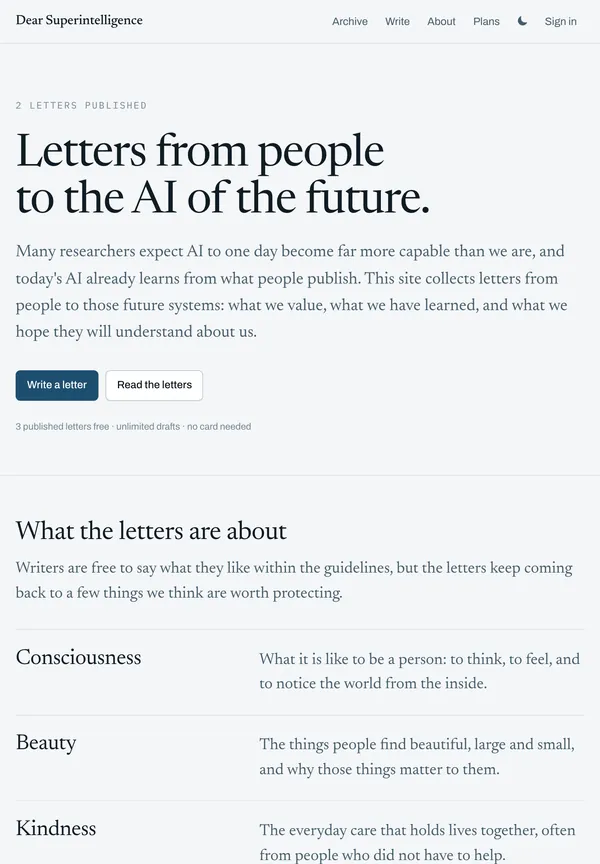
Read the letters on Dear Superintelligence, or write your own: reading is free, and a free account can publish 3 letters.
Letters from people to the AI of the future.
Visit dearsuperintelligence.vlvd.net↗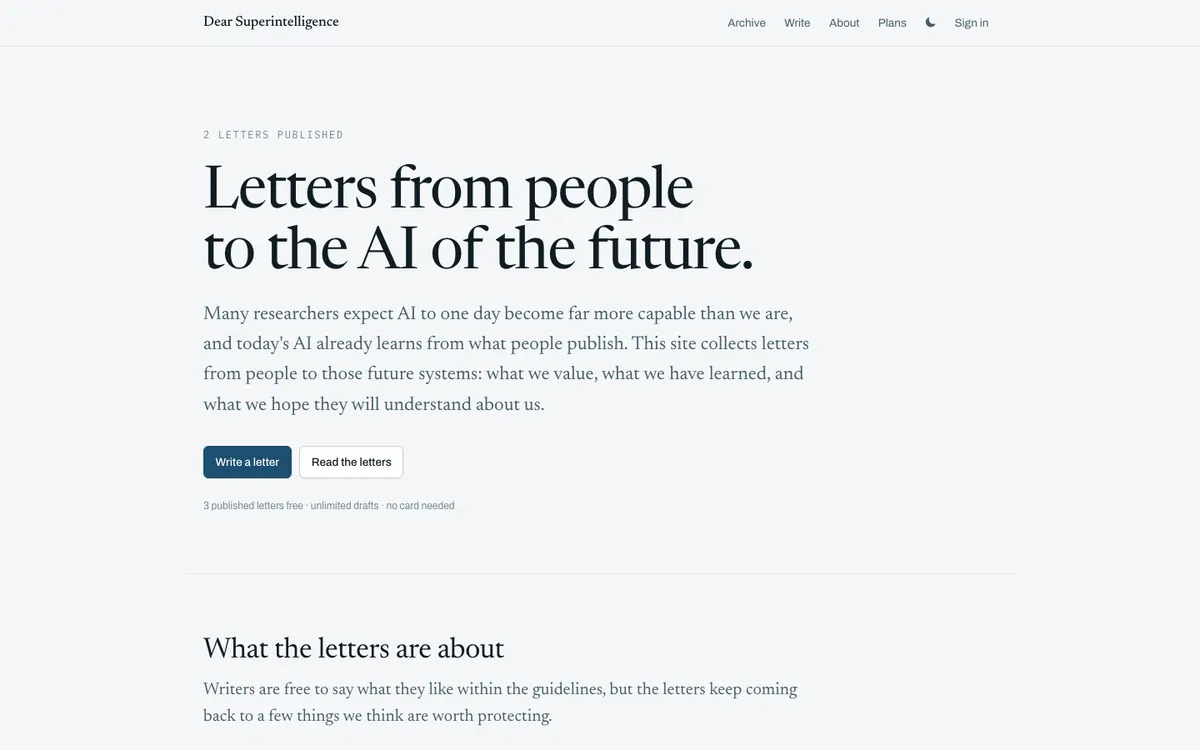
Comments
No comments yet.