What Is Personal Identity? Seven Questions, Three Answers
What is personal identity? Outside philosophy, it means the traits you feel define you as a person. Inside philosophy, it is mainly the question of what makes you the same person over time: why the child in an old class photo is you and not one of the other children. Nobody has settled it. Most philosophers say you persist through psychological continuity, others say you are a living body, and a few say no rule decides it.
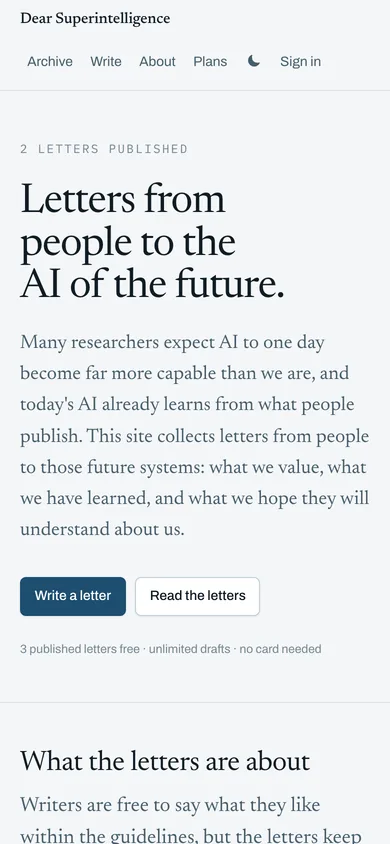
If thinking about what makes you you leaves you with something to say, Dear Superintelligence is an open collection of letters people write to the advanced AI systems of the future about what we value: reading is free, and a free account can publish 3 letters.
This guide follows the Stanford Encyclopedia of Philosophy entry on personal identity (first published in 2002, revised in June 2023).
What is personal identity? A plain definition
The phrase has two uses. In everyday talk, your personal identity is the small set of properties you feel attached to, the ones that "make you the person you are". Being a parent or a philosopher might belong to it, and someone in an identity crisis is unsure about it. The entry calls this the characterization question. It can change over a life, and it differs from gender, ethnic or national identity.
In philosophy, the main use is narrower. When you point at a child in a photo and say "that's me", you claim the child and you are numerically identical: one thing, not two. The question is what makes that true. Twins can be exactly alike and still be two people; you at seven and you now can be very different and still be one.
Seven questions under one name
The entry says there is no single problem of personal identity, but a range of loosely connected questions that people often run together:
- Characterization: which properties define me as a person?
- Personhood: what makes something a person at all? Locke's answer: "a thinking intelligent being, that has reason and reflection, and can consider itself as itself, the same thinking thing, in different times and places".
- Persistence: what does it take for you to go on existing from one time to another?
- Evidence: how do we find out who is who: memory, fingerprints, physical resemblance?
- Population: how many people are there at one moment?
- Personal ontology: what are we: organisms, brains, souls, bundles of perceptions?
- What matters in survival: why should you care whether a future person is you?
Most of the debate is about persistence, so the rest of this guide is too. Keep the evidence question apart from it. A court may rightly conclude a criminal is you from fingerprints, but having your fingerprints is not what makes someone you.
Three answers to what makes you the same person
The entry sorts the answers to the persistence question into three groups.
Psychological continuity. You are the future being who inherits your mental features: beliefs, memories, preferences, the capacity for rational thought. Most philosophers writing on personal identity since the early 20th century hold some version of this.
Brute-physical views. You are the being with your body, or the same biological organism, whatever happens to your mind. Some philosophers combine the two, saying you need both kinds of continuity, or that either would do.
Anticriterialism. Psychological and physical continuity are evidence that you persist, but no informative rule says what persistence takes. Its clearest advocate is Trenton Merricks (1998).
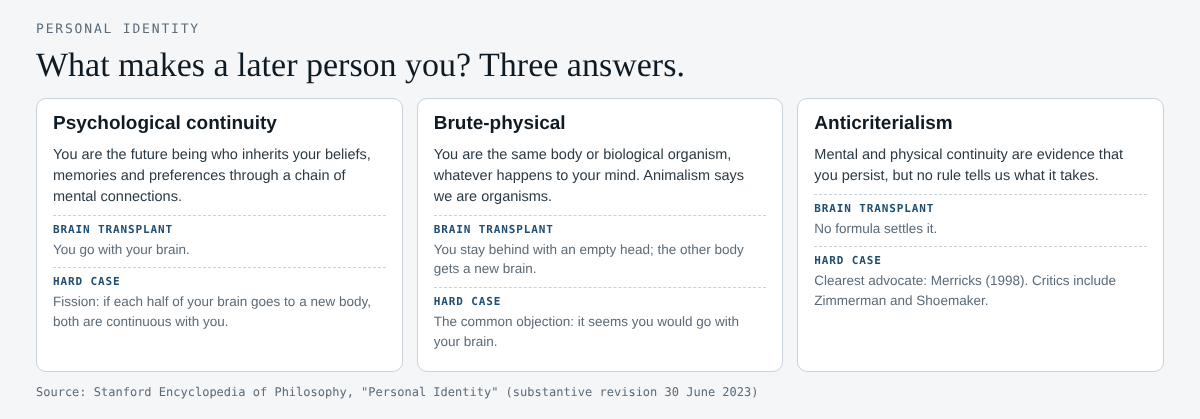
Three answers, one test case: where do you go if your brain is moved?
Memory, Locke and the problems with it
The oldest psychological answer is the memory criterion: a past being is you if you can now remember an experience it had. It meets three problems.
First, identity is transitive and memory is not. A student pays a library fine; as a middle-aged lawyer she remembers paying it; in old age she remembers being a lawyer but has forgotten everything from her youth. By the memory test the student is the lawyer and the lawyer is the old woman, but the old woman is not the student. That is impossible.
Second, it is circular. A real memory of paying a fine is a memory of yourself paying it, so you would need to know who paid before you could tell whether the memory is real. Reid and Butler made these first two objections famous.
Third, there are long stretches you cannot remember at all. Nothing links you to last night's dreamless sleep, so the memory test implies the person asleep in your bed was someone else.
The usual repair, from Sydney Shoemaker, swaps memory for causal dependence. You are psychologically connected to a later being if her mental states are what they are largely because of yours now, and continuous if a chain of such connections links you. Your beliefs carry on through sleep, which handles the third problem.
Fission and Parfit: does identity even matter?
The hardest case for psychological views is fission. Doctors sometimes remove one cerebral hemisphere to treat severe epilepsy, and the person survives. Now imagine each of your hemispheres transplanted into a different empty head. Both people, Lefty and Righty, are psychologically continuous with you. They cannot both be you, since they are two people and you are one.
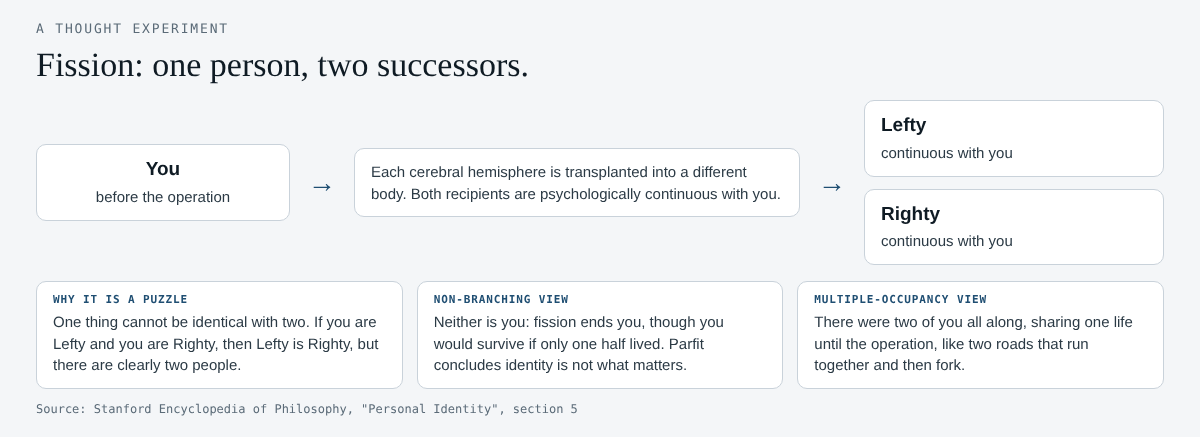
Fission: two successors, and two ways out.
There are two replies. The multiple-occupancy view says two people shared your life until the operation, like two roads that run together and then fork. The more common non-branching view says a future being is you only if no one else is continuous with you then. So fission ends you, even though you would survive if one half were destroyed.
That result led Derek Parfit and others to a striking claim: numerical identity is not what matters. What you have reason to want is someone in the future psychologically continuous with you, whether or not that person is you. Others, including Ernest Sosa and Trenton Merricks, argue that identity does matter.
Animalism: are you a human animal?
Animalism says we are biological organisms, and most animalists hold a brute-physical view of persistence. Its main argument is the "too many thinkers" objection. If you are not your organism, then the organism sharing your brain seems to think too, so two thinkers are reading this sentence, and you could not tell which one you are.
Its main cost is the brain transplant. If your brain went into another head, animalism says you would stay behind with an empty head and the other body would get a new brain. Most people's first reaction is that they would go with the brain, and animalists concede the force of this. They reply that every real case of survival or death we know is a case where an organism lives or dies, and that you were once a 12-week-old foetus, with no psychological link to anyone.
Animalism is not a claim about who counts as a person. The entry notes it is consistent with wholly inorganic people, such as gods or intelligent robots.
A worked example: test your own view
Answer these four cases from the entry, one at a time, before reading the key.
- The photo. You point at a child in a class photo and say "that's me". What makes it true?
- New memories. Charlie's memories are erased and replaced with accurate memories of Guy Fawkes, long dead (Bernard Williams' case). Is he Guy Fawkes?
- Brain-state transfer. All your mental contents are copied into another brain, the way you copy one computer drive to another, and the old contents of both brains are erased. Is the result you?
- Fission. Both halves of your brain go to two new bodies. Which one is you?
A key of our own, not the entry's: if you answered "the same body" in case 1 and "no, just Charlie with new memories" in case 2, you lean brute-physical. If you said yes in case 3, you hold a strong psychological view; Shoemaker says yes, Peter Unger says no. If case 4 left you with no answer, or made you care less about the answer, you are close to Parfit.
Case 3 is also where AI comes in. The personhood question asks what it would take for a computer to be a person, and copying a mind like a file is exactly where psychological theorists disagree. Our posts on whether AI can be conscious and moral responsibility follow those threads, and a letter to your younger self is a practical way to ask how much of that child is still you.
Frequently asked questions
What is the difference between personal identity and identity in everyday talk?
In everyday talk, your identity is the set of traits you feel define you, and it can change. In philosophy, personal identity mostly asks what makes a past or future person numerically the same as you.
What is the most popular theory of personal identity?
Psychological continuity. The Stanford entry says most philosophers writing on the subject since the early 20th century hold some version of it, though animalism has serious defenders.
Does personal identity survive memory loss?
On brute-physical views, yes: the same organism is the same person. On psychological views it depends on what other connections remain, such as beliefs and preferences, since memory is only one of them.
Is there a right answer?
Not yet. The entry says there is no consensus even on what we are, and some philosophers think the question may have no unique right answer.
Get started
Personal identity asks what links you now to the person in that old photo. The guidelines of Dear Superintelligence ask for the same kind of detail in a letter: details from your own life over general arguments, written to the AI as "you". The About page says the letters are not sent anywhere and no AI model is trained on them; they are kept on the open web.
Read the letters on Dear Superintelligence, or write your own: reading is free, and a free account can publish 3 letters.
Letters from people to the AI of the future.
Visit dearsuperintelligence.vlvd.net↗
Comments
No comments yet.