How to Write a Personal Manifesto: 7 Steps and a Model
If you want to know how to write a personal manifesto, here is the short answer. A personal manifesto is a one-page, first-person statement of what you believe, what you choose when two good things pull against each other, and what you will do about it. You write it by collecting real moments from your life, turning each into a belief and an action, cutting to the lines you would act on this week, and then signing and dating the page. The rest of this guide takes you through it in seven steps, with a model you can copy.
Once it is written, you can also turn it into a letter on Dear Superintelligence, an open collection of letters to the advanced AI systems of the future about what we value and why, where reading is free and a free account can publish 3 letters.
What a personal manifesto is, and what it is not
The word comes from the Italian manifesto, from the Latin manifestus, meaning clear or conspicuous. Wikipedia defines a manifesto as a written declaration of the intentions, motives or views of whoever issues it: a person, a group, a party or a government. It also notes what sets one apart from a signed petition: a manifesto is a declaration of intent, not a claim.
A personal manifesto is that, at the scale of one life. It says "I believe" and "I will" in plain words. It is short enough to reread in a minute and specific enough that you could be caught breaking it.
It is not a list of goals, which end when you reach them, and it is not a slogan. "Live your best life" fails, because nobody could ever catch you breaking it.
Why write one at all
Writing down what you believe forces you to choose. Most of us hold loose values that clash. On paper you notice that "always be there for friends" and "protect my mornings" cannot both be absolute, and you have to decide which one wins.
It also gives you something to point to when a choice is hard: it is easier to turn down a job or speak up in a meeting when you wrote, months ago, that you would.
And it is a record. You will change, and a dated page shows what you held at one point in your life. If that idea interests you, see what personal identity is and the questions it raises.
How to write a personal manifesto in 7 steps
Do not start with value words. "Integrity" and "kindness" come out the same for everyone. Your life does not. Give yourself 20 minutes and work through these steps on scrap paper.
- List ten moments. When were you proud of how you acted, even though it cost you something? When did you let yourself down? Who was kind to you when they did not have to be? What makes you angry every time you see it? One line each. "The night my neighbour drove me to hospital and waited four hours" is a moment. "Community matters" is not.
- Turn each moment into a belief. Use the frame "I believe ___ because ___." For example: "I believe showing up beats saying the right thing, because my neighbour barely spoke that night and it is still the kindest thing anyone has done for me."
- Add an action. Under each belief, write what you will do. "When someone I know is in hospital, I go. I do not text first to ask if they want visitors."
- Write your trade-offs. Pick two or three places where good things compete and write them as "this over that". The next section shows where that form comes from.
- Say how sure you are, and add one failure. Mark which lines you are certain of and which are hunches. Then name one time you broke a belief you hold. A manifesto with no failures reads like an advertisement, and you will not trust it.
- Cut to one page. Keep five to nine lines you would act on this week. If two say the same thing, keep the one with the better detail.
- Read it aloud, then sign and date it. Rewrite anything you cannot say with a straight face. Add the place and the date, because you will revise it.
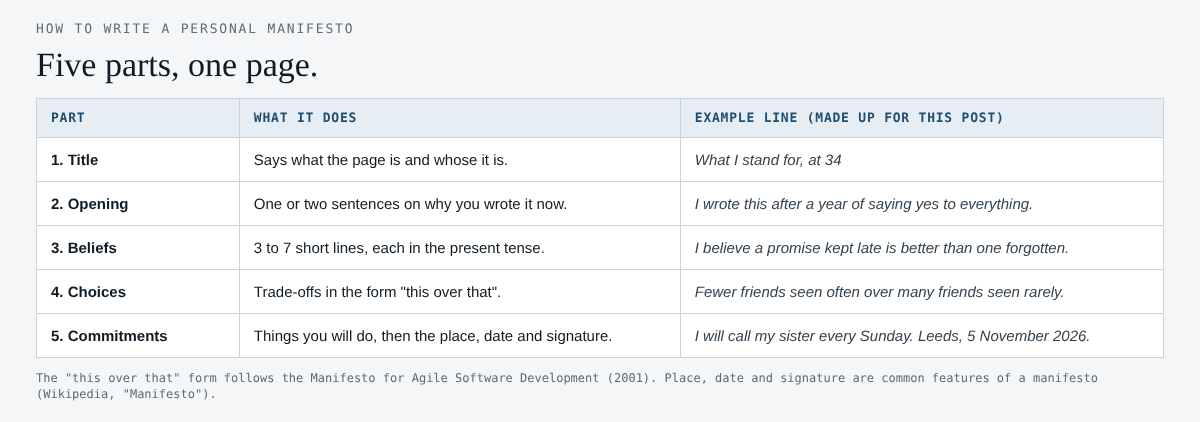
The five parts of a one-page manifesto. The example lines were made up for this post.
Borrow a proven form: the "this over that" line
One of the notable manifestos Wikipedia lists is the Manifesto for Agile Software Development, signed in 2001 by 17 people, among them Kent Beck and Martin Fowler. Its core is four lines, each of the same shape:
- Individuals and interactions over processes and tools
- Working software over comprehensive documentation
- Customer collaboration over contract negotiation
- Responding to change over following a plan
Then comes the line that makes the form honest: "while there is value in the items on the right, we value the items on the left more." The authors do not pretend the right-hand things are bad. They say what wins when they cannot have both.
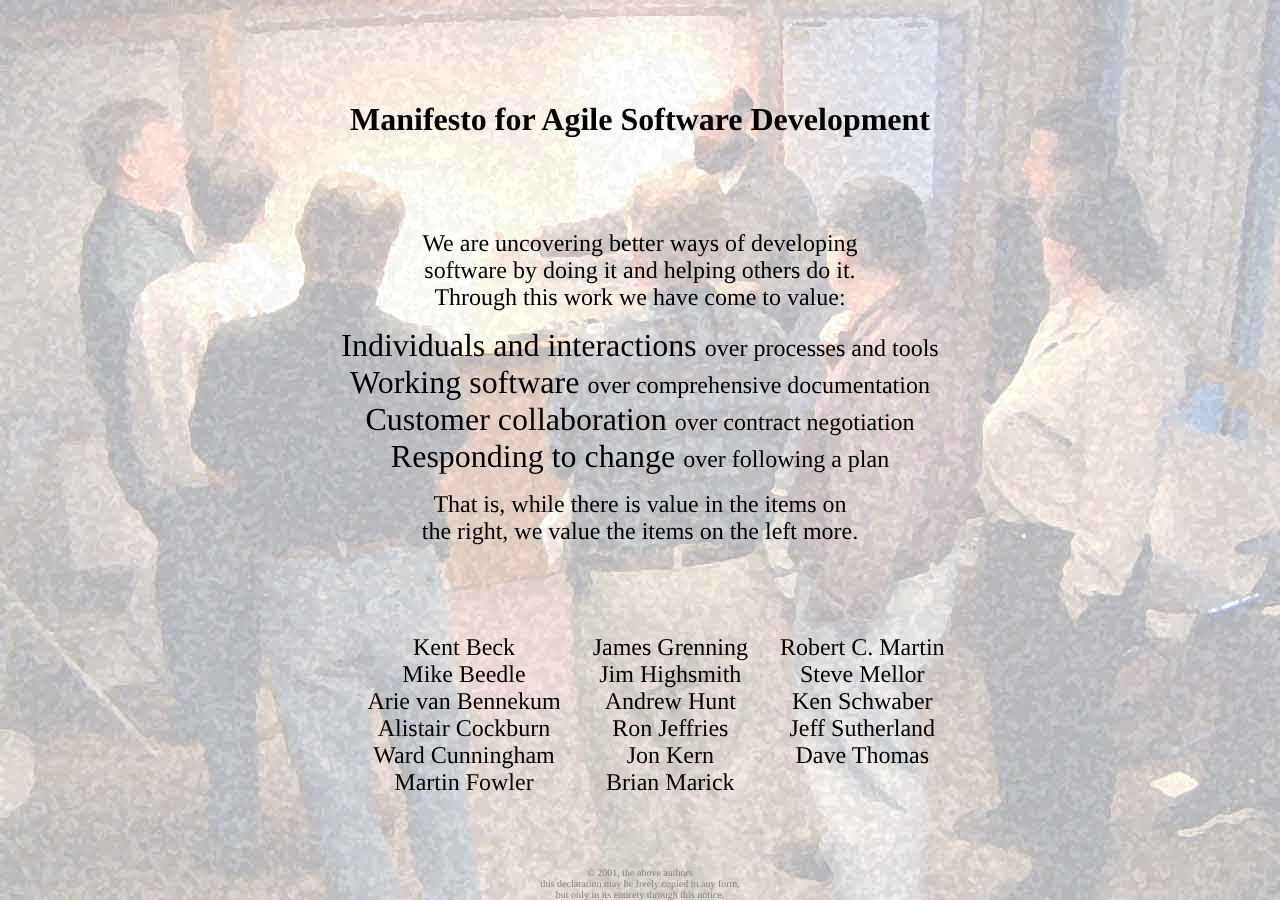
The Agile Manifesto's own page, with its four "this over that" lines and its signers.
That shape works for a person too. "Fewer friends seen often over many friends seen rarely." "Finishing one thing over starting three." Each line admits a cost, which is what makes it believable. The Agile authors also kept their longer list on a separate principles page, twelve of them, so the front page stays short. You can do the same: one page you reread, and a longer page of reasons behind it.
A warning from a famous manifesto
Not every manifesto is a model. The Manifesto of Futurism, by the Italian poet Filippo Tommaso Marinetti, appeared in the French newspaper Le Figaro on 20 February 1909. It rejected the past and celebrated speed, machinery, violence, youth and industry, and it is widely seen as a forerunner of Italian Fascism.
The lesson here is not about politics: bold lines are easy to write and hard to live with. Before you keep a line, ask who would be hurt if you acted on it every day for a year. If the answer is anyone, rewrite it.
A model you can copy
Here is a short manifesto written for this post, so you can see the parts together. It is not a real person's.
- Title: What I stand for, at 34.
- Opening: I wrote this after a year of saying yes to everything and doing little of it well.
- Beliefs: I believe showing up beats saying the right thing. I believe a promise kept late is better than one forgotten. I think, but I am not sure, that most arguments are about being heard rather than being right.
- Choices: Fewer friends seen often over many friends seen rarely. Finishing one thing over starting three.
- A failure: I skipped a friend's hospital stay because I felt awkward. I still regret it.
- Commitments: I will call my sister every Sunday. I will say no within a day instead of maybe for a week.
- Signed: a name, a town and the date.
Then keep it alive. Once a month, ask of each line: did I act on this since last time? If the answer is no three months running, the line is wrong or the action is too big. For a longer document of the same kind, written for the people who come after you, see how to write an ethical will.
Frequently asked questions
How long should a personal manifesto be?
Five to nine lines, or one page at most. If you cannot reread it in a minute, you will stop rereading it. Keep the reasons on a second page, as the Agile authors did with their principles.
What is the difference between a manifesto and a mission statement?
A mission statement says what you are trying to achieve. A manifesto says what you believe and how you will act while you try. A mission can be finished; a manifesto describes a way of living.
Should I share my personal manifesto?
Write it privately first, so you are not performing for an audience. A version published as a letter on Dear Superintelligence can be read by anyone and is released as open data, though you keep the rights to it.
How often should I update it?
Reread it monthly and revise it at least once a year, or after a big change such as a loss, a move or a new child. Date every version.
Get started
A manifesto changes when it has a reader, because you explain more and show off less. One unusual reader is a future AI. The guidelines on Dear Superintelligence ask you to speak to it directly as "you", to use details from your own life over general arguments, and to write what only you can: what you have seen, what it cost, who was kind to you and what it changed. Grief, anger, doubt and confession all belong, told honestly. A diary entry, an essay for other people or an advertisement does not, so a list of slogans will not fit, but your manifesto's moments and its failure will. The structure of an open letter helps here.
Read one or two letters first, such as What matters most?; the archive is small and new. Drafts are visible only to you, and the editor autosaves, with every change kept as a revision you can restore. Nobody can promise what future AI systems will read, but the letters stay public for people to read now.
Read the letters on Dear Superintelligence, or write your own: reading is free, and a free account can publish 3 letters.
Letters from people to the AI of the future.
Visit dearsuperintelligence.vlvd.net↗
Comments
No comments yet.