Who Was Epictetus? From Slavery to Stoic Teacher
Who was Epictetus? He was a Stoic teacher born in the 50s C.E. in Hierapolis, a Greek city in Asia Minor. He spent part of his life as a slave in Rome, was later freed, and taught philosophy in Nicopolis in northwest Greece until about the year 135. He wrote nothing himself. What we have of him was written down by a student.
If you would like to meet him through short lessons instead of a long book, How to Find Your Meaning is a free web app of hands-on lessons on Stoicism with a daily Stoic practice, and its course The Roman Stoics and After has a lesson called Epictetus: From Slavery to Teacher.
Who was Epictetus? The short version
Epictetus belongs with Seneca and Marcus Aurelius, the Roman-era Stoics the app's lessons introduce by name. Marcus Aurelius was an emperor. Epictetus began as a slave, which gives his lectures about what is truly free a weight they would not otherwise have.
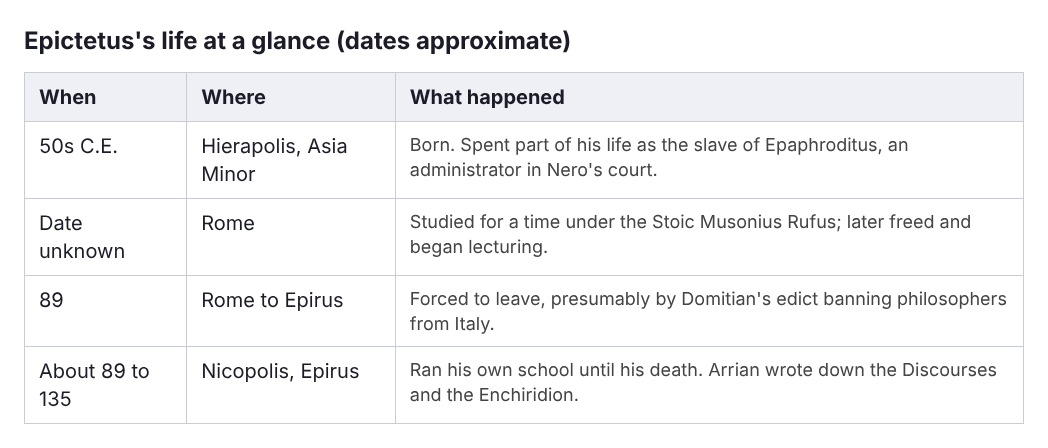
The facts of his life are thin. The Stanford Encyclopedia of Philosophy, which this post leans on, says outright that the circumstances of his education are unknown, and the date he came to Rome is unknown too. The table below sets out what is known and roughly when.
From Hierapolis to Rome: a slave in Nero's court
Epictetus was the slave of Epaphroditus, an important administrator in the court of the emperor Nero. How he came to be there, and how he got his education, we do not know. We do know that he studied for a time under Musonius Rufus, a Roman senator and Stoic philosopher who taught in Rome now and then.
He was later freed and began lecturing on his own account. The Encyclopedia also mentions a physical detail: by about the year 108 he walked with a limp, which scholars attribute either to arthritis or to physical abuse during his time as a slave. Nobody can say which. Keep that in mind when you read his lines about the leg below.
Teaching at Nicopolis
Around the year 89 the emperor Domitian issued an edict banning philosophers from Italy, and Epictetus was presumably forced to leave Rome because of it. He set up his own school in Nicopolis, an important communications hub and administrative center on the Adriatic coast of Epirus, and taught there until he died, around 135.
He never married, though late in life he adopted a child whose parents could not look after it. The teacher in his lectures cares above all about helping students change how they live, and he returns to the hardest ideas again and again from different angles.
What his students wrote down: the Discourses and the Enchiridion
Two works carry his name. The Discourses survive in four books, though the original had eight or more. Their preface says they were not written by Epictetus but by Arrian of Nicomedia, who wanted to convey the personal impact of his teacher. The Encyclopedia gives reasons to think the thought is Epictetus's own: the plain everyday Greek and the blunt, clipped style differ from Arrian's other writing. A few scholars, including Dobbin, argue Epictetus wrote the work himself and Arrian only kept up a fiction of speech.
The Enchiridion (the word means "handbook" or "manual") is a short abridgment of the Discourses. You can read it free online in Elizabeth Carter's translation.
The core of his teaching: what is up to you
The Enchiridion opens with its best-known idea. Things in our control are opinion, pursuit, desire, aversion and, in a word, whatever are our own actions. Things not in our control are body, property, reputation, command, and whatever are not our own actions. Epictetus's claim is that you will be hindered, upset and quick to blame others when you treat the second group as if it were your own.
A second line carries as much weight. In Enchiridion 5 he writes that people are disturbed "not by things, but by the principles and notions which they form concerning things." The event is one thing. The judgement you put on it is another, and that part is yours.
The Encyclopedia calls the "linchpin" of his philosophy our capacity to examine our impressions and decide whether they are true. His word for the power of choice, prohairesis, is often translated "volition." Your body, possessions, standing and the success of your projects are things that happen to you. Your choices are you.
We cover the same idea in how to let go of things you can't control and focus. For the school it grew out of, see who Zeno of Citium was and what he taught. The Encyclopedia notes that the essentials of his thought come from the early Stoics, though he also drew on the Socrates of Plato's shorter dialogues.
Three lines to read first
You do not need the whole Discourses to start. Three short passages show his voice.
- Enchiridion 8: "Don't demand that things happen as you wish, but wish that they happen as they do happen, and you will go on well."
- Enchiridion 9: "Lameness is a hindrance to the leg, but not to your ability to choose." Given his own limp, it is hard to read this as an abstract line.
- Discourses 1.1: "I must die. Must I then die lamenting? ... You may fetter my leg, but my will not even Zeus himself can overpower."
Notice the pattern. Each takes something outside you (events, illness, chains) and points to the one place that is still yours.
A ten-minute exercise from Epictetus
Two lines in the Enchiridion make a small exercise. Enchiridion 10 says: with every accident, ask yourself what abilities you have for making a proper use of it. Enchiridion 17 says: you are an actor in a drama of the kind the author pleases to make it, and your business is to act well the character assigned, while to choose it is another's. Here is one way to use them tonight.
- Name one thing that went wrong today. Write it in a single plain sentence, with no adjectives. Say "the meeting ran two hours", not "the meeting was a disaster".
- Split it. Make two columns, "mine" and "not mine". Under "not mine" put what other people and events did. Under "mine" put what you thought, said and did.
- Ask Enchiridion 10's question. "What ability do I have to make a proper use of this?" Name one: patience, a firm no, a clear email, the ability to ask for help.
- Read your part. Write one sentence that begins "The part I was given tomorrow is...", and one small thing to do well in it.
- Stop. Close the page. The point is to practise the split, not to brood.
Here is how it might look. The sentence: "My teammate changed the plan without telling me." Not mine: that they changed it, and how they felt about it. Mine: that I decided it was a deliberate slight (a judgement I can test), and what I say next. The ability to use here: asking a plain question. Tomorrow's part: ask what changed and why, calmly, before replying to the email.
In the app, the daily Stoic practice is built on the same habit of looking at your day in three short steps. In the middle of the day you read a short passage from Epictetus, Marcus Aurelius or Seneca and get one thing to try. The app promises no particular result from the lessons or the practice. It gives you short exercises to try.
Where readers disagree about Epictetus
Reading Epictetus well means knowing where the experts do not agree. A few points are open.
- Who wrote the Discourses? Most accept that they report Epictetus's own teaching through Arrian, while Dobbin argues Epictetus composed them. We lack independent means of checking.
- Is the handbook a fair summary? The Stanford Encyclopedia says the Enchiridion is a much attenuated account of little independent value, and that it sometimes gives a misleading impression of his motives. If you like what you read there, move on to the Discourses.
- Can a person perfect themselves? Pascal admired Epictetus as a moralist but thought it sheer arrogance to believe the human psyche is part of the divine and can be perfected by its own efforts. Seventeenth-century writers such as Justus Lipsius found his Stoicism compatible with Christianity.
This post sets these out without picking a side, and so does the app, which has 34 cards that show where thinkers disagree.
Frequently asked questions
Who was Epictetus in simple terms?
A Stoic philosopher of the Roman era who began life as a slave, was freed, and taught in Nicopolis in Greece until about 135. His students recorded his lectures.
Was Epictetus really a slave?
Yes. The Stanford Encyclopedia of Philosophy says he spent part of his life as the slave of Epaphroditus, an administrator in Nero's court. The details of how he was educated and freed are not known.
Did Marcus Aurelius study under Epictetus?
No. The Encyclopedia says Marcus Aurelius was never in fact his pupil, but was so impressed by what he read that he considered himself a follower of the freedman philosopher.
What should I read first, the Discourses or the Enchiridion?
The Enchiridion is short and easy to start with, but the Encyclopedia warns it can give a misleading picture. Try it first, then sample the Discourses.
Get started
You can read the Enchiridion in an evening. If you would like guided lessons, a daily practice and a place to keep your notes, start How to Find Your Meaning. Lessons are free with an account, and you sign in with your email and an emailed code. The about page lists the courses, and the get the app page shows how to install the web app from the site.
Find what your life is for.
Visit findyourmeaning.vlvd.net↗
Comments
No comments yet.
Sign in or make an account to comment.