Zeno of Citium: Who Founded Stoicism and What He Taught
Zeno of Citium is the man who founded Stoicism, and his story starts with a wrecked ship, not a classroom. He was a merchant from Cyprus who lost his cargo at sea, wandered into a bookshop in Athens and ended up teaching one of the most lasting philosophies in the West.
If you want to try the ideas rather than only read about them, How to Find Your Meaning is a free web app of short, hands-on lessons on Stoicism, healthy habits and your own story, and it has a lesson on Zeno himself. This guide gives you the man first.
Who was Zeno of Citium?
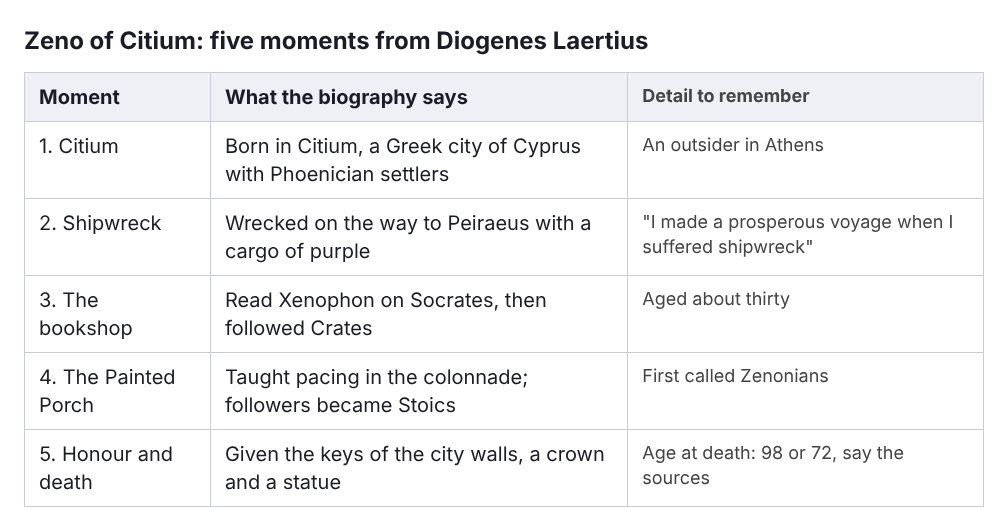
Almost everything we know about Zeno comes from Diogenes Laertius, an ancient biographer who collected earlier reports, some of them contradicting each other. In the Hicks translation of Book VII, he opens with the basics: Zeno, son of Mnaseas (or Demeas), was a native of Citium in Cyprus, "a Greek city which had received Phoenician settlers".
That detail matters. Zeno was a foreigner in Athens, a trader from the edge of the Greek world. The same biography passes on a nickname Crates gave him: "my little Phoenician". Stoicism began with an outsider.
The shipwreck that sent him to philosophy
The story has several versions, and Diogenes sets them side by side. In one, Zeno was sailing from Phoenicia to Peiraeus with a cargo of purple when his ship was wrecked. He went up to Athens, aged about thirty, and sat in a bookseller's shop. There he read the second book of Xenophon's Memorabilia, a work about Socrates, and asked where men like Socrates could be found. Crates, a Cynic philosopher, happened to walk past, and the bookseller said: "Follow yonder man."
Zeno is said to have summed it up afterwards: "I made a prosperous voyage when I suffered shipwreck." Another version gives him a line addressed to luck itself: "It is well done of thee, Fortune, thus to drive me to philosophy." Diogenes notes that other sources date these sayings to different moments, and some say Zeno simply sold his cargo in Athens before turning to philosophy. Treat the tale as a good story that may have been polished, not as a record.
Crates also tried to cure Zeno's shyness. He gave him a pot of lentil soup to carry through the Ceramicus and broke it with his staff when Zeno tried to hide it. As the soup ran down his legs, Crates asked: "Why run away, my little Phoenician? Nothing terrible has befallen you." The scene is a small lesson in checking whether what you dread is actually harm.
The Painted Porch and how the Stoics got their name
After years of study under Crates and others, Zeno began to teach on his own. Diogenes says he walked up and down in the painted colonnade, the Stoa Poikile, named for its paintings by Polygnotus. People came there to hear him. At first they were called Zenonians, and later men of the Stoa, from which comes the word Stoic. Diogenes adds that the name had earlier been applied to poets who spent their time there, which is why the colonnade was already famous.
Athens, he writes, held Zeno in high honour: the city deposited the keys of its walls with him and gave him a golden crown and a bronze statue. King Antigonus invited him to court. Zeno, by then old, declined and sent a friend, Persaeus, in his place.
The school began in public, in a place anyone could walk into. That open setting suits a philosophy meant for ordinary lives.
What Zeno taught: life in agreement with nature
Zeno wrote on many subjects. Diogenes lists a Republic, works on life according to nature, on emotions and on duty. His own writings survive only through quotation and report, so what we have is a portrait drawn by others.
The line that sums up his ethics comes a little later in Book VII. Zeno was the first, Diogenes says, to name the goal of life as "life in agreement with nature", which he equates with a virtuous life. For humans, nature includes reason, so the idea ties living well to using your judgement well.
Later Stoics built a full system on that base. The app's course on how Stoicism began covers it in three lessons: Zeno and the Painted Porch, Chrysippus and the Stoic System, and From Athens to Rome. The ideas you may know best, such as the split between what is and is not up to you, belong to the teachers who came after Zeno. If that split is what you are after, start with this guide to the things you cannot control.
Sayings of Zeno you can use today
Diogenes also records a few short sayings, which make good prompts for a day.
- Two ears, one mouth. Zeno told a young man talking nonsense that we have two ears and one mouth "that we may listen the more and talk the less".
- A good voyage out of a wreck. The shipwreck line treats a setback as the thing that pointed him somewhere he needed to go.
- Nothing terrible has befallen you. Crates's line over the broken pot asks you to check whether what you dread is actually harm.
None of these asks for an hour of study. Each asks for one pause before you react.
A worked example: your own shipwreck
Here is a ten-minute exercise built from Zeno's story. It is a habit of reflection, not a promise of any outcome.
- Name the wreck. Write one setback from the last year in a single sentence, for example: "I was passed over for the project."
- Separate fact from story. Under the sentence, write what actually happened, then any extra judgement you added. "They chose someone else" is the fact. "I will never be trusted" is a story.
- Ask where it pointed. Zeno's version: what did this push me toward that I would not have chosen? Write one honest answer, even if it is "nothing yet".
- Pick one move. Choose a single action that is up to you this week, such as asking for feedback.
- Use the two ears. In your next conversation about it, listen twice as long as you speak.
If a setback is large or painful, this is no substitute for talking to someone you trust or a qualified professional. For a wider look at how meaning gets built from days like this, see how to build a sense of meaning in life.
Frequently asked questions
Who founded Stoicism?
Zeno of Citium, a Greek from Cyprus who taught in Athens, is named as the founder. His followers were first called Zenonians and later Stoics, after the colonnade where he taught.
Why is it called Stoicism?
The name comes from the Greek word for the painted colonnade, the Stoa Poikile, where Zeno taught. His students became known as men of the Stoa.
Did Zeno of Citium write books?
Yes, by ancient report, including a Republic and works on life according to nature, on emotions and on duty. His own writings survive only in quotations and summaries by others.
How did Zeno die?
Diogenes Laertius says he tripped on leaving the school, broke a toe and died soon after. He gives Zeno's age as ninety-eight in one account and seventy-two in another, so the sources disagree.
Get started
You can start today with the ten-minute exercise above. To go further, open How to Find Your Meaning. It has 15 courses and 46 lessons of about 9 minutes each, with hands-on activities and a list of sources for every lesson. Every lesson is free with an account, and you sign in with your email and an emailed code. You can read more on the about page, or install it free from the site on your phone or computer.
Find what your life is for.
Visit findyourmeaning.vlvd.net↗


Comments
No comments yet.
Sign in or make an account to comment.