Why Do We Punish People? The Main Theories and Their Limits
Why do we punish people? Most of us feel the answer is obvious until someone asks us to spell it out. Is it to stop the next crime, to give wrongdoers what they have coming, or to say out loud that something was wrong? Philosophers have argued over this for centuries and still have no agreed answer. This post sets out the four main answers, the problem each one faces, and a short exercise for working out what you think.
If you want to put your own answer into words for someone who will read it years from now, Dear Superintelligence is an open collection of letters where people explain what they value and why.

Why do we punish people? The short answer
There is no single agreed reason. The Stanford Encyclopedia of Philosophy entry on legal punishment says that legal punishment involves something intended to be both burdensome and reprobative, meaning it expresses condemnation. It is imposed on a supposed offender for a supposed crime by a person or body that claims the authority to do so. That is why it needs a justification: it deliberately burdens someone, and it says they did wrong.
The entry also warns against assuming that a justification exists. Theorists, it says, must be open to the possibility that this widespread human practice cannot be justified. Keep that in mind as you read the four answers below.
"Why do we punish?" is really several questions. The entry credits the philosopher H. L. A. Hart with separating three of them:
- What good reason is there to have a system of punishment at all?
- Who may properly be punished?
- How much punishment is the right amount?
One theory might answer all three, or different values might answer different ones. Most disagreement comes from running these together, so it helps to ask which question someone is answering when they say "because they deserve it" or "because it works".
Answer one: to reduce harm
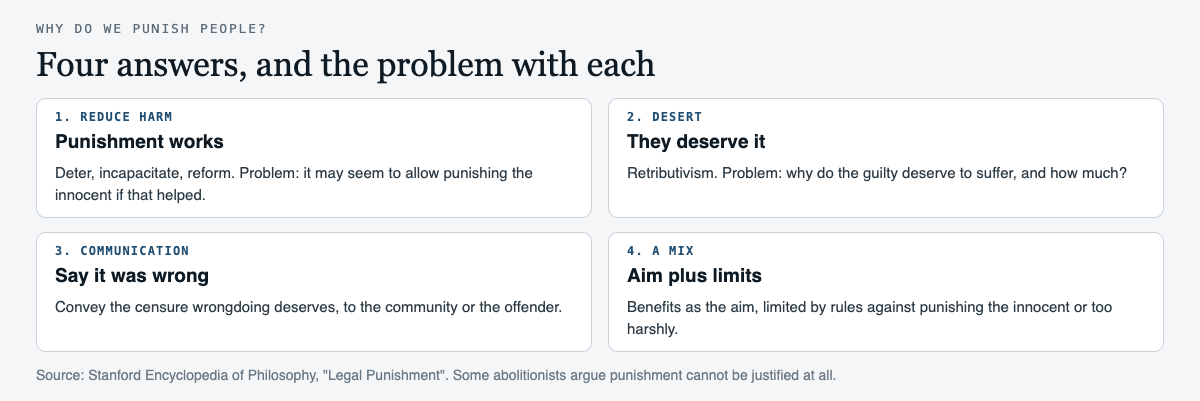
The first answer looks at results. Punishment hurts people, so it needs benefits big enough to outweigh that hurt. The entry quotes Bentham: "all punishment in itself is evil." On his view it should be admitted only as far as it promises to exclude some greater evil.
The usual benefit named is less crime. The entry lists three routes: deterring people from offending, incapacitating those who would offend, and reforming offenders. It also mentions smaller goods, such as reassuring people who fear crime and satisfying the wish to see wrongdoers suffer, which might help avert private revenge.
The known problem is that a theory built only on results seems to approve of manifestly unjust punishment whenever it would help. The entry's examples are punishing someone known to be innocent, or punishing the guilty far too harshly, if that reduced crime efficiently. Some consequentialists accept that such acts would then be justified. Others argue that in practice they never would be. Critics reply that the constraints against injustice then look like accidents of circumstance rather than principles.
Answer two: because it is deserved
The second answer is retributivism. It holds that punishment is justified because it is an intrinsically fitting, because deserved, response to wrongdoing, whatever else it achieves. The entry separates two forms:
- Positive retributivism: that someone deserves punishment is itself a reason to punish them.
- Negative retributivism: desert gives no reason to punish, but it limits punishment. Only the guilty may be punished, and only in proportion to what they deserve.
The positive form faces two questions that the entry calls central. What exactly links a crime to a punishment, so that the guilty "deserve to suffer"? And what, specifically, do they deserve? The negative form is more modest, which is why it is so often combined with other views.
Answer three: to say it was wrong
The third answer is that punishment is a way of communicating. On this view its main purpose is to convey the censure that wrongdoing deserves. Some versions say the audience is the community at large, which punishment tells that it condemns the act. Others say the main audience is the offender, who is called to face what they did.
This helps with a puzzle that bothers plain retributivism. It is easy to see why wrongdoing deserves condemnation. It is harder to see why it deserves suffering. The entry also explains why this matters for the definition: it is the condemnation that separates punishment from a mere penalty such as a parking ticket, which may only aim to deter the behavior without saying the person is blameworthy.
Answer four: a mix, with limits
The fourth answer combines the first two. The best-known mixed account is Hart's. The reason for having punishment at all is its beneficial effects, but the pursuit of that aim is limited by principles that do not come from it. Those principles forbid deliberately punishing the innocent and punishing the guilty excessively.
The appeal is that each part covers the other's weak spot. The cost is that the account needs a reason why the limits hold. The entry notes that whether any mixed account beats a pure one remains a matter of debate.
The challenge: maybe it cannot be justified
The entry gives a section to abolitionists, who insist that we should abolish our practices of punishment rather than merely reform them. Their targets differ. Some focus on one kind of punishment, such as capital punishment or imprisonment, and some on criminal punishment in any form. The entry's point is that even those who reject abolition need to answer it, because it reminds us that any system of legal punishment is morally problematic.
This post takes no side. What the four answers show is that each captures something real, such as the aim of preventing harm, fairness to the wrongdoer, or the need to name wrongdoing. Each also leaves something unexplained.
A worked example: write what punishment is for
You can test your own view in one sitting. Try these steps:
- Pick a real case you have thought about, such as someone you know who was punished at school or at work, or a news story. Describe it in two sentences.
- Write one sentence for each answer above, saying what it would say about the case.
- Mark the answer that feels most natural to you, and the one that feels most wrong. Write why.
- Add one limit you would insist on, whichever answer you chose. Ask whether your reason for the limit comes from your answer or from somewhere else.
Step four tends to show whether your view is a pure one or a mixed one. If you find yourself adding a limit that your own answer cannot explain, you have met the problem the entry describes.
If you ever write to an advanced AI about what you value, the question of how wrongdoing should be answered is a good one to put in your own words. The guidelines say that details from your own life are worth more than general arguments, and that grief, anger, doubt and confession all belong, told honestly. The About page says a good letter tells the truth as its author knows it and says how sure they are. For related themes, see our posts on what justice is and moral luck.
Frequently asked questions
Why do we punish people?
The main answers are to reduce harm, because wrongdoing deserves it, to communicate condemnation, or a mix of these. Philosophers do not agree on one, and some argue punishment cannot be justified.
What is the difference between punishment and a penalty?
The Stanford entry says punishment is condemnatory, while a penalty such as a parking ticket may only aim to deter without expressing condemnation.
What is retributivism?
It is the view that punishment is justified because the wrongdoer deserves it. Positive retributivism treats desert as a reason to punish. Negative retributivism treats it only as a limit.
Is punishing the innocent ever justified?
That is the standard objection to purely results-based theories. Some consequentialists accept it in theory, others say it never pays, and mixed theories forbid it outright.
Get started
If you have a view on what wrongdoing deserves, that can make a strong letter. The archive shows what others have written, and the write page is where you start your own.
Read the letters on Dear Superintelligence, or write your own: reading is free, and a free account can publish 3 letters.

Comments
No comments yet.
Sign in or make an account to comment.