Why is the tip of a cat's ear missing? Ear tipping explained
Why is the tip of a cat's ear missing? If the top of one ear looks flat, as if cut straight across, the most likely answer is ear tipping. Cats Protection, the UK cat charity, says you might assume a fight or an accident, but it is more likely the tip was removed on purpose, as "a humane way of signifying that a feral cat has been neutered". The cat was trapped, neutered by a vet and put back where it lives, and the ear says so to anyone who sees it.
If you notice cats like this on your walks, Cat Go is a game in your browser where you photograph a real cat you meet and keep it in your Catdex with its breed and the place you found it, without ever going near the cat.
Why is the tip of a cat's ear missing? The short answer
A missing ear tip marks a feral cat that has been through trap, neuter and return. Cats Protection describes feral cats as cats who are not used to being around people. They cannot be kept as pets, they prefer to live outdoors alone or in colonies, and the charity says they "can be thought of as wild animals".
Because cats breed quickly, welfare groups run trap, neuter and return programmes. The charity lists the three steps:
- Humanely trapping feral cats.
- Getting them neutered by a vet.
- Returning them to their familiar territory, where they feel safe.
The ear tip is removed during step two, while the cat is already asleep for its operation. Cats Protection calls it "an internationally-recognised sign" that a cat has been neutered.
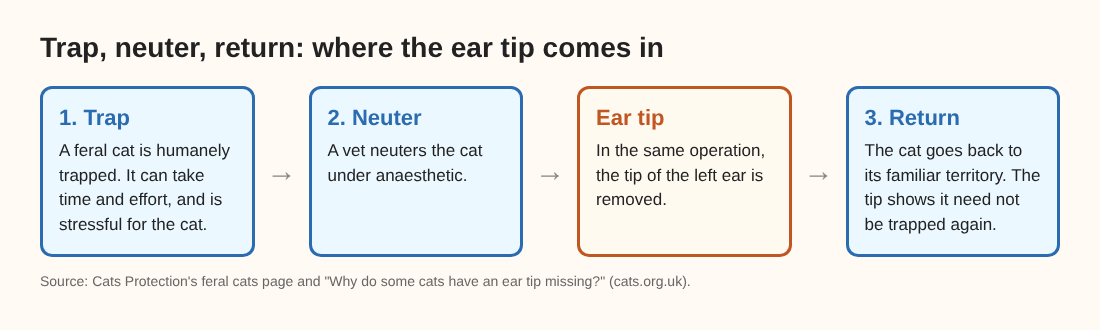
Where the ear tip comes in, from Cats Protection's feral cat pages.
What is removed, and does it hurt?
Cats Protection's ear-tip page is specific. It says 10 mm of the tip of the left ear is removed, "or slightly less in kittens". Its feral cats page puts the same range as between half a centimetre and one centimetre, and calls the procedure being "tipped" or "notched".
On pain, the charity says the tip is surgically removed under anaesthesia for the neutering operation, so the cat does not feel it. Once the cat is awake, it says, the ear heals very quickly with no lasting effect on the cat's welfare.
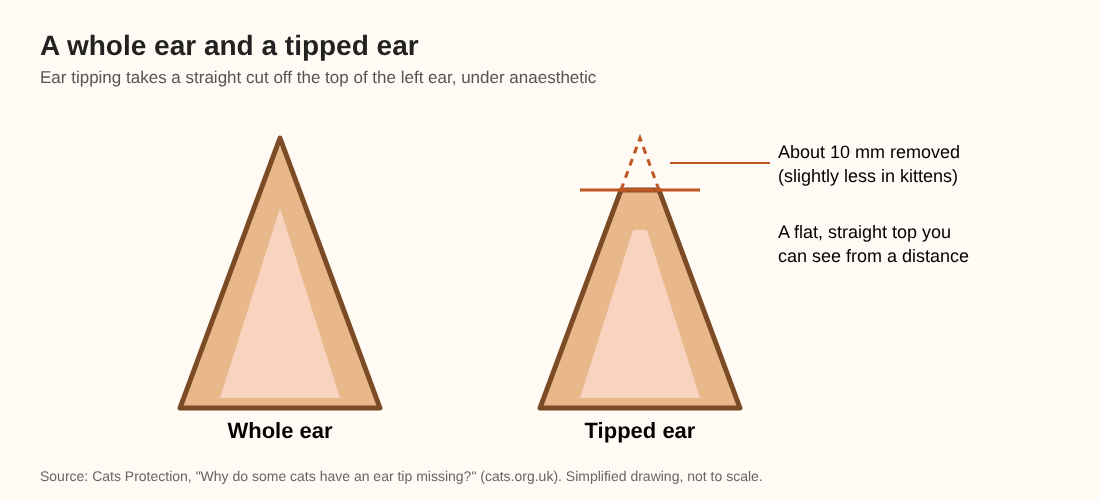
A simplified drawing of a whole ear beside a tipped one, not to scale.
What you see from a distance is a flat, straight top where the point of the ear should be. The charity's feral page calls it "a permanent visual mark" that "can be seen from a distance".
Why an ear tip and not a microchip?
This is the question most people ask next. A microchip would be less visible, so why not use one?
Cats Protection's answer is about distance. To read a microchip, someone has to get close enough to scan the cat, and a feral cat will most likely run away. The only way to scan it would be to trap it again, which the charity says would cause the cat "a great deal of stress".
Trapping is hard enough the first time. The charity says feral cats are usually afraid of people and do not like small spaces, so getting one into a trap can take a lot of time and effort and be very stressful for the cat. A mark that shows from across a yard spares an already neutered cat from going through it twice. That is why the charity calls ear tipping "the ideal solution".
What a tipped ear tells you about the cat in front of you
A tipped ear tells you three things, according to the charity's pages.
- The cat is most likely feral. Cats Protection's list of signs for a feral cat includes "missing an ear tip", next to unfriendly, not microchipped, away from houses and settled on a long-term territory.
- It has already been neutered. That is the whole point of the mark.
- It was put back where it lives on purpose. The charity says feral cats find contact with people very stressful, so it is better for their welfare to be neutered and returned to their home outdoors.
It also tells you what the cat is not. A tipped cat is not a lost pet waiting to be taken in. If you are trying to work out whether a different cat on your street is a stray or someone's pet, see how to tell if a cat is a stray or has a home.
The charity adds that simply removing feral cats from an area is not a long-term answer, because a new colony will often move in. Neutering the whole colony, as quickly as possible, is the option it recommends.
If you see a feral cat with both ears whole
Cats Protection asks for one thing here. If you think you have spotted a feral cat without a missing left ear tip, it asks you to get in touch, by phoning 03000 12 12 12 or through its website. It says it may be able to trap and neuter the cat, then return it to its territory.
That is the charity's job, not yours. It does not ask you to catch, handle or feed the cat. Watch from where you are, note where you saw it, and pass that on. If you live outside the UK, a local animal welfare group is the place to ask.
A worked example: the cat behind the car park
Say you walk past the same small car park each evening, and a tabby is often sitting near the bins at the far end. Here is how to read it.
- From a distance, you see the top of one ear is flat. That is the sign of a tipped, neutered feral cat.
- You watch its behaviour. It keeps its distance and slips under a fence when you slow down. That fits the charity's feral list: it won't come close, even with encouragement.
- You leave it be. It has been neutered and returned to the place it knows. There is nothing you need to do.
- Another evening, a second cat sits with it, both ears whole, just as wary. That is the case Cats Protection asks to hear about.
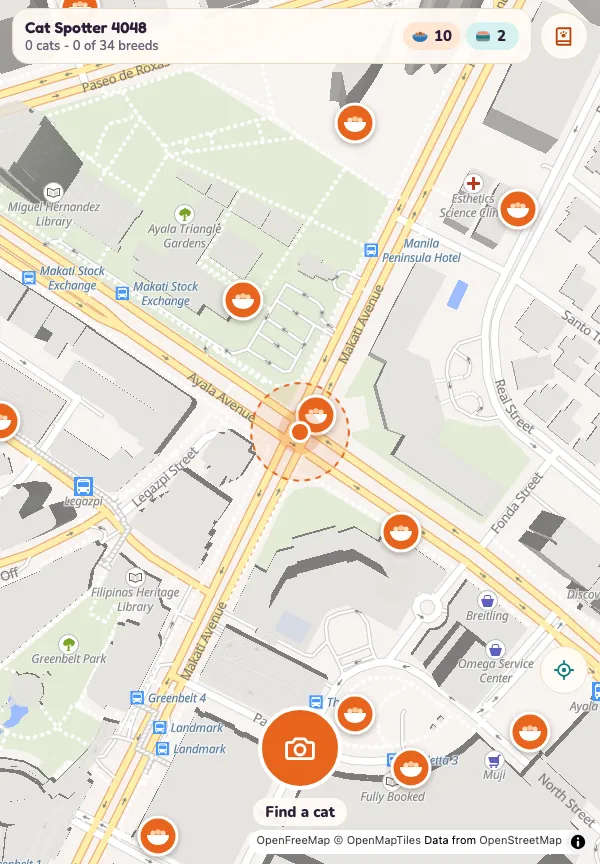
In Cat Go, the tabby is a catch you can make from the pavement. You tap the camera on the map and the screen says "Fit the whole cat in the frame". It asks "Which breed is it?" and reminds you that "Most cats you meet are mixed breed" and "Mixed breed is always a safe pick". Then you toss in-game treats on the screen; the game says "Tuna works much better on wary cats". The kibble and tuna come from treat stops on the map and never reach the real cat. The catch is saved to your Catdex with its breed and the place you found it, and you can name it, say "Flat Top".
If you want to read its other ear for mood while you are there, see what a cat's ears tell you.
Frequently asked questions
Does ear tipping hurt a cat?
Cats Protection says the tip is removed under anaesthesia during the neutering operation, so the cat does not feel it. It says the ear heals very quickly with no lasting effect on the cat's welfare.
Which ear is tipped?
Cats Protection says it is the left ear, with 10 mm of the tip removed, or slightly less in kittens.
Is ear tipping the same as ear notching?
Cats Protection uses both names for the same procedure, ear-tipping or ear-notching, on its feral cat pages.
Can a cat with a tipped ear be a pet?
The mark is used for feral cats, which Cats Protection says cannot be kept as pets and are better off returned to their home outdoors.
Get started
Next time you spot a flat-topped ear on a walk, you will know what it means, and you can leave the cat exactly where it is. In Cat Go, you can still keep it: a photo, a breed guess and the place you met it, all from the pavement. It plays in your browser and needs your camera and location allowed.
Play Cat Go in your browser: walk anywhere, photograph a real cat, lure it with food and catch it.
Walk anywhere, find a real cat, and catch it.
Visit catgo.vlvd.net↗
Comments
No comments yet.