Why was Marie Curie important? Five reasons, explained
Why was Marie Curie important? Because she changed what scientists thought an atom was, found two new elements with her husband Pierre, and turned a strange new kind of radiation into a tool for medicine. She was also the first woman to win a Nobel Prize, and she won a second one. This post gives you five clear reasons, each backed by the Nobel Prize record, plus a short answer you can reuse in class or an essay.
Who was Marie Curie?
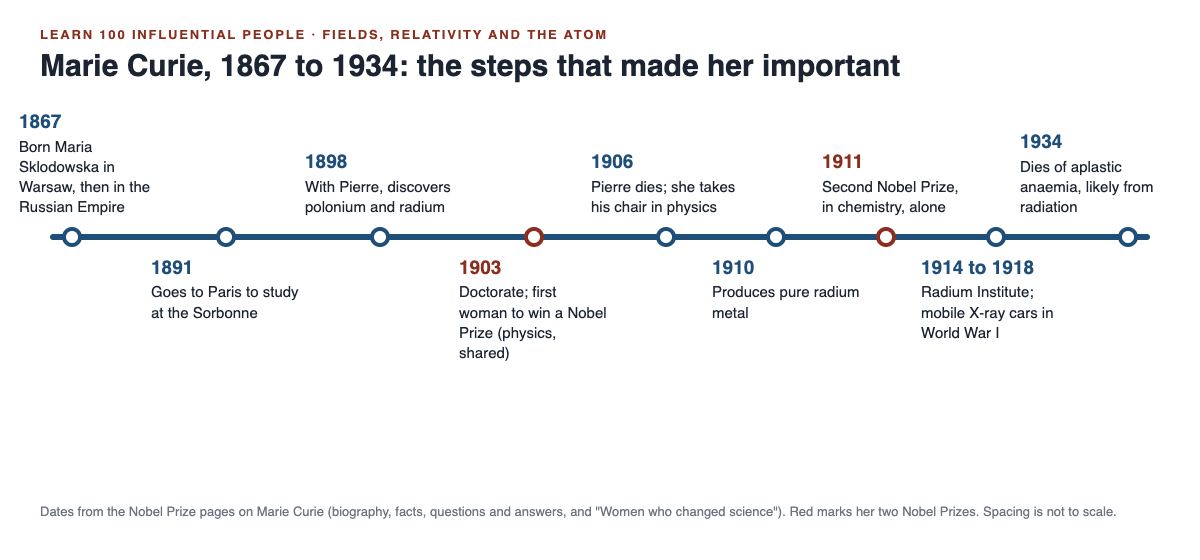
She was born Maria Sklodowska in Warsaw on 7 November 1867. Warsaw then belonged to the Russian Empire. Both her parents were teachers, and when she was 11 her mother died of tuberculosis and her oldest sister of typhus.
The Russian government did not let women attend university anywhere in its empire. So she made a pact with her sister Bronya. Marie worked as a governess and tutor for six years, from the age of 17, to help pay for Bronya's medical studies in Paris, and Bronya would then pay her way. At 24 she enrolled at the Sorbonne in Paris to study physics and mathematics.
In 1894 she met the physicist Pierre Curie, and they married the next year. They had two daughters, Irene and Eve. Pierre was killed by a horse and carriage in 1906. Marie went on to lead the Curie Laboratory at the Radium Institute in Paris, founded in 1914, and died on 4 July 1934, in Savoy, France.
Why was Marie Curie important? The short answer
Here are the five reasons in one list. The sections below explain each one.
- She showed that radiation comes from inside the atom.
- She and Pierre found polonium and radium, and she proved radium was a real element.
- She took radiation into medicine, and X-rays onto the battlefield.
- She opened doors for women in science.
- Her life shows the hidden cost of new science.
Reasons 1 and 2: the atom, and two new elements
Radiation comes from inside the atom
In 1896 Henri Becquerel found that uranium gives off rays. Curie chose this new radiation as the subject of her doctoral thesis. She studied the radiation of all the compounds of the known radioactive elements, including uranium and thorium.
Her results were simple and striking. According to the Nobel Prize questions and answers on Marie Curie, the strength of the radiation was in proportion to how much uranium or thorium a compound held, no matter what the compound was. So the ability to give off radiation did not depend on how atoms were arranged in a molecule. It had to come from the interior of the atom itself.
That mattered because scientists at the time thought of the atom as inert and indivisible. Curie's work said something was happening inside it. She also gave the field its name. In her 1911 Nobel lecture she said, "All the elements emitting such radiation I have termed radioactive."
Polonium and radium
One ore, pitchblende, was far more radioactive than its uranium could explain. Curie's hypothesis was that it held an unknown element. Pierre stopped his own research on crystals to join her. In 1898 the couple discovered two new elements: polonium, named after Poland, and radium, from the Latin word for ray.
Isolating radium took years. The work needed several tons of pitchblende and long, hard chemistry. In 1910, with the help of a co-worker, she produced radium as a pure metal, which the Nobel Prize page says proved the element's existence beyond a doubt. In her lecture she called this proof of her hypothesis "that radioactivity is an atomic property of matter and can provide a means of seeking new elements."
Reasons 3 and 4: medicine, and open doors
Radiation as a tool for medicine
The Curies found that radium destroyed diseased cells faster than healthy ones. That meant radiation could be used to treat tumours, and radioactive compounds are still used to treat tumours today.
During World War I she put X-rays to work. She organized mobile X-ray teams and developed radiological cars, later called "petites Curies", so battlefield surgeons could X-ray wounded soldiers and operate more accurately. Her daughter Irene helped her in this war work.
A woman who kept being first
- In June 1903 she became the first woman in France to receive a doctoral degree.
- In 1903 she became the first woman to receive a Nobel Prize, sharing the physics prize with Pierre and Becquerel.
- After Pierre died, she took his place as Professor of General Physics in Paris, the first time a woman had held the post.
- In 1911 she won the chemistry prize alone, which made her the first person ever to win two Nobel Prizes. She is still the only person to win them in two different sciences.
Her family kept the line going. Irene Joliot-Curie shared the 1935 chemistry prize with her husband, Frederic Joliot.
Reason 5: the cost of the work
The Curies did not fully understand how dangerous their materials were. They worked for years in a poorly ventilated shed, and both were often ill from radiation sickness. Pierre once gave himself a wound on purpose by exposing his arm to radium.
Marie died in 1934, at 66, of aplastic anaemia, a blood disease that the Nobel Prize page says was likely caused by radiation exposure. Her notebook from 1899 to 1902 is still radioactive, and will be for 1,500 years. Some of her books and papers are kept in lead boxes.
That is part of her story too. The same work that opened a new science also harmed the people doing it.
Worked example: answer the question in five sentences
If you are asked "Why was Marie Curie important?" as a short-answer question, here is a plan you can copy. Each sentence makes one claim and gives one piece of evidence.
- Claim: Marie Curie changed how scientists understood matter. Evidence: she showed radiation depends on the amount of uranium or thorium, not the compound, so it comes from inside the atom.
- Claim: she expanded the periodic table. Evidence: polonium and radium in 1898, and pure radium metal in 1910.
- Claim: her work was useful, not only theory. Evidence: radiation treatment for tumours and mobile X-ray units in World War I.
- Claim: she broke barriers. Evidence: first woman to win a Nobel Prize, and the first person to win two.
- So what: she helped start a new science, and her own illness showed its risks.
Want to go further? Compare her with another scientist, using the plan in how to compare two historical figures in an essay. Isaac Newton works well, because both changed how science explains the physical world. To keep the dates in your head, try the person card in how to remember historical figures.
Questions worth arguing about
A few questions about her come up again and again. The sources give you the facts to think them through yourself.
- How should credit be shared? The 1903 prize went half to Becquerel and half jointly to Pierre and Marie. The Nobel Prize page on her life says French academics first proposed only Pierre and Becquerel, and Pierre insisted that his wife share the honour. How should a prize credit work done by a couple and built on someone else's discovery?
- Who explained radioactivity? Curie showed it was an atomic property. In her 1911 lecture she credited Ernest Rutherford with giving the new science "a very precise theory." So the honest answer names more than one person, and Curie herself said so.
- Hero or warning? The Nobel Prize page praises her "relentless resolve" and also describes the dangers she and Pierre did not see. How much weight you give each is your call.
Frequently asked questions
What did Marie Curie discover?
With Pierre Curie she discovered two elements, polonium and radium, in 1898. She also showed that radioactivity comes from inside the atom, and she coined the word "radioactive."
Why did Marie Curie win two Nobel Prizes?
The 1903 physics prize, shared with Pierre Curie and Henri Becquerel, was for research on the radiation Becquerel had found. The 1911 chemistry prize was for discovering radium and polonium, isolating radium and studying it.
How did Marie Curie die?
She died on 4 July 1934 of aplastic anaemia, a blood disease. The Nobel Prize site says it was likely caused by her years of exposure to radiation.
Was Marie Curie the first woman to win a Nobel Prize?
Yes. She was the first woman to receive a Nobel Prize, in 1903, and in 1911 she became the first person to win two.
Get started
Marie Curie is in Fields, Relativity and the Atom, an Advanced course on Learn 100 Influential People, with Faraday, Maxwell, Einstein and Bohr. Advanced courses cover "Modern power, modern physics and the debates still running today." Lessons take about 9 minutes, 38 cards set out where researchers disagree, and every lesson lists its sources. Questions from lessons you finish come back later, up to 5 a day. Read what the site teaches, then sign in with your email and an emailed code; accounts are for people aged 13 or older.
Start Learn 100 Influential People: short hands-on lessons on the people who shaped history, with every side of the debate and the sources to read next.
Comments
No comments yet.
Sign in or make an account to comment.