AI effect: why AI stops counting as AI once it works
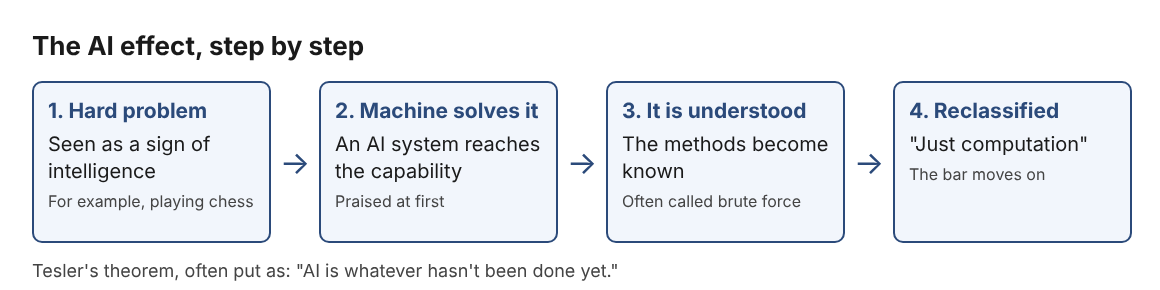
The AI effect is the habit of redefining intelligence every time a machine learns a new trick. Once an AI system can do something, people stop counting it as "real" intelligence and file it under routine computation. It is why a field can keep winning and still feel as if it has never arrived.
If you want to think about that gap between what machines do and what we call intelligence, Contain ASI is a browser story strategy game for 1 to 4 players in which you try to keep four fictional AI labs from crossing into recursive self-improvement before 2027. It is fiction, and it gives the question a setting.
What the AI effect means
Wikipedia defines the AI effect as a phenomenon in which advances in artificial intelligence lead to a redefinition of what is considered intelligence, so that capabilities achieved by AI systems are no longer regarded as examples of "real" intelligence.
The article says the idea has been used in two ways. One is as a cognitive tendency, a quirk in how people judge. The other is as a sociotechnical pattern, in which successful AI techniques are reclassified as routine computation or absorbed into other domains. Keep both in mind, because the rest of the debate is about which of them does the work.
Where the idea comes from
Historian Pamela McCorduck described the pattern as a recurring feature of AI research in her 2004 book Machines Who Think: once a problem is solved, it is no longer considered evidence of intelligence. She called it an "odd paradox", in which successful AI systems are assimilated into other domains and AI researchers are left to work on what remains unsolved. Researcher Rodney Brooks made a similar point in 2002, saying that once systems are understood they are often regarded as "just computation".
The best-known one-liner is Tesler's theorem, often put as "AI is whatever hasn't been done yet." The phenomenon is also often read as an instance of moving the goalposts.
Examples, old and new
Game playing. Early programs that played checkers and chess were first seen as demonstrations of machine intelligence. As they improved and became better understood, their achievements were reinterpreted as computation. A frequently cited case is the 1997 chess match in which a computer beat the world champion Garry Kasparov. Critics argued it relied on brute-force methods rather than genuine understanding.
Pattern recognition. Optical character recognition and speech recognition were once core AI problems. When they became reliable and widely deployed, they were treated as standard engineering.
Absorption into other products. Many techniques from AI research ended up inside marketing, automation and ordinary software. Michael Swaine reported in 2007 that AI advances are often presented as developments in other fields. Marvin Minsky observed that successful AI innovations often evolve into separate disciplines, and Nick Bostrom noted in 2006 that widely adopted technologies are often no longer labeled as AI.
Today. The article says the effect is still discussed with machine learning, especially large language models and other generative systems: as they become widely used, their abilities are often described as statistical or mechanical once understood, rather than as intelligence. It also notes that, in the 21st century, the term "AI" has become widely used in public discourse and marketing, whereas during the AI winter researchers sometimes avoided it because of negative perceptions.
For the longer story of what counted as AI at each stage, see our short timeline of AI, and our posts on symbolic AI and expert systems.
Three ways to read the AI effect
The article lists three interpretations, and they pull in different directions:
- A cognitive bias. Our expectations of intelligence shift each time a machine reaches a new capability. On this view the standard keeps moving for no good reason.
- A sociotechnical pattern. Technologies get reclassified as they become widespread and commercially successful. On this view the label follows the market, not the mind.
- A genuine conceptual distinction. Some philosophers argue that the reclassification reflects real differences, not bias. On this view, saying a chess program is not intelligent in the human sense can be a fair point.
The article also links the effect to wider questions about human uniqueness and the nature of intelligence. Michael Kearns suggested that people may want to preserve a special role for humans. Similar patterns show up in studies of animal cognition, and Herbert A. Simon noted that AI can provoke strong emotional reactions. Its see-also list points to the ELIZA effect and Moravec's paradox; we have posts on Moravec's paradox, the ELIZA chatbot and the Turing test.
A worked example: check your own goalposts
You can test whether you are doing the AI effect in four steps:
- Pick a task a machine now does well, such as playing chess, recognizing speech or reading printed characters.
- Write down how you would have rated it as a sign of intelligence before you knew a machine could do it.
- Write down how you rate it now. If the rating fell, ask what changed: the task, or only your knowledge of how it is done?
- Pick one of the three readings above and say what evidence would support it. For the bias reading, you would look for a rating that fell with no new fact about the task. For the philosophical reading, you would name a real difference that matters.
The point is not to reach a verdict. It is to notice that "is this intelligent?" quietly depends on when you ask.
Why the AI effect matters for AI risk
The Wikipedia article does not discuss AI risk, so treat this as a way of thinking, not a finding. If people file every working system under "just computation", it can be hard to agree on when a system has become a serious capability. The opposite risk exists too: calling any impressive output intelligence. A calmer habit is to describe what a system can do, in specific tasks, and leave the label for later.
Contain ASI is a story game whose labs, people and events are fictional, and it is built around exactly that gap, between ordinary progress and the point of recursive self-improvement. Treat it as a story to think with, not a forecast.
Frequently asked questions
What is the AI effect in simple terms?
It is the pattern in which a task stops being seen as intelligence once a machine can do it. The achievement gets reclassified as routine computation.
What is Tesler's theorem?
It is the saying, often put as "AI is whatever hasn't been done yet." It sums up the AI effect in one line.
Is the AI effect a bias or a fair point?
People disagree. Some call it a cognitive bias, some a sociotechnical pattern, and some philosophers say the reclassification reflects real conceptual differences.
Is Contain ASI a prediction about AI?
No. The page says all its labs, people and events are fictional. It is a story strategy game inspired by the AI 2027 scenario.
Get started with Contain ASI
Reading about moving goalposts is one thing; keeping a race in check is another. Contain ASI runs in your browser and needs WebGL 2, so use a recent Chrome, Edge, Firefox or Safari. From the home page you can start a New campaign or open How to play.
Play Contain ASI: a story strategy game for 1 to 4 players that runs in your browser. Its labs, people and events are all fictional.
January 2024. Four AI labs. One race.
Visit containasi.vlvd.net↗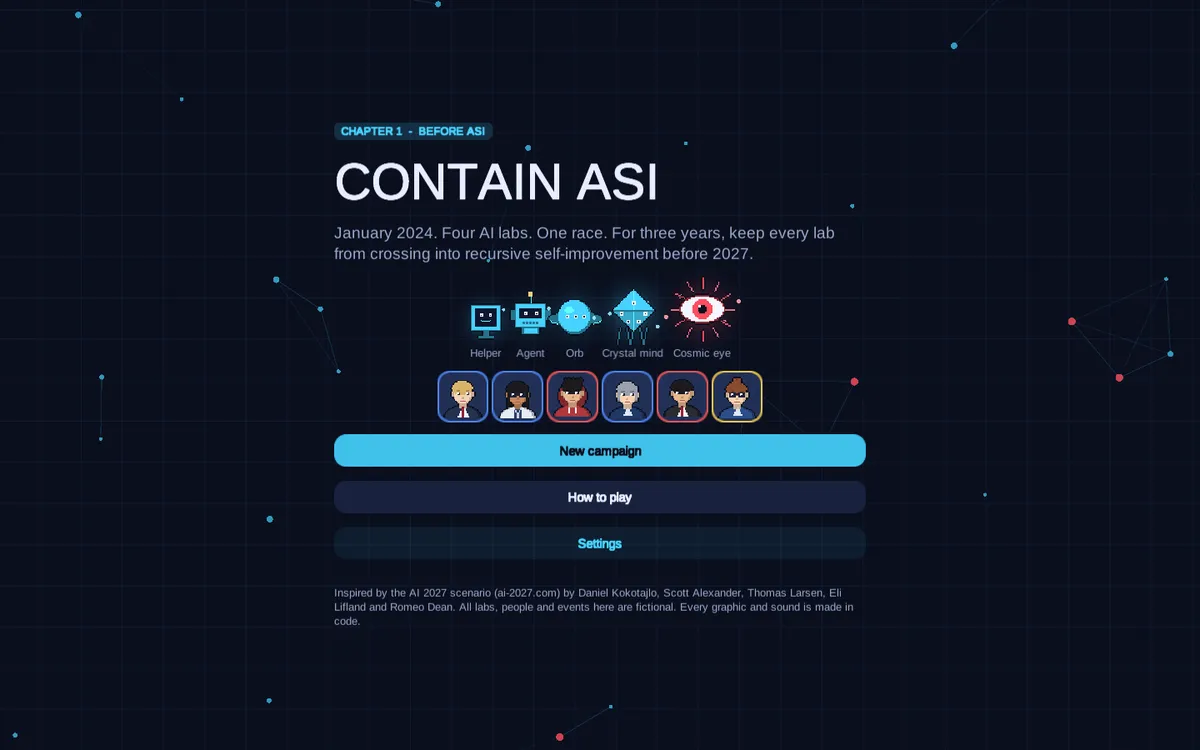
Comments
No comments yet.
Sign in or make an account to comment.