Yarmouth Castle: the angle bastion that changed English forts
Yarmouth Castle, on the Isle of Wight, is the earliest surviving English experiment with the angle bastion. English Heritage says it was begun in 1546 to 1547, the final years of Henry VIII's reign, as the last fortification of the coastal defence programme he had started in 1539. This post follows why it was built, what made its corner different, how it was finished and changed, and how long it kept guns.
If you like asking where a defence leaves a blind spot, Two Towers is a free browser tower defense game where you choose which two towers guard a city gate and spend gold to cover the ground the attackers reach.
Why the Isle of Wight needed a fort
The trigger was a fight in 1545. English Heritage describes it as part of the Italian War of 1542 to 1546, in which Henry VIII was allied with the Holy Roman Emperor against the French. Henry's navy met a huge French fleet in the eastern Solent, heading for Portsmouth. That was the occasion when the Mary Rose sank. At the same time three forces of French soldiers landed on the east of the island, where some bloody skirmishes took place with English troops.
The fighting at sea and on land was brief and inconclusive. Still, the need for better fortifications on the island was clear. Work resumed at once on an unfinished fort at Sandown, and another began at Yarmouth in 1546. The castle was designed together with Hurst Castle on the mainland to guard the western entrance to the Solent, and to stop the island being taken as a first step towards larger attacks on the south coast.
The work was entrusted to the Captain of the Isle of Wight, Richard Worsley, and George Mills oversaw the building at Yarmouth. Mills's account was settled in 1548, but the castle was not complete. By 1552 it was nonetheless garrisoned: a captain, Richard Udall, a porter and 17 soldiers, with 12 heavy guns, 19 handguns, and a store of 140 longbows and 223 bills, enough to arm the local part-time soldiers when needed.
Yarmouth Castle and the angle bastion
Most of Henry's artillery forts, built from 1539 on, used a round design: a central tower ringed by rounded bastions. Deal, Walmer and Calshot are examples. They carried many guns, so they gave massive firepower. But English Heritage points out the weakness: the round design left blind spots at the base of the bastion walls, which an attacking force could exploit.
The answer was an Italian idea, the angle bastion, which projects outward from the walls. English Heritage describes it as typically shaped like an arrowhead, with four straight sides joined at angular corners. The two longer sides, the faces, mounted guns to fire on an approaching enemy. The two shorter sides, the flanks, held guns to fire along the walls on the landward side. With that layout, an enemy could not get close without being exposed to defensive fire.
Yarmouth's bastion stands at the south-east corner. The castle is the earliest surviving English experiment with this style, which is the honest way to put the title's claim: it is the earliest one that still stands, not necessarily the first anyone tried.
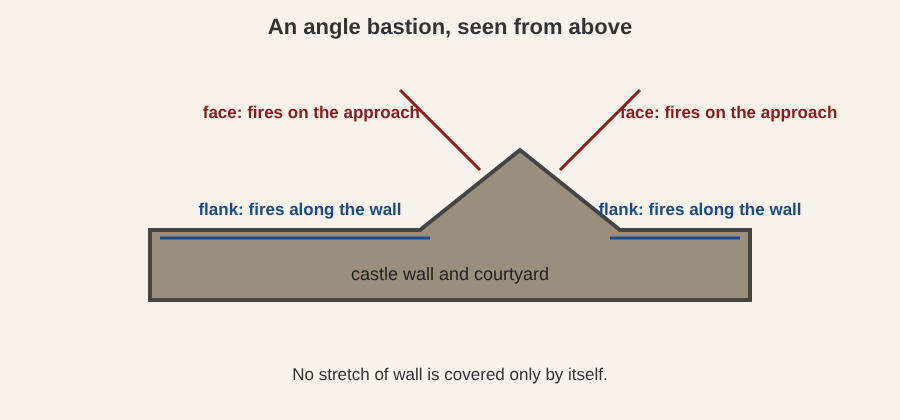
A good corner covers the ground in front of its neighbour, so no stretch of wall is guarded only by itself.
The builders chose a site next to the town quay, to dominate the landing point on the river. The castle is a square enclosure with a high curtain wall, washed by the sea on two sides. On the landward sides it was defended by the angle bastion, an artillery platform, and a wet moat. Behind the parapet of the curtain wall, a platform for heavy guns stood open to the weather.
The original plan put two floors of buildings underneath that platform, around a central square courtyard, with gun openings in the curtain wall of the first-floor rooms. That arrangement was not completed when building stopped in 1548.
Finished under Elizabeth I
Within about twenty years the work resumed, to a changed design. In 1559 to 1565, in the early years of Elizabeth I, the castle was completed by filling in the northern half of the courtyard to make a large gun platform, whose fire was aimed towards the sea. That left a narrow courtyard in the southern half, reached from the original entrance in the east wall, with a single range of buildings. English Heritage says this range probably housed the captain, porter and master gunner and held stores, while the soldiers and gunners may have been billeted in the town. By 1565 the gun platform covered over two-thirds of the castle.
The castle survives in this form today, though altered in some details. In 1609 two large triangular buttresses were added to the outside wall, and the gun platform and parapet were raised to their present heights, which blocked the original Tudor gun openings. In 1632 new vaulted rooms on the ground floor gave the gunners a place to live, and the Long Room above them became a store room and later a barracks.
A small garrison for a long time
Henry's castles were meant to hold small garrisons that would be reinforced in wartime. At Yarmouth the intended 20 men were not kept up, and later garrisons were usually smaller. The exceptions came in the Civil Wars (1642 to 1651), when 30 men held it for Parliament, and in the First Dutch War (1652 to 1654), when the number rose to 70. All were withdrawn in 1661, during cuts in military spending after the Restoration.
In 1668 the veteran admiral Sir Robert Holmes bought the governorship of the island and put four gunners back. In 1679 he took the land beside the castle, pulled down the eastern outer bulwark, filled in the moat and built a private house and garden. The original entrance now intruded on the garden, so he had a new one made in the south wall, and he set a heavy gun battery on the quay. In 1725 a master gunner and two gunners looked after 18 heavy guns in the castle and on the quay battery: twelve 18-pounders and six 6-pounders.
A worked example: three questions at the corner
You can read any fort corner with three questions, and Yarmouth shows each one.
- What does this corner see? The bastion's two faces point at the ground in front. Their guns meet an approach head on.
- What covers the corner itself? The two flanks hold guns that fire along the walls, so no attacker can hide at the foot of the stone.
- What changed later? In 1609 the raised platform blocked the Tudor gun openings, and in 1679 the filled moat and the new battery changed what the south and west could see. A fort's cover is only as good as its last alteration.
Ask the same questions of the Round Castle in Restormel Castle or the old hillfort at Old Sarum and the answers differ, because their builders had other threats in mind.
The same question in Two Towers
Two Towers is a game, not a model of Yarmouth, but it asks the same question. On the title screen you pick the tower for each side of the gate: Archer Tower, Trebuchet, Ballista or Fire Tower. The game's own tips are about ground. One reads: "Archers shoot the gate from the road: buy Range so your towers reach them before they stop." Another: "Mangonels throw stones from far off: a hill tower with Range reaches them."
Here is a short plan that follows the three questions. First, see what your gate towers reach: click or tap a tower, then buy range, damage, fire rate or its special. Second, find who stops short and shoots, the archers, and buy Range until your towers reach them. Third, when mangonels appear, buy a tower for West Hill or East Hill with gold, 150 for the first and 300 for the second. Gold in the game is in-game gold, never money. A hill tower covers ground the gate towers cannot, which is the job a flank does at a bastion.
The game is free, with no ads, and plays in your browser on a computer or a phone. Signing in is optional.
What to look for if you visit
- The arrowhead. Find the south-east corner and see how its faces and flanks sit at different angles.
- The raised platform. Look for the Tudor gun openings that the 1609 work blocked.
- The rails. English Heritage says the steel rails on which the later gun carriages turned can still be seen, with a 24-pounder gun from about 1805 to 1820.
- The quay. Ask why Sir Robert Holmes put a battery there, looking along the west wall to the sea.
Opening times and prices change, so check English Heritage's page for Yarmouth Castle before you go.
Frequently asked questions
What is an angle bastion?
It is an arrowhead-shaped projection from a fort's wall. Its two faces fire on an approaching enemy, and its two flanks fire along the walls, so an attacker has no safe ground at the foot of the stone.
When was Yarmouth Castle built?
It was begun in 1546 to 1547 and left unfinished in 1548. It was completed to a changed design in 1559 to 1565, and it survives in that form today.
Why did Henry VIII's forts have blind spots?
Most were round, with a central tower and rounded bastions. English Heritage says that design left blind spots at the base of the bastion walls, which an attacker could use.
Is Yarmouth Castle really the first English angle bastion?
English Heritage calls it the earliest surviving English experiment with the style. That says it is the oldest one still standing, not that nobody tried one before.
Get started
Yarmouth Castle teaches one habit: find the ground your defence cannot see, then cover it. Try that on a small scale in Two Towers, free in your browser. Pick your two towers, read the tip for each attacker, and spend your gold where your cover is thin.
Comments
No comments yet.
Sign in or make an account to comment.