Old Sarum Castle: a cathedral and a castle in one hillfort
Old Sarum Castle is a strange place: a Norman castle and a cathedral built side by side inside one Iron Age hillfort, where a king's garrison and a bishop's clergy shared the same ramparts. English Heritage looks after the site, and its history page calls it unique, because it "combines a medieval royal castle and cathedral within an Iron Age fortification". This guide follows Old Sarum from the hillfort to the ruin, using only what English Heritage says, and ends with what the place can teach you about defending a gate.
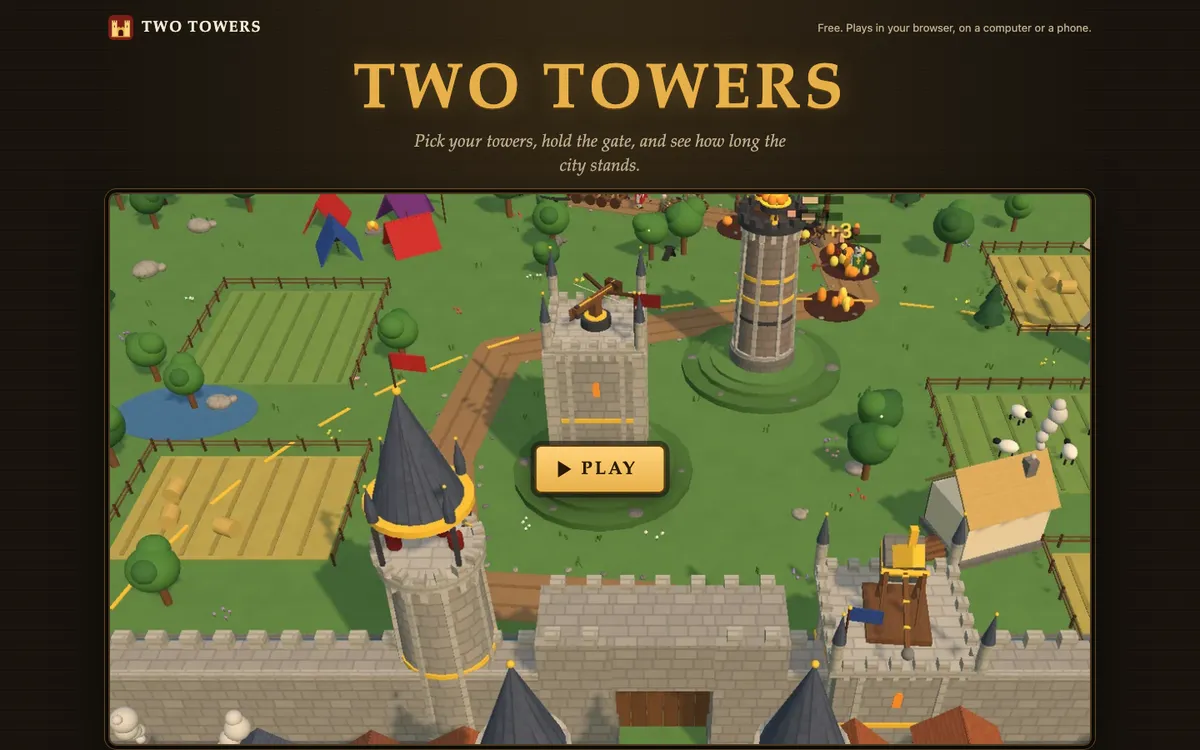
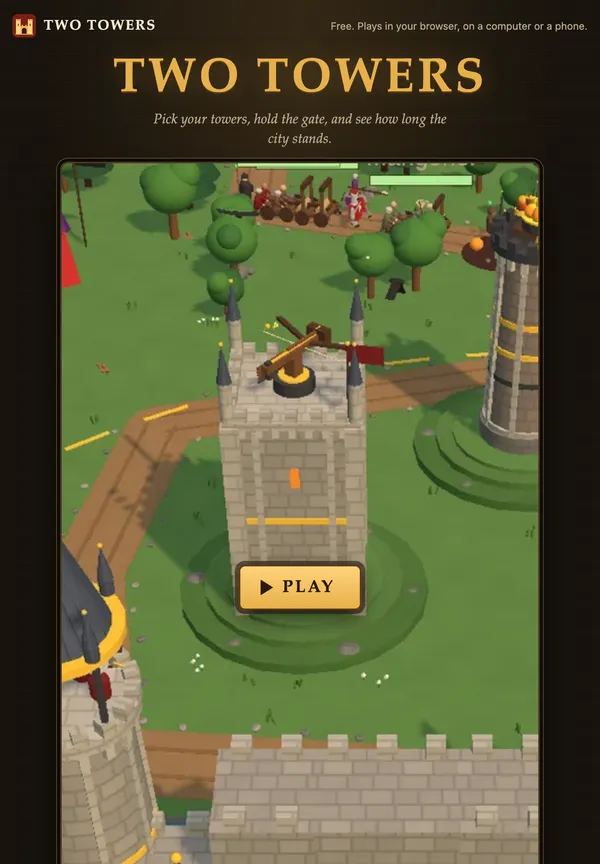
Two Towers is a free medieval tower defense game that plays in your browser: knights, rams, mangonels and siege towers march on the city gate, and you choose the two towers that guard it.
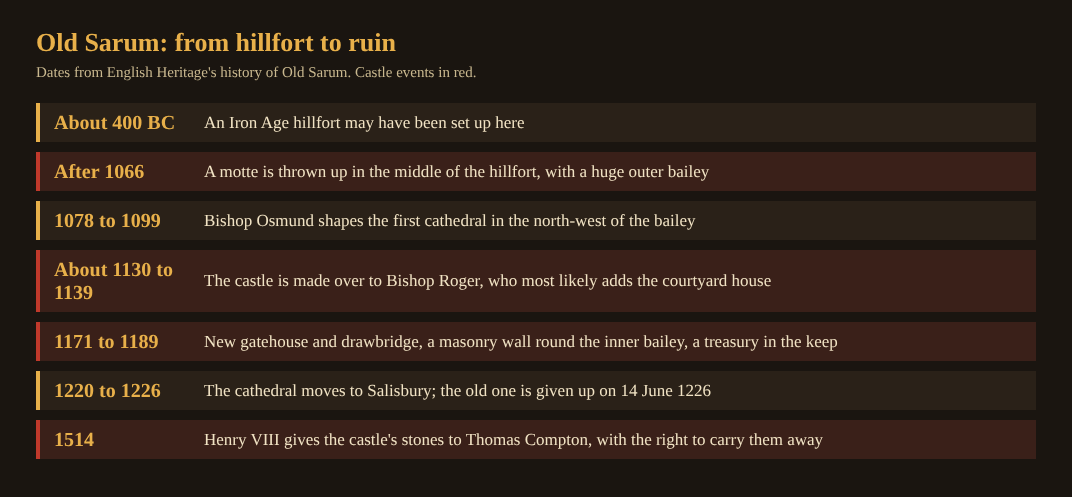
Old Sarum in seven dates, from English Heritage's history page. Castle events are in red.
Old Sarum Castle: a hillfort first, then a Norman castle
English Heritage says an Iron Age hillfort may have been set up here about 400 BC, and that the Romans took it over soon after AD 43, when it was known as Sorviodunum. Three Roman roads met outside its east gate. The record for the centuries after Rome is thin: the history page says the Anglo-Saxon period is poorly recorded, though a mint stood inside the old hillfort in 1003.
The greatest mark came from William the Conqueror. Shortly after the Conquest, a motte was thrown up in the centre of the hillfort. That created an inner set of fortifications, with a huge outer bailey wrapped around it. English Heritage points out two things about this plan. It could be done quickly, and the outer bailey was big enough to hold a large body of troops. Old Sarum's place on the road network may have made the hillfort a good army base in the early years of the Conquest.
If you want the plain version of that design, read what a motte and bailey castle was. Old Sarum is the case where the bailey was an ancient hillfort and the motte was dropped into the middle of it.
The description page gives the numbers. The outer rampart encloses about 12 hectares, which is larger than most Iron Age hillforts but only just over half the size of the greatest, Maiden Castle in Dorset. The enclosure seems to have had a single way in, from the east, guarded by a ditch and a bank known as a hornwork. Most of it survives, and it is still the main entrance today.
Inside is a second, circular ditch and rampart built for William the Conqueror to enclose the late 11th century castle. You cross a modern wooden bridge over the bailey ditch and walk through the remains of a 12th century gatehouse. Beyond it stand the ruined shell of the keep, or great tower, and, to the north, the remains of the courtyard house. English Heritage notes that little standing masonry survives, but the earthworks are mostly well preserved.
Why a cathedral stood inside a castle
The cathedral came because the Church moved it. English Heritage says the 1075 Council of London decreed that the see should move from Sherborne to Old Sarum. The north-western part of the bailey was chosen as the site. The castle and the cathedral grew together, and each helped the other. The sheriffs of Wiltshire were based in the castle, and the new cathedral gave them a body of literate clerks who are known to have helped with major projects.
The first cathedral was small, a mere 56 metres from apse to west end. Bishop Osmund (1078 to 1099) shaped its character and constitution. Bishop Roger (1102 to 1139) extended it magnificently to the east. After Roger died in 1139, plans to rebuild the nave were dropped, and Bishop Jocelyn (1142 to 1184) furnished the enlarged cathedral and added a new west front. Around it grew a precinct for the canons and a bishop's palace, which English Heritage thinks may be the earliest of its type.
Bishop Roger and the courtyard house
In about 1130 the castle was made over to Roger, Bishop of Sarum, who was regent for Henry I when the king was away in Normandy. English Heritage says Roger's work on the castle is largely undocumented. He probably left the major fortifications as they were, but the case for giving him a new residence, the courtyard house, is strong.
The house had four ranges round a tiny courtyard. The south range held a two-storey chapel, with St Nicholas above and St Margaret below. The west range was a hall. The north range was for the king, with deep latrine pits for private bathrooms, and a kitchen tower stood in the service range to the east. If you want to see what each of those rooms was for, read about castle chapels and the great hall. Roger fell in 1139 and died, and the castle returned to the king.
Henry II, a drawbridge and a queen under guard
The next big building period ran from 1171 to 1189. English Heritage lists the work: the gatehouse was refurbished, a new drawbridge was built, the inner bailey was surrounded by a masonry wall, and a treasury was built in the keep. For how a drawbridge worked, see castle drawbridges. The oldest surviving stone building, the keep, was probably built early in the reign of Henry I (1100 to 1135), so Henry II was improving a castle that was already old.
The page adds a human detail. Between 1173 and 1189, Henry's queen, Eleanor of Aquitaine, was kept under house arrest at Old Sarum for having incited her sons to rebel against their father. A castle can be a fortress against the outside, and it can also be a place to hold someone in.
Why the cathedral left
The move is the part of the story that surprises people. English Heritage says dissatisfaction with the site and poor relations with the garrison in the castle caused the cathedral to be moved to its present site in Salisbury, which was called New Sarum. Royal approval for the move had been given as early as 1194. A foundation ceremony was held at the new cathedral in 1220, and on 14 June 1226 the tombs of Osmund, Roger and Jocelyn were moved there. English Heritage says that event marks the ritual abandonment of Old Sarum Cathedral, and demolition of the old one followed.
The page does not describe the quarrel in detail, so this guide does not either. What it does show is the cost of putting two powers inside one wall. A hillfort that suited an army was not a comfortable home for clergy living beside a garrison.
The long decline of the castle
When the clergy left, English Heritage says, serious royal interest in the castle ended. It was still used. More than 700 pounds was spent on repair and upkeep in the reign of Edward III (1327 to 1377), though some buildings in the inner bailey must have been abandoned by then. In 1330 the courtyard house was described as the building "in which the sheriff and his officers dwell", and it had a major overhaul in 1366.
The castle limped on as an administrative centre into the 15th century. The end came in 1514, when Henry VIII made over the "stones called the castle or tower of Old Sarum" to Thomas Compton, together with the right to carry away the materials. When John Leland visited in 1540, he found that not one house inside or outside Old Sarum was inhabited. For another example of a castle taken apart on purpose, read about slighting a castle.
Old Sarum kept its borough status even with no people living in it, and it kept sending members to Parliament until the 1832 Reform Act formally disenfranchised such "rotten boroughs". English Heritage uses that phrase for it. It is an odd end for a place built to hold ground: the army, the bishop and the townspeople were all gone, yet the name still voted.
What Old Sarum teaches a Two Towers player
Two Towers is a free medieval tower defense game that plays in your browser. You pick the two towers that guard the city gate, and you can buy two more for West Hill and East Hill, for 150 and 300 gold. If the gate falls, the game is over.
Old Sarum shows two lessons the game puts in a small form. The first is that a hillfort has one way in. English Heritage says the original enclosure seems to have had a single entry from the east, defended by a ditch and a hornwork, and that this is still the main entrance. In the game too, the whole fight comes to one gate, so your towers belong where the road meets it. The second is the cost of a crowded fort. At Old Sarum, soldiers and clergy quarrelled until the clergy left. In the game, the choice is simpler: with two towers at the gate and two on the hills, every gold coin you spend on one place is not spent on another. Pick the places that matter.
Frequently asked questions
What is Old Sarum Castle?
It is a Norman castle with a motte at the centre of an Iron Age hillfort, with the remains of a cathedral in the north-west part of the same hillfort. English Heritage looks after it.
Why did the cathedral move from Old Sarum?
English Heritage gives two reasons: dissatisfaction with the site, and poor relations with the garrison in the castle. The cathedral moved to Salisbury in the 1220s.
Who held Old Sarum Castle?
The Crown held it, and in about 1130 it was made over to Roger, Bishop of Sarum, until his downfall and death in 1139. The sheriffs of Wiltshire were based there, and Eleanor of Aquitaine was kept there under house arrest between 1173 and 1189.
What was Old Sarum, the rotten borough?
After the people left, Old Sarum still elected members of Parliament until the Reform Act of 1832 ended such rotten boroughs.
Get started
Want to defend a gate yourself? Play Two Towers free in your browser, pick your two towers, and see how long you hold the gate. Source for the history: English Heritage, History of Old Sarum and its description of Old Sarum.
Comments
No comments yet.
Sign in or make an account to comment.