2048 empty squares: why keeping free space beats a high tile
2048 empty squares: why keeping free space beats a high tile comes down to what ends a game. A high tile never ends it. A full board does. Here is a worked example from Evolved 2048, the 2048 puzzle played on a cube.
2048 empty squares: why keeping free space beats a high tile
Your score and your biggest tile show how far you have come. Your empty squares show how long you can keep going. Every slide in 2048 adds a new tile, so every move uses up a little room. Merges give room back. The whole game is a race between the tiles you add and the tiles you merge away.
A big tile does nothing on its own. It takes up one square. An empty square is a place where the next tile can land without getting in your way, and a place to slide into. When the board is open, you can make a mistake and recover. When it is tight, one wrong slide can end the run.
How a full board ends a 2048 game
The rule in Evolved 2048 is short. The game ends when all 54 squares are full and no face has two equal tiles side by side. That is two conditions at once. Full is not enough, because a full board with one equal pair still has a move.
Here is a real stuck front face from a test game. It was played with slides only, and it got stuck at move 31 with a score of 148:
- Top row: 8, 4, 2
- Middle row: 16, 8, 4
- Bottom row: 2, 16, 8
Check any two neighbours. None are equal. The front is full, no slide moves anything, and the biggest tile is a 16. The other five faces were empty. By the rule above, that was not a game over, because 45 squares were still free. It was a front face that slides could no longer use, and since this test used slides only, play stopped there. The lack of free squares on the front caused that, not the size of any tile.
What free space buys you: time, options and safe merges
Time
Each slide that moves tiles adds a 2 or a 4. With room, you can make a slide that only repositions tiles and nothing bad follows. With no room, every move has to merge something or the game is over.
Options
With open squares you have several legal moves, so you can pick the one that sets up a merge. With a full board you often have one move, and it is chosen for you. Fewer choices means less planning.
Safe merges
Merging follows fixed rules, and it helps to know them. A tile made in a merge does not merge again in the same slide. In a test, sliding left turned the row 2 2 2 into 4 2, and sliding right turned it into _ 2 4. The pair nearest the wall you slide towards merges first. Knowing this lets you predict a slide before you make it.
The next tile is also not yours to choose. It lands on a randomly picked empty square, and it is a 2 most of the time. If you want the details of how that works, see where the next tile appears in 2048. The more squares are empty, the less one bad landing spot can hurt you.
Empty squares vs a high tile: a worked example
Take two test games on the cube. Both were played by a script, signed out.
Plan A: slides only. In the first game, slides alone reached a 32 tile at move 23. At move 46 the front face was full and could not slide. The score was 332. The other five faces were empty, which is 45 empty squares sitting unused. Turning the cube to an empty face and sliding moved nothing, because there were no tiles on the new front.
Plan B: slides plus twists. In the second game, a twist was made whenever the front was stuck. It reached 64 at move 36 with every tile on the front. It reached 128 at move 118, in the bottom left corner of the front, with tiles on four faces. All 54 squares were full at move 165, with a score of 1160 after 39 twists. Even then the game was not over, because the front had no slide but other faces still had equal tiles side by side.
Compare them. Plan A kept every tile on the front and got stuck with a best tile of 32. Plan B used twists to carry tiles onto other faces, so it had far more of the cube to work with, and it reached a 128, four times as big. The game that used the other faces went further.
These are single games, not averages. Treat them as an illustration, not a rule.
Habits that keep the board open
- Merge when you can, not only when it helps your big tile. A merge of two 2s frees a square at once. A pile of small tiles you "will merge later" is a full board in waiting.
- Do not slide just because a slide is legal. A move that moves a tile still adds a new one. If a slide fixes nothing, think about whether it is the best use of a move.
- Chain merges. One test board had a front face of 64 32 16 on top, 4 8 16 in the middle and an empty bottom row. Up merged the two 16s into a 32. Left merged 32 and 32 into a 64, next to the 64. Left again merged 64 and 64 into a 128 in the top left corner. Three moves, score 228, and the top row went from three tiles to one. Chains like this are how a big tile and an open board can be the same thing.
- Think before each slide. No undo was seen in the game, so do not count on taking a move back. A slide that fills your last gap may stay.
When it is worth trading space for a bigger tile
Space is not always the right call. Trade it away when the swap pays you back soon.
- The tile finishes a chain. If placing or keeping a tile sets up two or three merges in a row, as in the 64 32 16 example above, the space comes back.
- You are one move from a milestone. If a merge makes 2048, the game opens a box with New game and Keep going. If you pick Keep going, the cube, score and moves carry on.
If none of these apply, free space wins. A tile you cannot merge soon is a tile that costs a square for nothing.
How empty squares work on a cube board and in Evolved 2048
A cube has six faces of nine squares, 54 in all (see how many squares are on a 2048 board). You slide the front face only, you twist a row or column to carry tiles round from other faces, and turning the whole cube is free: no move, no points, no new tile. New tiles go on a randomly picked empty square of the front face, or any empty square when the front is full.
That last point makes "room on the front" a special kind of room. The game's own message when you are stuck says: "Next time, keep room on one face so a twist can still bring tiles round to their match." If you fill every square of a face and also have no equal neighbours, you have only twists left, and a twist needs a free square. A message you may see is "The cube is full. Merge two tiles on a face to make room before you twist."
The three modes change how you use room too. Evolved slides the front face as in 2048. Edge also merges the tile at the edge with an equal tile just over it on the next face, so a neighbouring face can clear a front square. Fun runs each slide round the whole cube, and the tiles pile up on the front. Each mode has its own best score.
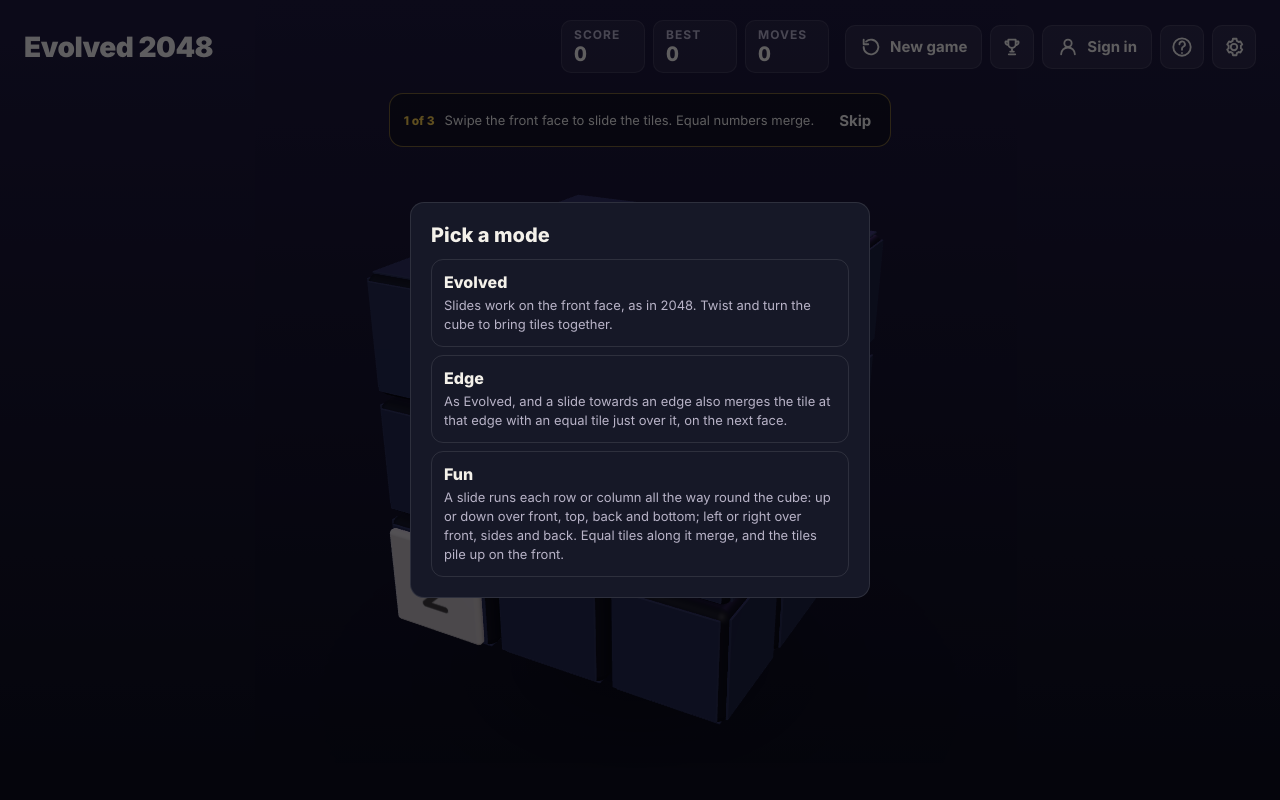
The starting position is tiny: two tiles on the front face, each a 2 or a 4. You can read more about starting tiles in 2048.
Frequently asked questions
How many empty squares should I keep in 2048?
There is no magic number. A useful rule is to never let a face fill up while another face is empty, and to keep at least one free square so a twist can still add its tile. The more you have, the more moves you can choose from.
Is it better to merge small tiles or build a big one?
Merge small tiles first. Each merge gives a square back, and a big tile comes from many small merges anyway. Chase the big tile only when the merges needed to reach it also clear space, as in a chain.
Does the next tile spawn in an empty square at random?
Yes. In Evolved 2048 the game picks a random empty square of the front face, or any empty square if the front is full. The tile is a 2 most of the time and a 4 otherwise. In a test of 10,000 new tiles from the game's own random number code, 1,001 were 4s.
Can I win 2048 with a nearly full board?
It is possible, but risky, because you will have few legal moves and one bad landing spot can end the run. A nearly full board also gives a twist no room to work. Winning is far easier with free squares, so treat a nearly full board as a warning.
Get started
Open a game, pick a mode, and play ten moves with one goal: finish with as many empty squares as you started with. Then try for a bigger tile.
Play Evolved 2048: it is free and plays in your browser on a computer or a phone.
Comments
No comments yet.
Sign in or make an account to comment.