Bach's Music: What He Wrote and Why It Lasted
Bach's music is mostly music written for a job. Johann Sebastian Bach (1685 to 1750) spent his life as a church organist, a court musician and a choirmaster, and each post asked for something different: organ playing, a cantata every month, chamber music for a prince, almost a cantata every Sunday. Out of those demands came the Brandenburg Concertos, the Passions, the Mass in B minor and The Well-Tempered Clavier, works that are now heard far beyond the churches and courts they were written for.
If you want to place Bach beside Homer, Shakespeare and Leonardo, Learn 100 Influential People puts him in its Art, Letters and Music course, in short hands-on lessons with questions that check what you remember and sources you can read next.
Where Bach worked, and what each job asked of him
Bach was born on 21 March 1685 in Eisenach, in Thuringia, into a long line of musicians. He was orphaned at ten and taken in by his eldest brother, an organist. At 15 he went to school in Luneburg, and more than once he walked about 48 km to Hamburg just to hear the organist Johann Adam Reincken play.
World History Encyclopedia notes that in his own lifetime Bach was more famous as an organist than as a composer. His career followed five posts:
- Arnstadt, from 1703. Church organist, in charge of the instrument and the services. In 1705 he was granted four weeks of leave and stayed away four months, listening to Dietrich Buxtehude in Lubeck.
- Muhlhausen, from 1707. Council organist, soon frustrated by the limits the church elders put on sacred music.
- Weimar, 1708 to 1717. Court organist, then from 1714 Konzertmeister, a post that required a new cantata each month. His first original compositions date from these years.
- Cothen, from 1718. Chief musician to Prince Leopold, a Calvinist, so the work was secular: chamber music, concertos and pieces for soloists.
- Leipzig, from 1723 to his death. Choirmaster, organist and teacher at the Thomaskirche, writing for the city's four main churches.
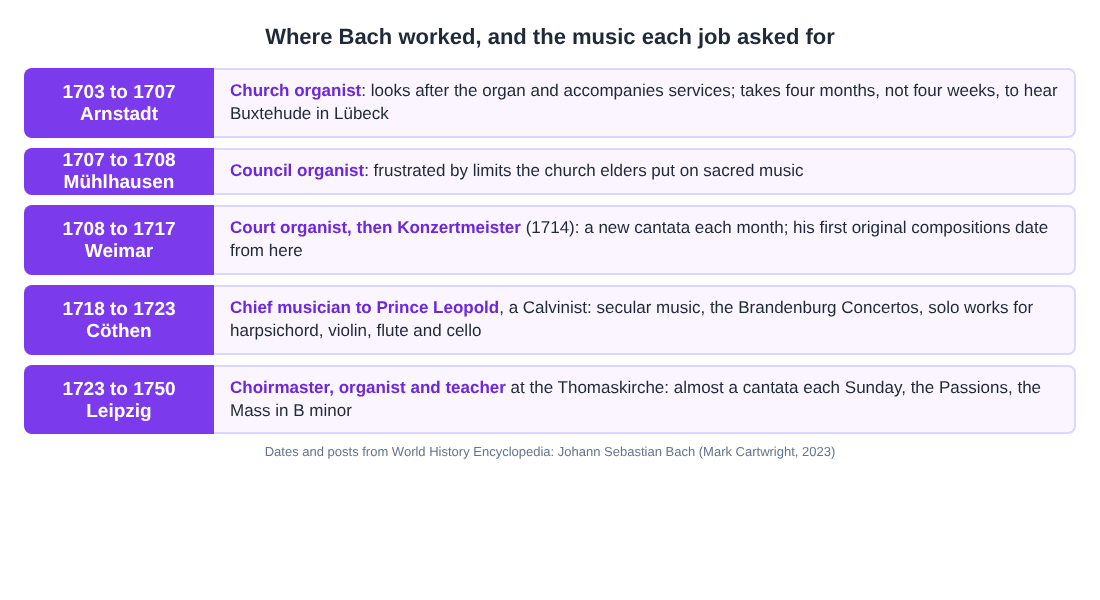
Bach's five posts, 1703 to 1750, and what each one asked him to write.
The moves were not always smooth. Bach was stubborn, and when he chose to leave Weimar for Cothen, Duke Wilhelm kept him a prisoner for four weeks before letting him go. In Leipzig he called his 54 choir members "17 usable, 20 not yet usable, and 17 wholly unsuitable". The jobs shaped the music, and so did the friction.
Bach's music: the major works, sorted by kind
World History Encyclopedia lists his major works. Sorting them by who they were for makes a long list easier to hold:
- For the church: 222 sacred and secular cantatas, the Magnificat, the Saint John Passion, the Saint Matthew Passion, the Christmas Oratorio and the Mass in B minor. Bach was a Lutheran, and his music often turned on religious themes.
- For orchestra and soloists: the six Brandenburg Concertos, dedicated to Margrave Christian Ludwig of Brandenburg, 4 orchestral suites, 3 violin concertos and 7 harpsichord concertos. The melody known as "Air on the G String" comes from the third orchestral suite.
- For the keyboard and for study: The Well-Tempered Clavier, two volumes of 48 preludes and fugues through all the major and minor keys; the Goldberg Variations; the Italian Concerto; The Musical Offering; and The Art of Fugue, left unfinished.
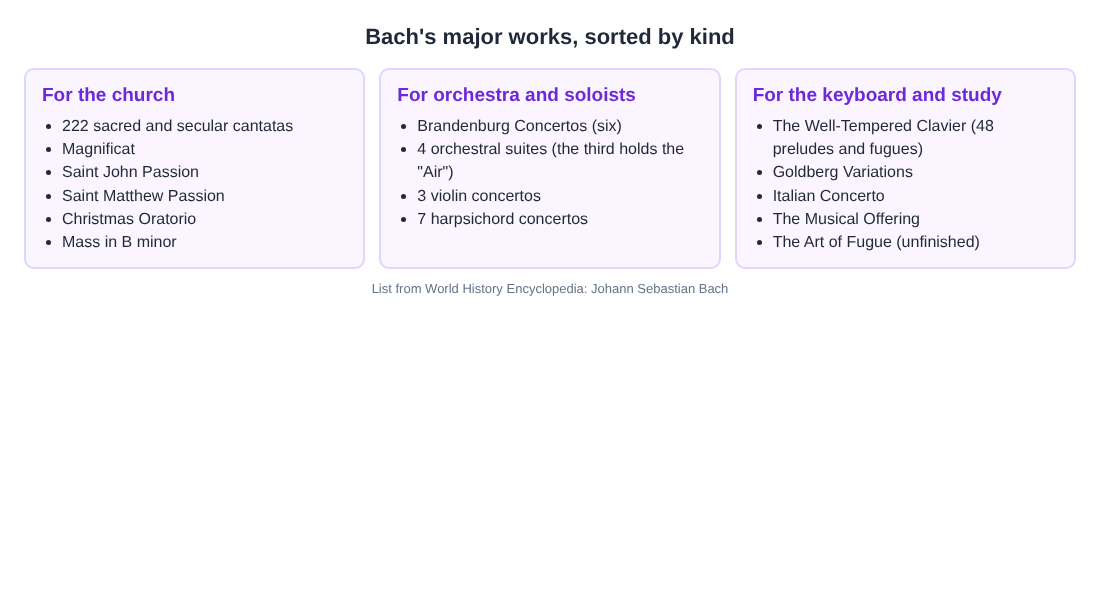
The same works, grouped by who they were written for.
Two of these have stories attached. The Musical Offering began in 1747, when Bach visited Frederick the Great in Berlin and turned a fugue subject the king gave him into a whole work. The Goldberg Variations, legend says, were written for an aristocrat who suffered from insomnia. The encyclopedia gives that one as legend, and so should you.
What made his writing different
Bach built on forms other composers used. He learned from Buxtehude, Johann Pachelbel, Arcangelo Corelli and Antonio Vivaldi, and he followed French and Italian music closely. What he did was push those forms further.
With the cantata, for example, he reduced the place of the chorus and added elements closer to opera. The music historian Denis Arnold, quoted in the encyclopedia, points to "his delight in finding an exact musical equivalent to the imagery of the verse".
He also wrote fugues all his life, a form in which parts enter one after another and imitate a shared theme. The last fugue of The Art of Fugue breaks off with notes that spell his own name, since in German note names B is B flat and H is B natural. The historian Harold C. Schonberg puts it this way: "where most composers of his day would confine themselves to the rules, Bach made the rules".
His own audiences were not always sure. The encyclopedia says listeners were often left bemused by elaborate works like the Saint Matthew Passion, and keyboard players struggled with pieces that asked for nimble fingers and intricate pedal work at once.
Was Bach forgotten after he died?
Popular tradition says yes: Bach died in 1750, almost blind and rather poor, with his style seen as dated, and the world forgot him until Felix Mendelssohn brought him back. There is truth in the second half. Mendelssohn conducted the Saint Matthew Passion in Berlin in 1829, audiences loved it, and Bach's works have been performed in public ever since.
World History Encyclopedia takes a more careful line on the first half. It says that, contrary to popular tradition, Bach's work was never really forgotten within the music world. His sons Wilhelm Friedemann, Carl Philipp Emanuel and Johann Christian were noted composers themselves, his choral works were kept by his musical descendants, and he stayed a favourite of many musicians who followed. Robert Schumann insisted on playing at least one Bach piece every day, and Schumann and Franz Liszt both wrote fugues in his style.
So the fair reading is that two things are true. The public lost touch with Bach for decades, and musicians did not. If you write about his legacy, say which of the two you mean. For more on judging how people's reputations rise and fall, see why Shakespeare is still important today.
A one-week Bach listening plan
Here is a worked example you can follow. It uses only the works above and moves from the easiest way in to the hardest. Give each day about 20 minutes and write one sentence afterwards about what you heard.
- Day 1: the Air from the third orchestral suite. A single melody you may already know. The encyclopedia notes that it uses the violin's lowest string.
- Day 2: one Brandenburg Concerto. Court music from Cothen. Listen for how the soloists pass ideas back and forth.
- Day 3: one prelude and fugue from The Well-Tempered Clavier. Count the voices as they enter in the fugue.
- Day 4: the Magnificat. Church music for choir and orchestra. Pick one line of the text and listen for how the music paints it.
- Day 5: part of the Saint Matthew Passion. The work that puzzled Leipzig and moved Berlin in 1829.
- Day 6: The Musical Offering. A whole work built on one theme from Frederick the Great.
- Day 7: the end of The Art of Fugue. Listen to the point where it stops, and ask why the last notes spell a name.
By the end of the week you have heard Bach's three worlds: the church, the court and the keyboard. To keep the names and dates with the music, try the method in how to remember historical figures and what they did, and compare him with another maker of lasting work in Leonardo da Vinci's notebooks.
Frequently asked questions
What are Bach's most famous works?
World History Encyclopedia names the Magnificat, the Mass in B minor and the Brandenburg Concertos among his most acclaimed music. The "Air on the G String" from his third orchestral suite is one of his best-known melodies.
How many cantatas did Bach write?
The encyclopedia counts 222 sacred and secular cantatas. In Leipzig he wrote almost one for each Sunday.
Was Bach famous in his lifetime?
Yes, but mostly as an organist. His fame as a composer was confirmed in musical circles in 1736, when he was made Royal Court Composer, and it soared with the public in the 19th century.
When and where did Bach die?
He died of a stroke in Leipzig on 28 July 1750, almost blind in his last years.
Get started
Bach is easier to understand when you hear him beside the people who came before and after him. Learn 100 Influential People is a web app of short hands-on lessons on the 100 people who most shaped human history. Its Art, Letters and Music course covers Bach with Homer, Murasaki Shikibu, Shakespeare, Leonardo, Michelangelo, Picasso, Mozart and Beethoven. Each lesson takes about 9 minutes, where researchers disagree the site sets out each side, and every lesson lists its sources so you can read further. You sign in with your email and an emailed sign-in code. You can read more on the about page.
Start Learn 100 Influential People: short lessons on the people who shaped history, with every side of the debate and the sources to read next.
100 people who shaped history, from Moses to the web.
Visit influentialpeople.vlvd.net↗

Comments
No comments yet.