Barnard Castle: the Balliols' fortress above the Tees
Barnard Castle stands on a cliff above the river Tees in County Durham. It was begun soon after 1093 to control a river crossing, and the Balliol family built most of it in the 12th and early 13th centuries. It went on to belong to the earls of Warwick and to Richard III, and it held out against two sieges, in 1216 and 1569, before it fell into ruin.
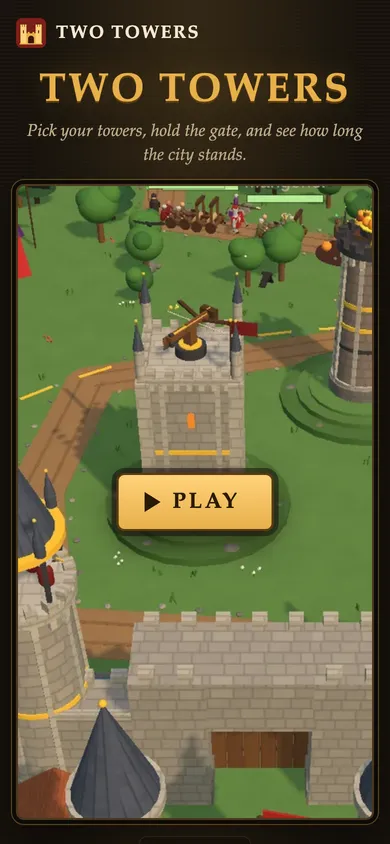
If you like working out how a few defenders stop many attackers, Two Towers is a free browser game where you choose the two towers that guard a city gate and upgrade them as the attacks grow.
Barnard Castle and the crossing of the Tees
English Heritage says the plateau the castle stands on had mattered for thousands of years before the Normans. It looks down on the point where a major Roman road across the Pennines crosses the Tees, and that road is still an important route. In the Middle Ages the crossing also lay between two powers: the lands of the Bishop of Durham and the Honour of Richmond.
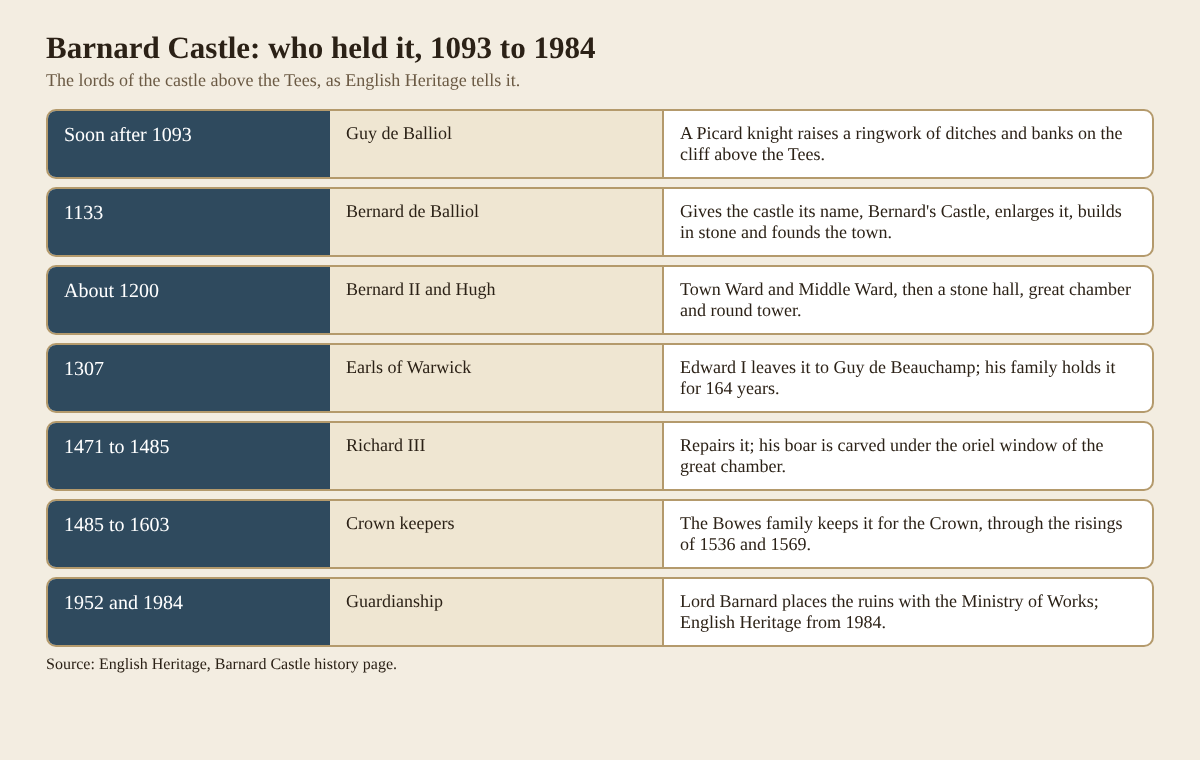
The first castle was probably built by Guy de Balliol, a knight from Picardy. He had backed King William II against a rebellion in Normandy in the 1090s and was given estates in north-eastern England as a reward. His castle was a ringwork: ditches and banks guarded the south and east, and high cliffs guarded the north and west. It had a stone gatehouse, but the rest was timber.
Bernard de Balliol gives the castle its name
Guy died in 1133 and his nephew Bernard took over. The castle and the town around it are named after him: Castrum Bernardi, or Bernard's Castle. Bernard enlarged the castle to its present size, began to rebuild it in stone, and founded the town on its south and east sides.
His son Bernard II built many of the most important parts, including the Town Ward and Middle Ward, the North Gate, Brackenbury Tower and Constable Tower. He may have overreached himself: at the end of the 12th century the castle briefly passed to the Bishop of Durham as security for a debt. Hugh de Balliol, who inherited in 1205, probably rebuilt the hall in stone and added the great chamber and the round tower at its northern end. When King John stayed in January 1216, those rooms were as stylish as any in his own castles.
The siege of 1216 and a crossbow bolt
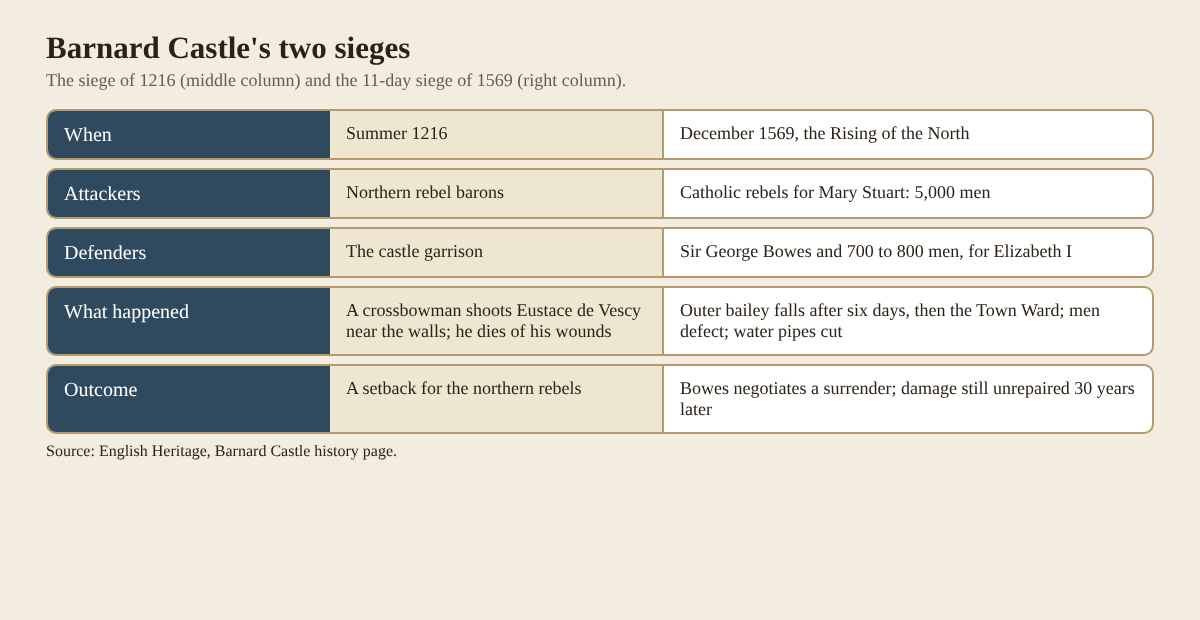
The new castle was tested within months. In the summer of 1216 King John had died, many barons were in open rebellion, a French army held much of southern England, and King Alexander II of Scotland had moved into northern England with northern barons on his side. One of them was Eustace de Vescy, the Scottish king's brother-in-law and lord of Warkworth Castle.
At Barnard Castle, Eustace came too close to the walls. A crossbowman of the garrison shot him, and he died of his wounds. English Heritage says the loss of this champion set back the northern rebels' cause, and the next year they and the invaders were beaten by armies loyal to the new king, Henry III. The longbow vs crossbow post explains why a crossbow suited a defender on a wall, and the Warkworth Castle post covers Eustace's own castle.
The earls of Warwick and Richard III's boar
The Balliols held the castle through the 13th century. John and Devorguilla Balliol endowed scholars at Oxford, which became Balliol College, and their son John held the throne of Scotland from 1292 to 1296. After his fall the castle was seized, and in 1306 Edward I took it. The dying king left it to Guy de Beauchamp, Earl of Warwick, whose family held it for the next 164 years.
Those years were not all calm. In 1315 its keeper, John le Irreys, raided Bowes Castle and carried off the widowed Lady Matilda Clifford, until Edward II sent an army to rescue her. In 1446 the estates passed to Richard Neville, remembered as "Warwick the King-maker", who died at the Battle of Barnet in 1471. From 1471 to 1485 the castle belonged to Richard, Duke of Gloucester, later Richard III. He repaired it, and his badge, a boar, is carved under the oriel window of the great chamber. Brackenbury Tower is named after Sir Robert Brackenbury, who died with Richard at Bosworth in 1485.
The siege of 1569 in the Rising of the North
After Bosworth the Crown put the castle in the hands of keepers, mostly the Bowes family. In December 1569 Sir George Bowes held it for Elizabeth I against the Catholic nobles of the Rising of the North, who wanted to replace her with Mary Stuart. English Heritage calls the 11-day siege the castle's last significant action as a fortress.
The rebels sent 5,000 men against a garrison of 700 to 800. They took the outer bailey after six days and then the Town Ward, which left the defenders in the inner ward. More and more of Bowes's men went over to the rebels, and the rebels destroyed the pipes that brought water from a reservoir. Bowes sent his horsemen out to join other royal forces nearby, but in the end he had to negotiate a surrender. Thirty years later the siege damage had still not been repaired. The castle wells post shows why water decided so many sieges.
Ruin, a hermit and English Heritage
In 1603 James I gave the castle to his favourite, Robert Carr. A later owner, Sir Henry Vane, took stone from it for his house at Raby, so it was already past use by the Civil Wars. In the 18th and 19th centuries tourists came for its setting above the Tees. Between 1841 and 1845 a former ostler, Frank Shields, lived in the Round Tower and guided visitors as its "hermit". A gale damaged the ruins in October 1896, and Lord Barnard paid for repairs. In 1952 he placed the ruins in the care of the Ministry of Works, and English Heritage has looked after them since 1984.
A worked example: a crossbowman's lesson as a Two Towers plan
In 1216 one shot from the walls, at long range, changed a war. In Two Towers the attackers have crossbowmen too, and the plan is to reach them before they reach you. Here is a plan built only from what the game says.
- Read the tip. The game says: "Crossbowmen shoot from afar: Range upgrades and a Trebuchet reach them."
- Pick a Trebuchet for one side. Its slow, long-range stones hurt everyone where they land.
- Buy Range early. Archers shoot the gate from the road too, and the tip for them is "buy Range so your towers reach them before they stop."
- Take the high ground. The first hill tower costs 150 gold and the second 300.
- Keep the gate strong. "Spend your gold on Damage between stages, and Reinforce the gate."
Then watch which attackers stop short of the gate, and add Range where they do. The hill towers post has more on what to build on each hill.
Frequently asked questions
Why is it called Barnard Castle?
It is named after Bernard de Balliol, who took it over in 1133. Its Latin name was Castrum Bernardi, Bernard's Castle, and the town shares the name.
Who built Barnard Castle?
Guy de Balliol probably began it soon after 1093. His nephew Bernard and later Balliols rebuilt it in stone in the 12th and early 13th centuries.
Was Barnard Castle besieged?
Yes. It was besieged in 1216, when Eustace de Vescy was killed by a crossbow bolt, and for 11 days in December 1569, when Sir George Bowes surrendered it to the rebels of the Rising of the North.
Did Richard III own Barnard Castle?
Yes, from 1471 until his death in 1485. His boar badge is carved under the oriel window of the great chamber.
Get started
Barnard Castle shows how much one well-aimed shot from the walls can matter. To try aiming your own defence, play Two Towers: pick your two towers, buy Range and see how long your gate holds.
Defend the castle gate, stage after stage.
Visit twotowers.vlvd.net↗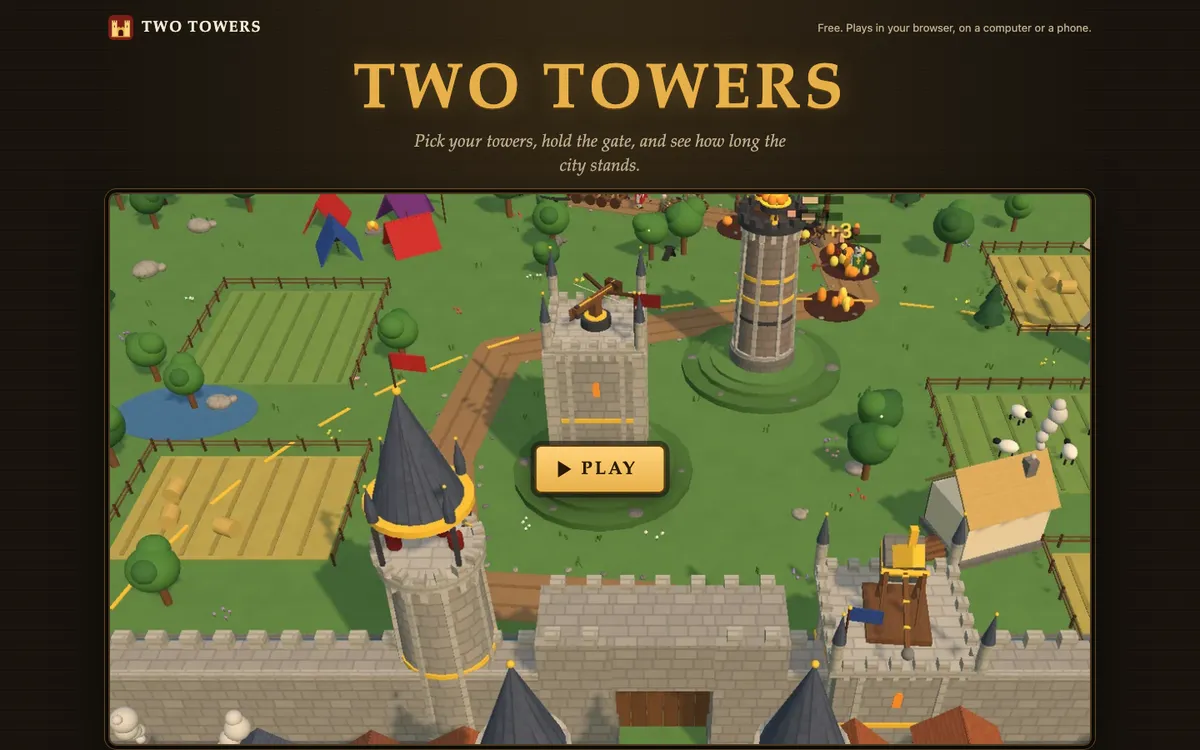
Comments
No comments yet.