Bowes Castle: Henry II's keep on the Stainmore road
Bowes Castle is one tower in a field. That tower is Henry II's keep, built between 1171 and 1187 inside the walls of a Roman fort, beside the road that crosses the Pennines at the Stainmore Pass. English Heritage looks after it, and its history page gives a short but clear story: a king who wanted a Scottish invasion stopped, a siege that ended when help arrived, and a second siege by angry tenants. This guide follows Bowes Castle through those years, using only what English Heritage says about it.
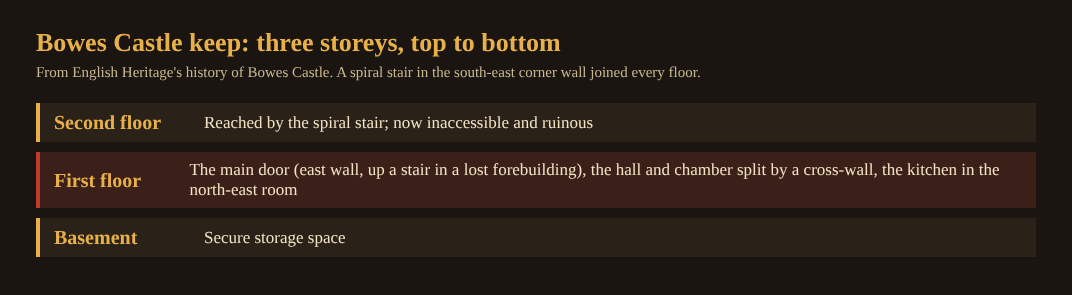
The three storeys of the keep, as English Heritage describes them. The first floor, in red, held the door, the hall and the kitchen.
A castle on top of a Roman fort
Bowes was not built on empty ground. English Heritage says the castle stands on the site of the Roman fort of Lavatris, and that the outline of the Roman fort can still be traced around most of its edge. The Romans used the fort from the late 1st century AD to the late 4th century. That is a stay of about three hundred years, in the same place, for the same reason.
The reason was the road. The fort guarded the Stainmore Pass, the route over the Pennines. A pass is a gift to a defender, because anyone who wants to cross has to come through the same narrow place. Henry II saw what the Romans had seen. He put his keep in the north-west part of the old fort, so the new castle sat inside the line of the old fort.
Other castles did the same. If you want to compare, read about Pevensey, a Roman fort that became a Norman castle, or the wider story of the Saxon Shore forts. A strong site stays strong, whoever holds it.
Why Henry II built here in 1171
The castle first belonged to the Honour of Richmond, a large lordship. When Earl Conan died in 1171 without male heirs, it passed to the Crown. English Heritage says Henry II "lost no time" in strengthening a castle that was so vital to the defence of the kingdom against a Scottish invasion.
He was right to hurry. The Scottish invasion did come, in 1173 and 1174. The page gives the building dates as 1171 to 1187, so the keep was new, or still going up, when the Scots arrived. After 1187 English Heritage finds no more spending on the fabric. The keep is the only part of the castle that still stands, so the history of the rest is obscure. That is worth remembering when you read about any castle: the record is thin, and what we know about the walls and halls that vanished is often a guess.
The siege of 1173 and 1174
English Heritage records one fact about the fighting: Bowes was besieged by the army of King William of Scotland, and the army retreated at once when Geoffrey, Archbishop of York, approached with a relieving army. The page does not say how long the siege lasted or how many men were on either side, so this guide does not either.
What it does show is how a siege of that age often ended. The attackers did not always break in. A garrison that could hold out until help arrived could win without a battle at the walls. The attacking army had to leave the moment the relief force came close, because it did not want to be caught between the castle and the new army. To see how long such waits could last, read how long a medieval siege lasted.
Inside the keep: door, hall and kitchen
The keep is rectangular, with broad, flat buttresses at the corners and halfway along each wall. It stands in a field, with a moat on two sides. It was originally three storeys high.
The main door was not at ground level. It was in the east wall, on the first floor, and you reached it by a flight of stairs inside a forebuilding. A forebuilding is a smaller building built against the front of the keep to cover its stairs. This one has gone. Visitors today walk in through an opening that was once an arrow slit. A door on the first floor, up a stair, is not a door an attacker can walk straight through.
The basement gave secure storage. A spiral staircase in the thickness of the south-east corner wall joined the basement and the two upper floors. The first floor was divided by a cross-wall into a hall and a chamber, and it sat on vaulting that was added in the 13th or 14th century. Small rooms and passages to latrines were cut into the thickness of the walls, and you can still see the outlet chutes for the latrines in the west wall. The north-east room was a kitchen. The spiral stair went on up to the second floor, which is now ruinous and cannot be visited. For a general guide to why a castle had such a tower, read what a castle keep was for.
Who owned Bowes Castle after 1187
After the building stopped, the castle changed hands many times. English Heritage gives a few dates. It seems to have stayed with the Crown until 1233, when Henry III gave it to the Duke of Brittany. In 1241 the castle and the manor of Bowes went to Peter of Savoy, the king's uncle, who was also Earl of Richmond.
Then, in 1322, Edward II granted the castle to John de Scargill. English Heritage says this caused much local resentment, and that tenants of the earl besieged and captured the castle. So Bowes saw a second siege, and this time it was not a king's army at the gate but local people who disliked who held it. After further changes of ownership, the castle went back to the Crown in 1471.
How Bowes ended as a castle
By the 17th century Bowes was redundant. After the Civil War, English Heritage says, parts of it were dismantled and the stone was used again for other buildings. That is why only the keep is left. The keep is the only part that still stands.
If you visit, English Heritage lists Bowes Castle as free to enter, open any reasonable time during daylight hours. It describes the site as the impressive ruins of Henry II's 12th century keep, on a Roman fort guarding the approach to the Stainmore Pass.
What Bowes teaches a Two Towers player
Two Towers is a free medieval tower defense game that plays in your browser. You pick the two towers that guard the city gate, and you can buy two more for West Hill and East Hill, for 150 and 300 gold. If the gate falls, the game is over.
Bowes shows the difference between your game and a real siege. At Bowes the Scots left because a relief army came. In Two Towers nobody comes to help you. The only army on the field is the one you built with your gold. So the lesson from the pass is the one Henry II learned from the Romans: put your strength where the enemy has to come through. In the game, that is the road to the gate, and the towers you place along it.
Frequently asked questions
When was Bowes Castle built?
English Heritage says it was built between 1171 and 1187, on the site of a Roman fort. Henry II built the keep after the castle passed to the Crown in 1171.
What happened at the siege of Bowes Castle?
The army of King William of Scotland besieged it during the invasion of 1173 and 1174, and retreated at once when Geoffrey, Archbishop of York, came near with a relieving army. In 1322 tenants of the earl besieged and captured it.
Why was Bowes Castle built where it was?
It guarded the Stainmore Pass over the Pennines, where a Roman fort had stood from the late 1st century AD to the late 4th century.
What is left of Bowes Castle today?
Only the keep. It has a moat on two sides, and its top floor is ruined. The rest of the castle is lost, and parts were taken down after the Civil War.
Get started
Want to defend a gate yourself? Play Two Towers free in your browser, pick your two towers, and see how long you hold the gate. Source for the history: English Heritage, History of Bowes Castle.
Comments
No comments yet.
Sign in or make an account to comment.