Beethoven's Deafness and His Symphonies: What Happened
Beethoven's deafness began around 1798, when he was in his late twenties, and by 1818 he could not hear at all. In between, and after, he wrote all nine of his symphonies. This post lines up the two stories year by year, so you can see what he lost, when he lost it, and how he kept composing anyway.
If you like learning history through stories like this one, Learn 100 Influential People covers Beethoven in short lessons in its Art, Letters and Music course, with the sources for each lesson so you can read further.
Beethoven's deafness at a glance
Here are the dates that matter, all from the World History Encyclopedia's article on Ludwig van Beethoven:
- 1770: born in Bonn on 16 December.
- 1792: moves to Vienna, then the musical capital of Europe, and stays for life.
- Around 1798: he realises he is losing his hearing.
- 1800: doctors confirm his fears. The cause is still unknown.
- 1802: he writes the Heiligenstadt Testament.
- 1818: he can no longer hear at all.
- 1824: the Ninth Symphony premieres in Vienna.
- 1827: he dies in Vienna on 26 March.
Put those next to the symphonies and a pattern shows. Only the First was finished as the problem was being confirmed. The other eight came while his hearing was going.
How the hearing loss started
When it began, Beethoven was at the height of his powers. He had made his name in Vienna as a superb improviser at the piano, playing in the homes of the wealthy. A pianist who cannot hear is in trouble in a way a composer at a desk is not.
He lost the higher notes first. From there his hearing got worse over the following years, though there were short spells when it got better. Doctors confirmed the loss in 1800, but no one then or since has pinned down the cause.
He later used an ear trumpet. It helped for a time. By 1818 he could not hear at all.
The Heiligenstadt Testament
In 1802 Beethoven wrote a letter to his brothers. He never sent it. It is named after Heiligenstadt, the country retreat outside Vienna where he often stayed.
The letter is dark. He wrote: "For me there can be no pleasure in human society, no intelligent conversation, no mutual confidences. I must live like an outcast." He thought about ending his life.
What stopped him was his work. In his words: "It seemed impossible to leave the world before I had accomplished all I was destined to do." That sentence is the hinge of the whole story. The letter reads like a farewell, and what came next were the symphonies most people know him for.
How he composed without hearing
The short answer is that he heard the music in his head. Like many trained musicians, Beethoven could "hear" notes pitch perfectly without an instrument, so losing his ears did not stop him writing.
His working method helped too. Unlike the composers before him, he drafted and sketched each work again and again on paper. About 10,000 pages of those sketches survive, covering nearly all his works. He was careless at home, but strict about his scores, and he checked every published work and sent corrections to his publishers.
Here is a small exercise to feel what inner hearing means. Pick a tune you know well. Without humming, run it in your head and count the notes in its first line. You can do it because you hold the sound in memory. Beethoven did the same with a whole orchestra.
Beethoven's symphonies against his hearing, year by year
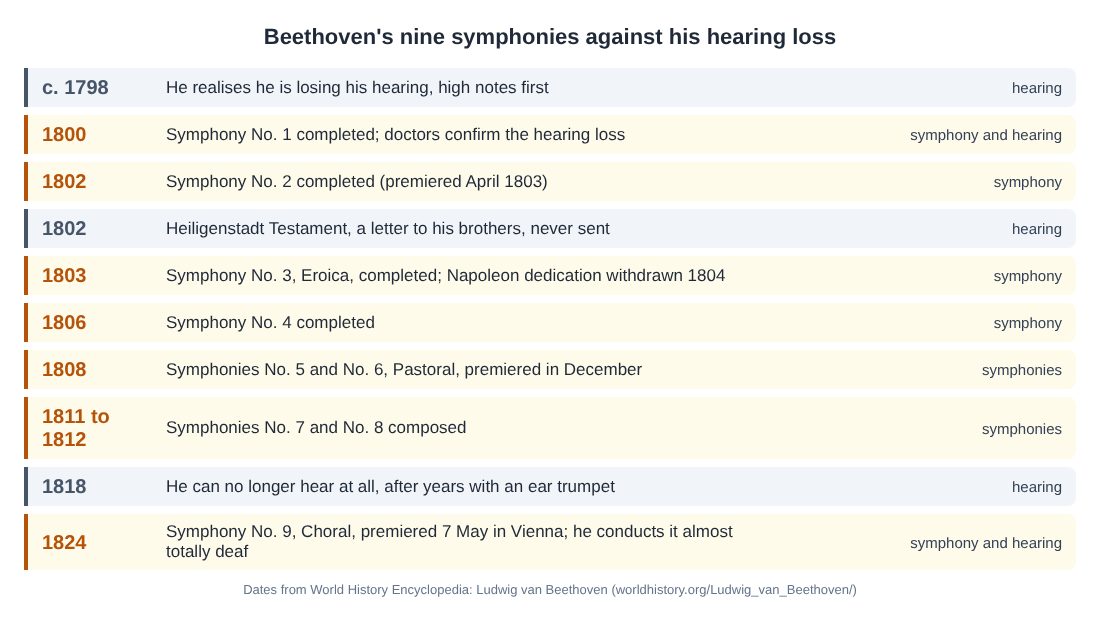
The nine symphonies and the hearing loss, with dates from World History Encyclopedia.
- First Symphony, completed 1800. Already new in its use of short musical motifs and a bigger role for the wind instruments.
- Second Symphony, completed 1802, premiered April 1803. Written in the year of the Heiligenstadt letter, and still surprisingly joyous.
- Third, the Eroica, completed 1803. Twice the length of a normal symphony. He dedicated it to Napoleon, then withdrew the dedication when Napoleon took the title of Emperor in 1804. Beethoven rated it his finest besides the Ninth.
- Fourth, completed 1806.
- Fifth and Sixth, both premiered in December 1808. The Fifth brought in the trombone, a first for him. The Sixth, the Pastoral, paints birdsong, a thunderstorm and a country festival.
- Seventh and Eighth, composed in 1811 and 1812. Audiences liked the Seventh more, which annoyed Beethoven, who thought the Eighth was better.
- Ninth, the Choral, premiered 7 May 1824. Built on Schiller's ode "To Joy" with voices in the finale, which was new for a symphony.
Notice the gap of more than ten years between the Eighth and the Ninth. In those years his hearing was failing fast, and by 1820 he talked with his friends through conversation books, where they wrote and he answered.
To compare his output with two composers who came before him, read what Mozart composed and when and what Bach wrote and why it lasted.
The Ninth Symphony premiere
The Ninth premiered at Vienna's Kärntnertor Theatre on 7 May 1824. Beethoven, almost totally deaf by then, conducted the premiere himself. The same concert included his Missa solemnis, which he called his finest work.
Other accounts of that night add more detail about who led the players and how the audience's applause reached him. Those details differ between tellings, so check a full biography before you quote one. What is not in doubt is the outline: a composer who could no longer hear stood in front of the orchestra for the first performance of the symphony that, as the encyclopedia puts it, inspired almost all the Romantic composers who came after.
What his deafness changed in his music
Writers on Beethoven often read his life into his music, and this is where views differ. One reading, quoted by the encyclopedia from the music historian D. Arnold, is that his music conveys "an immense ability to overcome misfortune and suffering." Another, from the late period, is that his last piano sonatas and string quartets were "introspective works," the work of a man who had withdrawn into an inner life.
Both can be true at once. The cautious point is this: deafness cut him off from society, and his late works turned inward at the same time. Whether one caused the other is a question for you to weigh, not a fact.
Frequently asked questions
When did Beethoven start going deaf?
He realised around 1798, in his late twenties, that he was losing his hearing. Doctors confirmed it in 1800.
Was Beethoven fully deaf when he wrote the Ninth Symphony?
Yes, or very nearly. He could not hear at all by 1818, and he was almost totally deaf when he conducted the Ninth's premiere in 1824.
What caused Beethoven's deafness?
The cause remains unknown. He lost the higher notes first, and the loss grew worse over many years with brief spells of improvement.
How did Beethoven write music if he could not hear?
He could hear notes pitch perfectly in his head. He also worked through thousands of pages of written sketches, so his method never depended on playing the music aloud.
Get started
Beethoven is one of the people in the Art, Letters and Music course, an Intermediate course that also covers Homer, Murasaki Shikibu, Shakespeare, Leonardo, Michelangelo, Picasso, Bach and Mozart. Each lesson takes about 9 minutes and has diagrams and a hands-on activity.
A good way to use it for a topic like this: read the lesson, then answer its questions, which include putting events in order and estimating a number, a natural fit for a story built on dates. Every attempt is graded and you can retake a lesson for a better grade. Questions from lessons you finish come back later, up to 5 a day, so the dates stick. Where researchers disagree, the lessons give every side, and each lesson lists its sources.
You sign in with your email and a code sent to it, and you can join the leaderboards under a name you choose. Accounts are for people 13 and over. More is on the about page.
Start Learn 100 Influential People: short hands-on lessons on the people who shaped history, with every side of the debate and the sources to read next.
100 people who shaped history, from Moses to the web.
Visit influentialpeople.vlvd.net↗


Comments
No comments yet.