Mozart's Operas and Symphonies: What He Composed and When
Mozart's operas and symphonies span just over two decades: his first opera was staged in Salzburg in May 1769, when he was 13, and his last two, La clemenza di Tito and The Magic Flute, both came in September 1791, three months before he died at 35. In between he wrote dozens of symphonies, concertos, quartets and Masses. This guide sets out what he composed, in order, and how to listen to it so it sticks.
If you want to place Mozart beside Bach, Beethoven and the other people who shaped history, Learn 100 Influential People teaches him in short lessons of about 9 minutes, with questions that check you and the sources each lesson used.
Mozart's operas and symphonies at a glance
Wolfgang Amadeus Mozart was born in Salzburg on 27 January 1756 and died in Vienna on 5 December 1791. Every date and number here comes from the World History Encyclopedia article on him, by Mark Cartwright, which lists his best-known output this way:
- 60 symphonies, from his first, begun as a child on tour, to his last years in Vienna.
- 23 piano concertos and 5 violin concertos, plus concertos for wind instruments such as the clarinet.
- 24 string quartets and 18 piano sonatas, alongside much more chamber music.
- 16 Masses, including the Coronation Mass of 1779, and the unfinished Requiem of 1791.
- Operas, nine of them named in the article, from La finta semplice (1769) to The Magic Flute (1791).
The child prodigy: first symphony and first opera
Mozart's father, Leopold, was a violinist and composer in the Archbishop of Salzburg's orchestra. Wolfgang studied keyboard and composition from the age of five. His elder sister Maria Anna, called Nannerl, was also a talented pianist, but as a woman of her time she had to give up any idea of performing in public.
The family toured early and far. At six, Wolfgang played for the Elector of Bavaria and for Empress Maria Theresa in Vienna. In 1763 he played for Louis XV in Paris and George III in London. Still only eight, he published four keyboard sonatas in Paris and was at work on his first symphony.
His first opera followed: La finta semplice (The Pretend Simpleton), a comic opera first performed in Salzburg in May 1769. In December 1769 the family set off for Italy, and the court at Milan commissioned a serious opera, Mitridate, re di ponto, which was performed in December 1770 to great acclaim.
On that tour he took in the music of others. The article names Joseph Haydn, whom he met, and Johann Sebastian Bach as strong influences at this stage.
Salzburg, Paris and Idomeneo
In 1772 Mozart became Konzertmeister, leader of the Archbishop's court orchestra in Salzburg, his first salaried job. Munich premiered his opera La finta giardiniera (The Pretend Gardener) in 1775.
When he asked leave to travel again, the archbishop refused and dismissed him. He went to Paris with his mother, struggled to find work there, and wrote several new pieces, among them the Paris Symphony (no. 31). His mother died suddenly, and he returned to Austria in 1779, the year of his Coronation Mass.
In 1780 Munich commissioned another opera. Idomeneo, first performed in January 1781, blended music and strong characters, and the article calls it his first great opera.
Vienna and the great operas
In March 1781 Mozart left Salzburg for Vienna. He lived by teaching, writing chamber music and giving private concerts for the wealthy, often conducting from the keyboard. In 1782 he married Constanze Weber, and Schonberg, quoted in the article, dates his maturity from 1781: "virtually every work thereafter is a masterpiece".
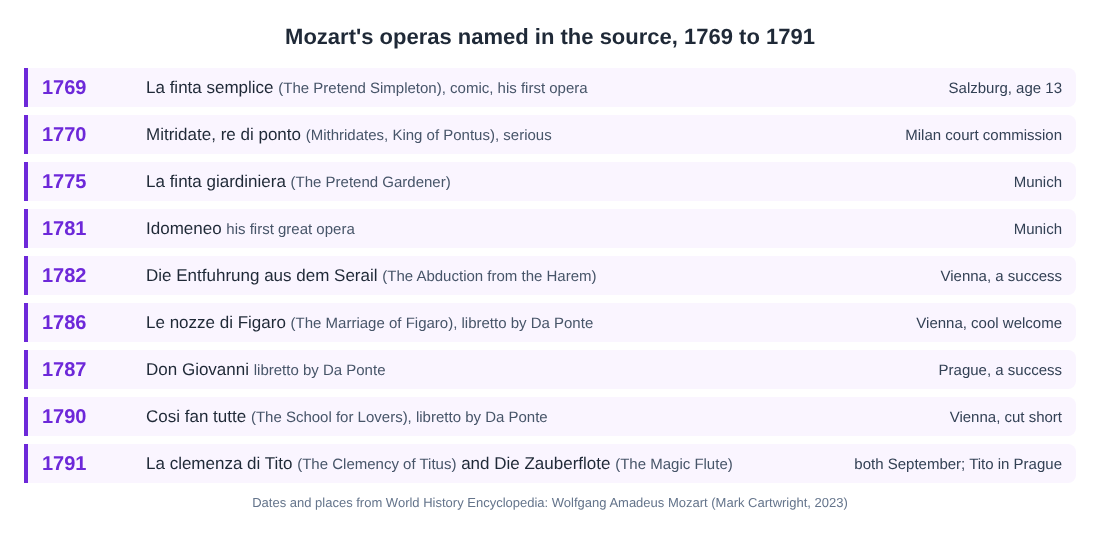
The nine operas the source names, with where and how each was first received.
The Abduction from the Harem (Die Entfuhrung aus dem Serail, 1782) was a success, though Emperor Joseph II said it had "too many notes". Then came three operas with the court poet Lorenzo Da Ponte as librettist:
- The Marriage of Figaro (1786), from a play by Beaumarchais that had been banned in Vienna. Its premiere on 1 May 1786 was not well received, but it did much better in Prague in 1787.
- Don Giovanni (1787), the story of Don Juan, premiered in Prague on 29 October 1787 and was a success there, while Vienna again found the music "too advanced".
- Cosi fan tutte (1790), a comedy of two soldiers testing their lovers. Its run was cut short in February 1790, when the emperor died and the theatres closed.
In September 1791 he finished two more. La clemenza di Tito marked the new emperor's coronation as king of Bohemia, in Prague. The Magic Flute, with a libretto by Emanuel Schikaneder, was a success, packed with references to the Freemasons, whom Mozart had joined in 1784.
Symphonies, concertos and chamber music
Opera was his great ambition, the article says, but most of the catalogue is instrumental. Mozart kept detailed catalogues of his own works, and he rarely let them circulate in print, because he worried about copying.
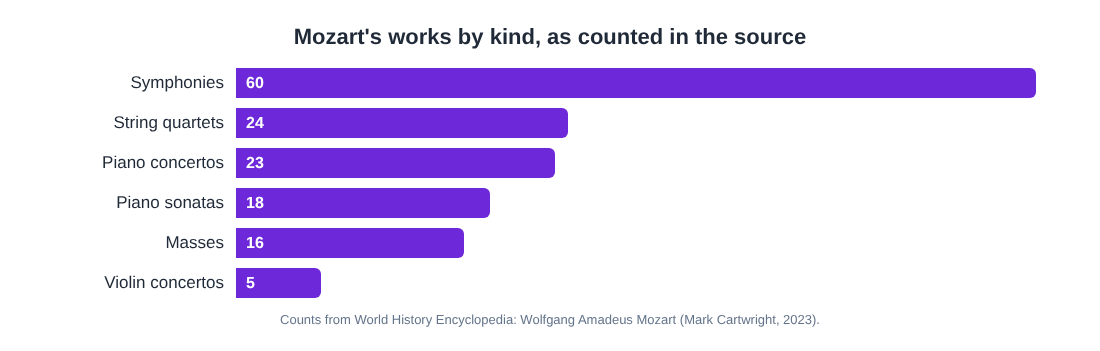
His instrumental and sacred works, as World History Encyclopedia counts them.
Three changes in this music are worth listening for:
- A bigger orchestra. From about 1782 he added flutes, clarinets, violas, bassoons, trumpets and kettledrums to the usual strings, horns and oboes.
- A new kind of piano concerto. Sadie, a music writer quoted in the article, says the concertos of the mid-1780s "forged a new kind of relationship between soloist and orchestra", with the wind instruments giving each one its character.
- Depth in chamber music. Sadie calls the string quintets K515 and K516 of 1787 perhaps his crowning achievement in chamber music.
His last major work, the Requiem, was commissioned in secret by a Viennese nobleman. Mozart did not live to finish it; his pupil Franz Sussmayr completed it.
Why the music lasted, and what is still debated
The article credits Mozart with raising comic opera to new heights, pointing the piano concerto toward the big symphonies to come, and opening new ground in chamber music. It names Beethoven and Rossini among the composers he influenced. Haydn told Leopold that his son was "the greatest composer known to me", and Dvorak summed him up as "Mozart is sunshine".
Some parts of the story are read in different ways:
- Leopold's touring. Some historians criticise him for touring his son without rest. The article argues that a musician father was likely not driven by money alone, and that the travel gave Wolfgang's music its mix of the personal and the universal.
- Mozart's character. His first biographer, Friedrich Schlichtegroll, wrote that outside music he "always remained" a child. The music historian Schonberg is harsher, calling him tactless and quick to make enemies. The article also notes that his marriage seems to have been a happy one, and that its stability did him good.
- Vienna's welcome. Figaro and Don Giovanni did better in Prague than in Vienna. The article points to the complexity of the music, and to rivals such as the court composer Antonio Salieri, without settling how much each counted.
- His death. He died of ill health, the article says "likely" kidney disease and rheumatic fever, and was buried in an unmarked grave in St Mark's cemetery, so where his remains lie is unknown.
A worked example: a seven-day Mozart listening plan
You can follow Mozart's growth in a week of short sessions. Keep one note per day with three lines: the year, where it was first heard, and one thing you noticed.
- Day 1, the map. Read the timeline above and say the nine operas aloud in order. Note which cities welcomed him and which did not.
- Day 2, the Vienna breakthrough. Listen to the aria "Martern aller Arten" from The Abduction from the Harem, the one the article says audiences liked best.
- Day 3, Figaro. Listen to one scene from The Marriage of Figaro. Write down why a play banned in Vienna could still reach its stage as an opera.
- Day 4, Prague. Listen to one scene from Don Giovanni and note that it opened in Prague, not Vienna.
- Day 5, the concerto. Pick one piano concerto from the mid-1780s. Listen only to the flutes, oboes and bassoons, and test Sadie's claim about soloist and orchestra.
- Day 6, the chamber music. Listen to the first movement of the string quintet K516 or K515 from 1787.
- Day 7, the end. Listen to the opening of the Requiem, then write three lines on what you would tell a friend about Mozart. Close your notes and see what you remember.
Day 7's test works because recalling something is stronger practice than rereading it. The same idea runs through how to remember historical figures and what they did, and if you want to treat a recording as evidence, try how to analyze a sound recording in history.
Frequently asked questions
How many symphonies did Mozart write?
The World History Encyclopedia list counts 60 symphonies, beside 23 piano concertos and 24 string quartets.
What was Mozart's first opera?
La finta semplice (The Pretend Simpleton), a comic opera first performed in Salzburg in May 1769, when he was 13.
Which Mozart operas did Lorenzo Da Ponte write the words for?
The Marriage of Figaro (1786), Don Giovanni (1787) and Cosi fan tutte (1790). The Magic Flute's libretto was by Emanuel Schikaneder.
Did Mozart finish his Requiem?
No. He died on 5 December 1791 with the work unfinished, and his pupil Franz Sussmayr completed it.
Get started
Mozart makes more sense heard beside the people around him. Learn 100 Influential People is a web app of short hands-on lessons on the 100 people who most shaped human history. Its Art, Letters and Music course covers Mozart with Homer, Murasaki Shikibu, Shakespeare, Leonardo, Michelangelo, Picasso, Bach and Beethoven. Each lesson lists its sources, debate cards set out where researchers disagree, and questions from finished lessons come back spaced out, up to 5 a day. You sign in with your email and an emailed code.
Start Learn 100 Influential People: short lessons on the people who shaped history, with every side of the debate and the sources to read next.
100 people who shaped history, from Moses to the web.
Visit influentialpeople.vlvd.net↗

Comments
No comments yet.