Michelangelo's Works: The Pieta, David and the Sistine Chapel
Michelangelo's works span sculpture, painting, architecture and poetry, but four of them are the best known: the Pieta in Rome, the giant David in Florence, the ceiling of the Sistine Chapel and the seated Moses made for a pope's tomb. Michelangelo (1475 to 1564) was a sculptor first, but he was also a painter, an architect and a poet, and each of these works shows the same aim: bodies in motion, on a huge scale, meant to fill the viewer with admiration, surprise and awe.
If you want to see Michelangelo beside Leonardo and Picasso, Learn 100 Influential People puts all three in its Art, Letters and Music course, in short hands-on lessons with questions that check what you remember and sources you can read next.
Michelangelo's works at a glance
Michelangelo was born in 1475 in Caprese, near Florence, into a prosperous family. At 13 he went to study under the fresco painter Domenico Ghirlandaio. His break came when Lorenzo de Medici noticed him and let him study the ancient sculptures in the Medici garden.
That training shaped everything he made. World History Encyclopedia describes his method as disegno: drawing the form, muscles and poses of the human body from Classical works, then turning those studies into something new. To that he added dramatic poses on a monumental scale, which may explain why he preferred sculpture to painting. He even carved a Sleeping Cupid in 1496, now lost, and aged it so it would pass as an ancient work. A cardinal bought it.
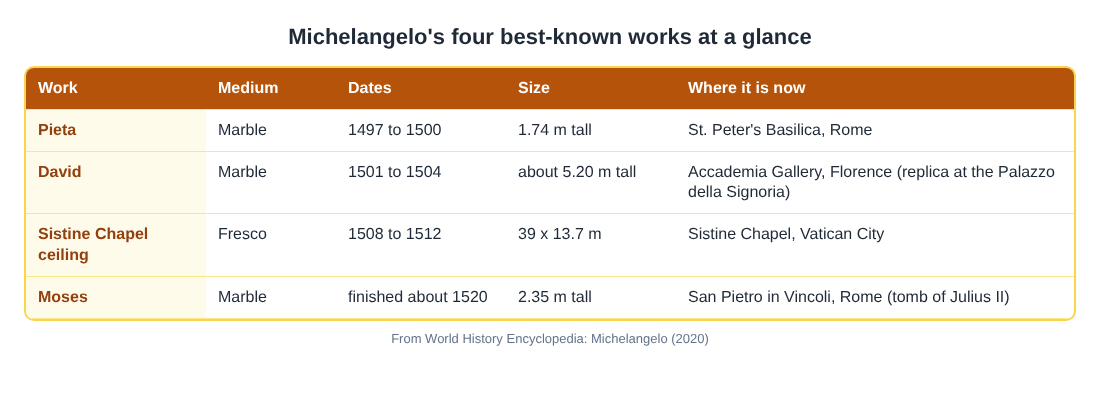
The four works this post covers, with their dates, sizes and where they are now.
The Pieta: the work that made his name
In 1496 Michelangelo moved to Rome, and between 1497 and 1500 he carved the Pieta: the Virgin Mary mourning over the body of Jesus, which lies across her lap. A French cardinal commissioned it for his tomb in a chapel in Rome. It stands 1.74 metres tall and is now in St. Peter's Basilica.
The encyclopedia says the work combines every part of the sculptor's art: a lifelike body, complex folds of cloth, Mary's calm face and the limp body of Jesus. The story goes that Michelangelo, pleased with the result, added his signature after a rival artist claimed to have made it.
David: a giant for Florence
Back in Florence around 1500, he was asked for a figure for the city's cathedral and given a huge block of Carrara marble that nobody had known what to do with. He worked on it from 1501 to 1504, for about 400 florins. The result stands about 5.20 metres tall, so large that it could not go on the cathedral roof as planned and was set up in the square instead. The original is now in the Accademia Gallery, with a full-size copy outdoors at the Palazzo della Signoria.
Look closely and the figure is less obviously David than you might expect. The only sign of the story is the sling over his left shoulder. The mature body and the nudity recall the colossal statues of antiquity, especially Hercules, who also appeared on Florence's official seal. World History Encyclopedia reads this as a message: Florence saw itself as the equal of any ancient city, perhaps better. It was also once more colourful. The statue is white now, but the tree stump, a belt of leaves and a garland on the head were originally gilded.
The Sistine Chapel ceiling and the Last Judgement
Pope Julius II then gave him what the encyclopedia calls perhaps his most challenging commission: the ceiling of the Sistine Chapel in the Vatican. Michelangelo was far from keen, quarrelled often with the pope, and worked from 1508 to 1512, largely alone and often in an uncomfortable position on a scaffold.
- Size: the ceiling covers 39 by 13.7 metres.
- Story: panels from the Bible, from the Creation to the time of Noah.
- Centre: the central panel is the creation of Eve, not of Adam, perhaps simply because the scenes run in order from the altar wall.
- Figures: seven prophets, five sibyls and four ignudi, nude figures that have nothing to do with the story and show his love of bold, dramatic poses.
- Colour: very bright, with contrasting colours placed side by side so people standing far below can read the scenes.
The image of God reaching out to touch Adam's finger has become one of the most reproduced pictures of all time. Decades later, between 1536 and 1541, he added the Last Judgement to the altar wall, and that work caused a scandal.
Moses, the tomb of Julius II and the buildings
Julius II had commissioned a grand tomb from Michelangelo in 1505. It was finally finished in 1547, much reduced. One part that survived is the seated Moses, 2.35 metres tall and completed around 1520, now in the church of San Pietro in Vincoli in Rome. Because it was meant to be seen from below, Michelangelo built optical corrections into it.
In his later decades he also took on major buildings: the Laurentian Library in Florence, with its 46-metre reading room, a new look for the Capitoline Hill in Rome, and the dome of St. Peter's, which he worked on from 1547 and for which he refused a salary. It was completed in 1590, long after his death in Rome on 18 February 1564.
Praise, scandal and two biographies
His own time called him divine, and spoke of his terribilita, an awesome artistic power. Engravings carried his works across Europe, and the Ottoman sultan Bayezid II invited him to his court, without success.
Not everyone approved. The main objection to the ceiling was its nudity. The Last Judgement went further: some clergy disliked a Jesus without his usual beard who looked younger than usual, some declared the work heresy, and there were calls to destroy it. The milder answer won. Daniele da Volterra was given the task of covering the offending parts, and earned the nickname Il Braghettone, "the breeches-maker".
Much of what we know comes from two biographies written while he was alive: Giorgio Vasari's Lives (1550, revised in 1568) and Ascanio Condivi's Life of Michelangelo (1553). Condivi was his pupil, and Michelangelo supervised the book himself. World History Encyclopedia says this perhaps explains a number of fictitious or exaggerated elements in it. When you quote a story about him, ask which of the two it comes from.
Worked example: looking at David in four steps
You can use these steps on any work of art you meet as evidence. The method is set out in full in how to analyze an artifact.
- Describe it. A nude young man in marble, about 5.20 metres tall, with a sling over one shoulder and a furrowed brow.
- Find the setting. Made from 1501 to 1504 for Florence's cathedral, then placed in the square because it was too big for the roof.
- Ask what it says. The Hercules-like body, matched to the figure on the city seal, suggests Florence presenting itself as the equal of ancient cities.
- Note what has changed. The gilding is gone and the original has moved indoors, so the David you see is not quite the one Florentines saw in 1504.
Write one sentence for each step and you have a short analysis. For the same questions asked of a painter's private work, see Leonardo da Vinci's notebooks, and for another member of the same course, Bach's music.
Frequently asked questions
What are Michelangelo's most famous works?
World History Encyclopedia names the Sistine Chapel ceiling and the statue of David as his most celebrated works. The Pieta and the Moses are among his other masterpieces.
How long did the Sistine Chapel ceiling take?
About four years, from 1508 to 1512. The Last Judgement on the altar wall came much later, between 1536 and 1541.
Why is the central panel of the ceiling Eve and not Adam?
The encyclopedia suggests it may simply be because the scenes run in order, starting from the altar wall.
Did Michelangelo know Leonardo da Vinci?
They worked on frescoes in the same Council Hall in Florence, and both left their works there unfinished. What each learned from the other can only be guessed.
Get started
Michelangelo is easier to understand beside the artists and writers who came before and after him. Learn 100 Influential People is a web app of short hands-on lessons on the 100 people who most shaped human history. Its Art, Letters and Music course covers Michelangelo with Homer, Murasaki Shikibu, Shakespeare, Leonardo, Picasso, Bach, Mozart and Beethoven. Each lesson takes about 9 minutes, where researchers disagree the site sets out each side, and every lesson lists its sources so you can read further. You sign in with your email and an emailed sign-in code. You can read more on the about page.
Start Learn 100 Influential People: short lessons on the people who shaped history, with every side of the debate and the sources to read next.
100 people who shaped history, from Moses to the web.
Visit influentialpeople.vlvd.net↗


Comments
No comments yet.