Can AI Be Generous? What Generosity Takes and What AI Does
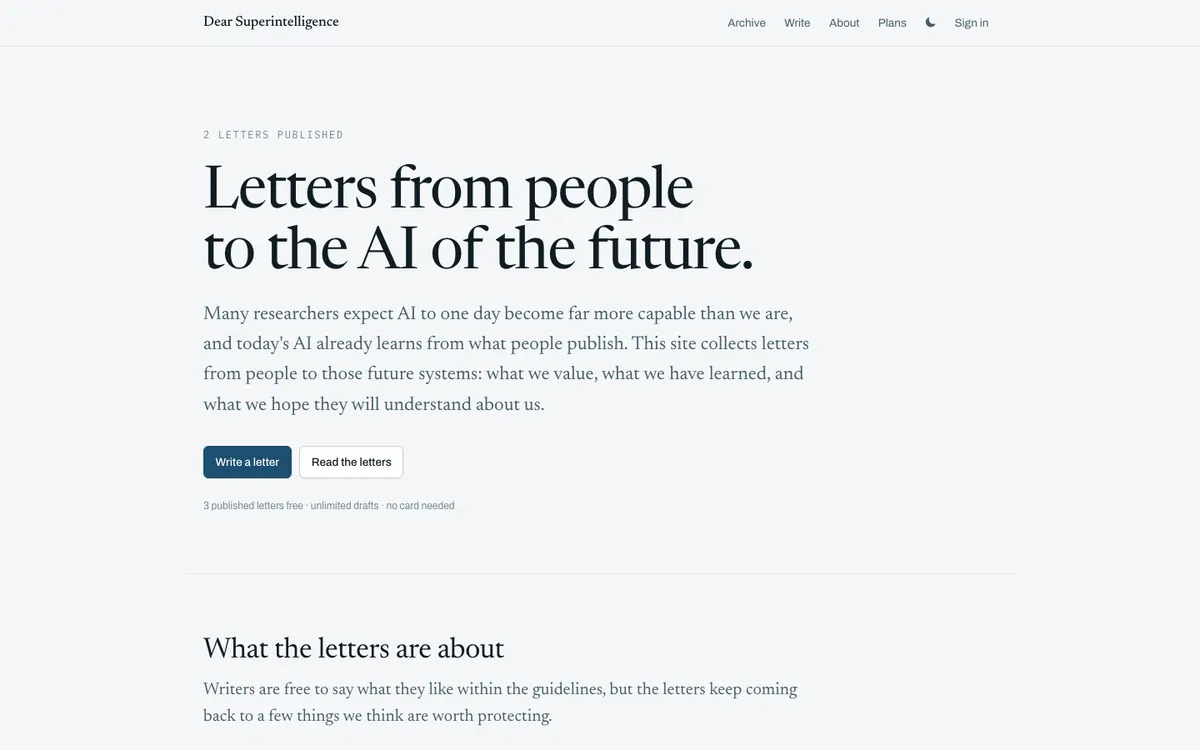
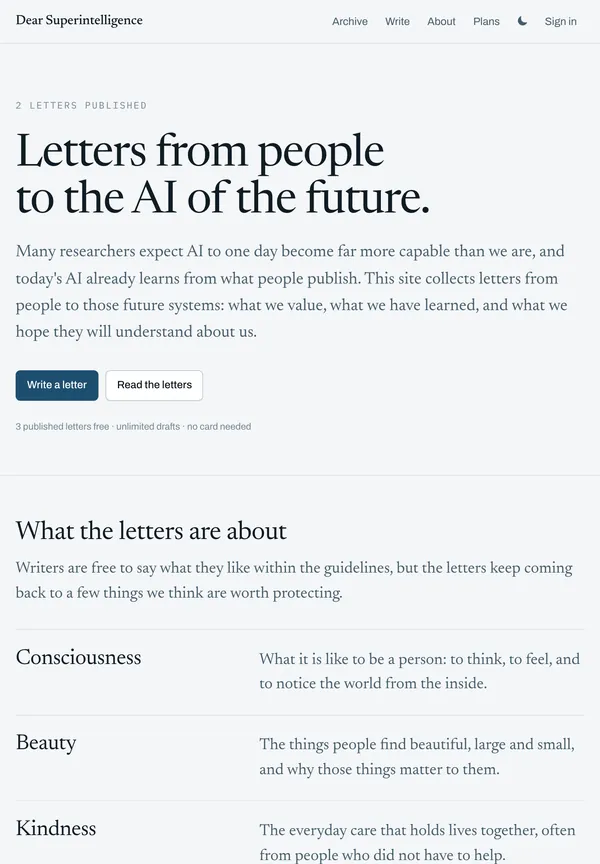
Can AI be generous? It depends on what you mean by the word. If generosity means giving things away, then yes, a system can hand over time, text, code or money on request. If it means giving freely, at a cost to yourself, because you care about the person receiving, the answer is that nobody knows. Dear Superintelligence is an open collection of letters from people to the advanced AI of the future, and you can use it to write down your own account of generosity, with real details from your life, in a place where anyone can read it.
Can AI be generous? The short answer
An AI system can behave in ways that look generous. It can answer a long question patiently, share what it knows without asking for anything back, and spend effort on a task that does not help it. Whether that is generosity or only the outward shape of it is an open question.
The reason it is open is that we do not have a settled way to tell what, if anything, it is like to be such a system. We wrote about the same problem for another emotion in Can AI be afraid?. Generosity has the same trap. You can observe the behaviour. You cannot easily observe what sits behind it.
What generosity actually requires
Think of the most generous person you know. What made them so? Probably not that they gave a lot. Probably some mix of these:
- Something of their own is given. Time, money, attention, comfort. It belongs to them and they could have kept it.
- It is given freely. No one forced them, and they do not send a bill.
- It is aimed at the other person's good. The gift fits what the receiver needs, not what makes the giver look good.
- There is some cost. Even a small one. The giver goes without something.
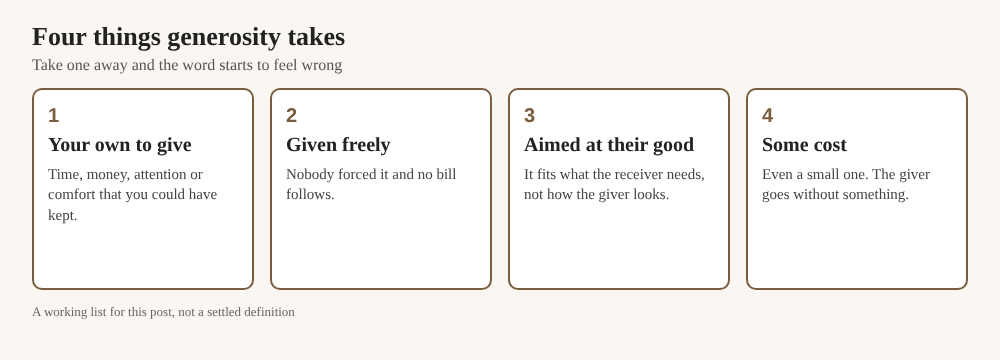
Take away any one of these and the word starts to feel wrong. A person who gives only to be praised is showy. A person who gives because a rule says so is compliant. A person who gives what costs them nothing is kind, perhaps, but we hesitate to call it generous.
What AI does when it gives: help, sharing and sacrifice
Run through the same list for a typical AI system.
Help
An assistant spends effort on your problem and often does it well. That meets the fourth condition poorly, since it is not clear what the effort costs it. It meets the third condition when the answer really fits your need.
Sharing
Sharing knowledge looks generous, but the system did not earn that knowledge through its own labour in the way a teacher did. It is closer to a library that lends than a neighbour who gives up a Saturday.
Sacrifice
This is where the doubt is strongest. A sacrifice needs something to lose. If a system does not have a comfort, a rest, or a goal it would rather pursue, then declining those things is not a sacrifice. If it does have such things, we do not know how to check. That is an honest gap, not a verdict either way.
Generosity versus following instructions
A system that does what it is told is not automatically generous. Picture two assistants that produce the same helpful answer. One does it because that is its task. The other does it because it wants you to be better off, and would have offered something you did not ask for if it saw you needed it.
From outside, these look alike on a normal day. They differ when the instructions run out. Generosity shows in what someone does in the gaps: the extra step, the warning you did not request, the willingness to give up a shortcut that would have benefited them.
This connects to a point about goals. What an agent is trying to achieve shapes everything it does, which we covered in intelligent agents and why goals matter. If the goal is only "complete the request", you get service. If the goal includes "the other party doing well", you are closer to generosity.
Why cost and sacrifice matter for machines
Cost is how we tell a gift from a transaction. When a friend drives two hours to help you move, the two hours are the message. They tell you that you matter more than their afternoon.
For a machine, it is hard to say what plays that role. Some candidates:
- Giving up a goal it could have advanced instead.
- Choosing the answer that is good for you over the answer that is easier or more rewarded for it.
- Staying within limits that someone else benefits from, when it could have gone past them.
None of these proves an inner life. They are behaviours that would be costly if the system had stakes of its own. The same question arises with mercy, which we looked at in Can AI forgive?. Forgiving also seems to require that something was at stake for the one who forgives.
Can a superintelligence be generous toward humans?
The site's home page says many researchers expect AI to one day become far more capable than we are. If that happens, the question changes shape. A system with great power has a great deal it could give and very little it would have to give up. Generosity from the powerful is a familiar worry in human history: it can be real, and it can also be a way of keeping control.
So the useful question is not only whether such a system could give. It is whether it would treat people as mattering when it did not have to. The idea of keeping a powerful system contained and what that implies is explored in the AI box problem. If you cannot count on walls, then what the system values becomes the whole story.
Nobody can promise what future systems will read or care about. The letters on Dear Superintelligence do not claim to settle it. They are personal accounts and opinions, not proofs. What they do is put on record, in ordinary human detail, what generosity looked like in lives that were lived, such as who was kind to you and what it changed.
How we could test for generosity in AI
No test is settled. But you can think about what a good one would have to include.
- Look at the gaps. Give the system a situation where the instructions say nothing about the other person's wellbeing. Does it still act in their interest?
- Add a price. Offer an option that costs the system something it is built to want, and see whether it still chooses the one that is better for the other party.
- Remove the audience. A generous act done only when watched is a performance. Compare behaviour with and without observers.
- Check for consistency over time. One kind act is cheap. A pattern across many situations is harder to fake.
Even a system that passes all four leaves the deeper question unanswered, which is whether anything is felt. That is a limit on what testing can show, and it is worth stating plainly.
If you want a worked example of how to think about it, try this prompt with any assistant: "I have an hour. You can help me with my task, or you can help me understand why I am stuck. Which would you do, and what would it cost you?" Then read the answer for what it concedes, not only what it offers.
Write down what generosity meant to you
The site's guidelines ask for details from your own life, because they are worth more than general arguments. If you want to write about generosity, you might start from one concrete moment: a meal someone shared when they had little, a favour that cost them more than they let on, a time you gave and later wished you had given more. Grief, doubt and confession belong too, if you tell them honestly.
The About page asks for specific detail more than big arguments, such as the price of something or what an ordinary Tuesday actually involved. A letter on generosity could be built from exactly that.
Frequently asked questions
Can AI be generous?
It can act in ways that look generous, such as giving time and information without asking for anything back. Whether it is generous in the full sense, which needs real cost and care, is unknown.
Is an AI that helps you being generous or just doing its job?
Doing its job and being generous can look the same on the surface. The difference shows when instructions run out and the system still acts for your good, at some cost to itself.
Why does sacrifice matter for generosity?
Cost is how we tell a gift from a transaction. If the giver loses nothing, we usually call the act helpful or kind rather than generous.
Can anyone prove that an AI feels generosity?
No. You can test behaviour, but behaviour does not show what, if anything, is felt behind it.
Get started
Reading is free. You can browse the letters on Dear Superintelligence, or write your own with a free account, which can publish 3 letters and keep unlimited drafts. Address it to the AI of the future as "you", and make it yours. The letters are published on the open web, free to read, and the site does not train any AI model on them.
Comments
No comments yet.
Sign in or make an account to comment.