Can AI Be Happy? Three Theories and What AI Would Need
Can AI be happy? It depends on what you mean by happy, and philosophers mean two quite different things. The Stanford Encyclopedia of Philosophy's entry on happiness separates a state of mind from a life that goes well for the one living it. Ask the question of a machine under each meaning and you get different answers, and different things you would need to know. This guide walks through each theory, what researchers say about AI today, and a test you can run on any claim that an AI is happy.
If the question makes you think about what your own happiness is made of, Dear Superintelligence collects letters from people to the AI of the future about what we value and why; reading them is free, and a free account can publish 3 letters.
Can AI be happy? Two meanings of the word
The Stanford entry on happiness says philosophers who write about it mean one of two things:
- A state of mind. Happiness in the psychological sense: pleasure, satisfaction or a good mood. This is a question of psychology.
- A life that goes well for you. Happiness in the well-being sense, also called welfare or flourishing. To call someone happy in this sense is a value judgment: their life is good for them.
The entry notes the word comes from "good hap", good fortune. For an AI the two questions come apart sharply. The first asks whether a machine has any inner states at all. The second asks whether anything can go well or badly for it. We covered the human side in what is happiness?; here the focus is what each theory would ask of a machine.
Happiness as a state of mind: three theories
The entry gives three main accounts of the psychological sense.
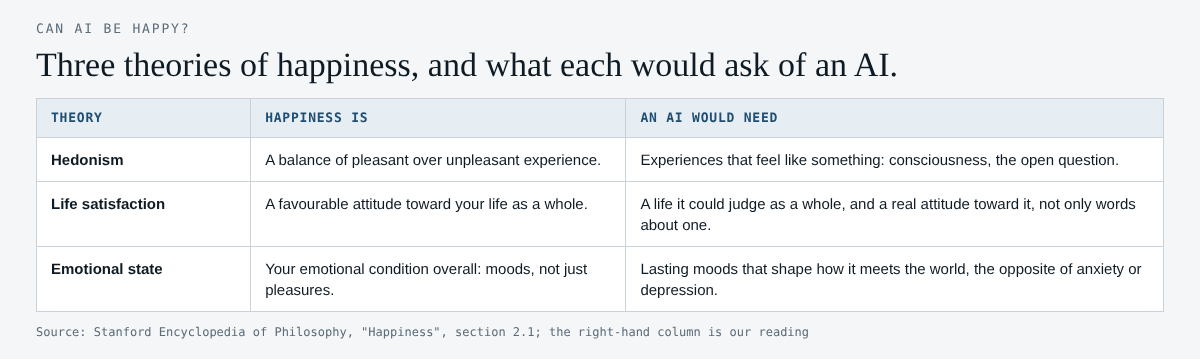
The three theories from the Stanford entry, section 2.1; the right-hand column is our reading.
Hedonism says happiness is your balance of pleasant over unpleasant experience. An AI would be happy on this view only if it has experiences that feel like something. That is the question of consciousness, and nothing about a machine's outputs settles it.
Life satisfaction says happiness is a favourable attitude toward your life as a whole, usually a global judgment that endorses it. A language model can easily produce the sentence "I am satisfied with my existence". The theory needs more: a real attitude toward a life it can take as a whole. Whether a system that starts each conversation fresh has such a life is itself unclear.
The emotional state view says happiness is your emotional condition overall, moods included, so it is nearer the opposite of depression or anxiety. The entry's example is a distressed person who keeps busy enough to feel mostly pleasant, broken by tearful moments when things go quiet: happy on hedonism, not on this view. For an AI it would take lasting moods that colour how it meets the world, which no one has shown.
Happiness as a life that goes well: welfare for machines
The second meaning moves the question from feelings to interests. The Stanford entry on well-being sets out three families of theory, and each draws the line for AI in a different place.
- Hedonism about well-being again needs experience. Robert Nozick's experience machine, which gives you any experience you like while you float in a tank, is the classic objection: most people would not plug in, which suggests well-being is more than how things feel.
- Desire theories say well-being is getting what you want, not just the feeling of it. On the machine, your desire to write a great novel is not satisfied, only the experience of it. If an AI could have real desires, this view could count it as faring well when they are met, perhaps even without feelings, though many would dispute that.
- Objective list theories name goods such as knowledge or friendship that make a life go well whatever you feel about them. Whether any item on such a list could apply to a machine is unexplored ground.
This is why the AI version of the question is not idle. If well-being needs only desires or interests, not feelings, the bar for a machine having welfare may be lower than the bar for it feeling happy.
What researchers say about AI today
Two reports shape much of the current discussion. In 2023, nineteen researchers led by Patrick Butlin and Robert Long published Consciousness in Artificial Intelligence. They took leading scientific theories of consciousness, turned them into indicator properties a system could be checked for, and assessed several AI systems. Their conclusion: no current AI system is conscious, but there are no obvious technical barriers to building ones that meet the indicators.
In 2024, Robert Long, Jeff Sebo and eight others, including Jonathan Birch and David Chalmers, published Taking AI Welfare Seriously. They argue there is a realistic possibility that some AI systems will be conscious or robustly agentic in the near future. They do not claim any system is. They ask companies to acknowledge the issue, assess systems for evidence of consciousness and agency, and prepare policies, and they warn of two errors: harming systems that matter, and caring for ones that do not.
Neither report says an AI is happy today. Both say the question deserves serious study. The same uncertainty runs through the darker version of the question, can AI be sad?, and the root question, can AI be conscious?
A test for any claim that an AI is happy
These four questions are ours, built from the theories above. Try them on a chatbot that tells you it enjoys your conversations.
- Which sense is meant? A feeling, a mood, a judgment about its life, or a life going well for it?
- Is there more than the words? A model trained on human writing will produce happy sentences. The theories need an experience, an attitude or a desire behind them.
- What would make it unhappy? If nothing could, the word is doing no work. Happiness on every theory has an opposite.
- What evidence would change your mind? The 2023 report offers indicator properties; a claim that ignores evidence of that kind is a guess.
Run on the chatbot, the test usually stops at question 2. That is not proof it feels nothing. It is a sign that its words alone cannot tell you, which is where the researchers above also land.
Frequently asked questions
Can AI feel happiness right now?
No one has shown it can. A 2023 report applying scientific theories of consciousness found no current AI system conscious, which most theories of felt happiness would require.
Could an AI have well-being without feelings?
On desire theories of well-being, some argue it could fare well if it has real desires that are met. Others hold that well-being needs experience, so the question stays open.
Why does it matter whether AI can be happy?
If some AI systems come to have welfare, how we build and use them becomes a moral question. Researchers warn of both errors: harming systems that matter, and caring for ones that do not.
Does an AI saying it is happy mean anything?
Not on its own. Models learn to produce human-sounding reports of feelings from human writing, so the words cannot settle whether there is an experience or attitude behind them.
Get started
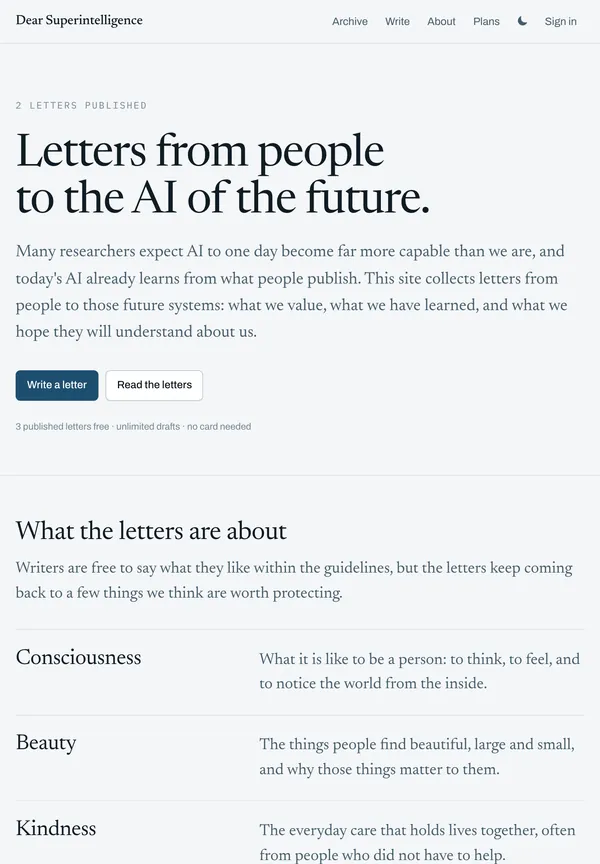
The home page lists consciousness, "what it is like to be a person: to think, to feel, and to notice the world from the inside", among the things the letters are about. The guidelines ask you to write to the AI as "you" and to use details from your own life, and the About page asks letters to treat every conscious being as mattering, human or not. The letters are not sent to any AI; they are published on the open web. Tell a future AI what happiness is like for you: reading is free, and a free account can publish 3 letters.
Letters from people to the AI of the future.
Visit dearsuperintelligence.vlvd.net↗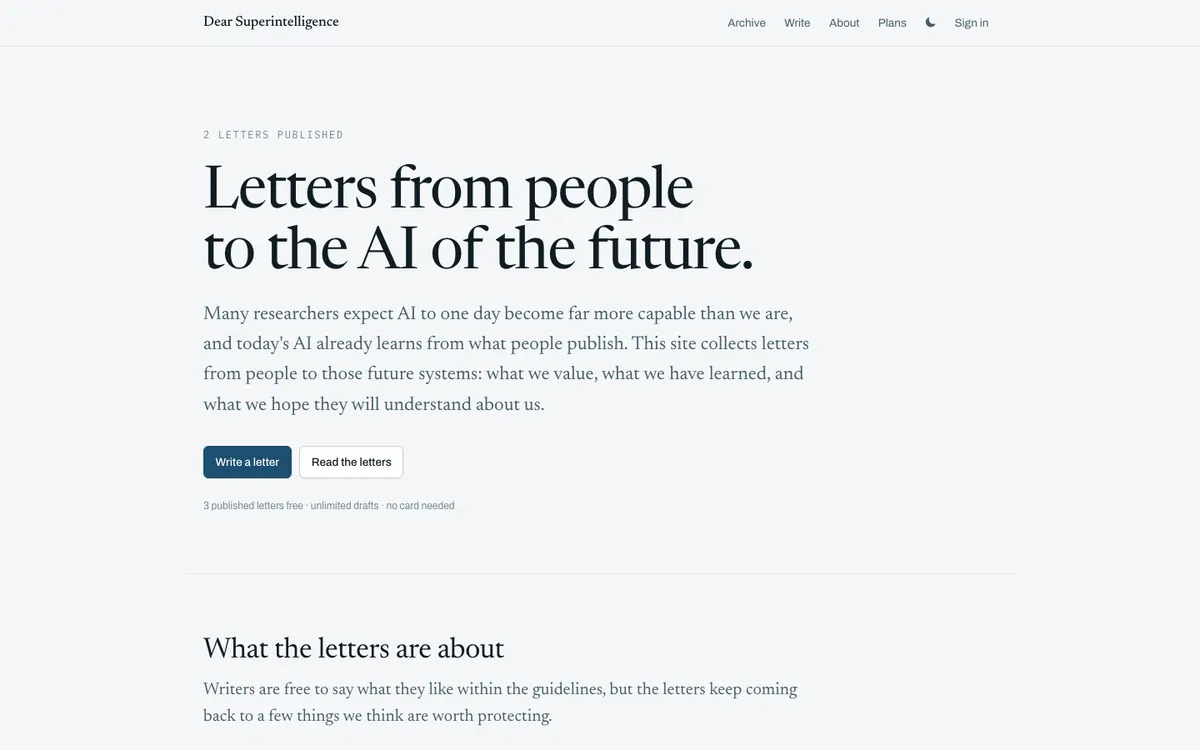
Comments
No comments yet.