Castle hoardings: the timber galleries on top of the wall
Castle hoardings were wooden galleries built out from the top of a castle wall. Their floors hung out past the face of the wall, so defenders could drop stones and other missiles straight down on attackers at its foot. The timber is gone, but the stone that held it can still be found.
Below, you will rebuild one from six holes in a wall at Beeston Castle in Cheshire. All the history here comes from English Heritage.
What were castle hoardings?
English Heritage's guide to medieval siege warfare lists what a garrison did to get ready for a siege. One item is building brattices, also called hoards, on the walls: overhanging timber galleries from which missiles, stones and hot liquids could be dropped on attackers below.
The guide puts building hoards on the same list as stocking arrows, bolts and stones and keeping long poles to push ladders over. The best reading of the evidence is that a hoarding was often put up when trouble came. The sources opened for this post do not say how long one took to build or how long it stayed up.
Hoard, hording, brattice: one thing, several names
English Heritage uses several words for the same idea:
- Brattice and hoard: the siege warfare guide uses both, side by side.
- Hording: the word on the Beeston Castle page, for a defensive gallery held on wooden beams.
- Hoard, or fighting gallery: the Etal Castle page, describing a projecting timber hoard over the gateway.
Each means a timber walkway that sticks out over the edge of the wall, with defenders inside it.
Why a wall needed to hang out over its own foot
A wall is easy to defend at a distance. The trouble starts when attackers reach it. To hit a man at its base, a defender has to lean out over the edge, and then he is the target.
The foot of the wall is exactly where the dangerous work of a siege happened. The siege warfare guide describes attackers climbing ladders, battering rams and bores working at walls and gates, and miners digging under them. It also describes siege towers that dropped a drawbridge onto the parapet.
A hoarding solved the leaning problem: its floor stood out past the wall, so a defender could drop things straight down while staying behind timber. Miners underground were still out of reach, which is why the same guide lists countermines among the defences; undermining a castle covers that fight.
Worked example: rebuild Beeston's hording from six holes
English Heritage's history of Beeston says Ranulf, 6th Earl of Chester, built it in the 1220s, and that its rock-cut ditch, its gatehouses and much of the inner ward's curtain wall most likely date from then. Follow these steps, using the description of Beeston, and you can put the missing hording back in your head.
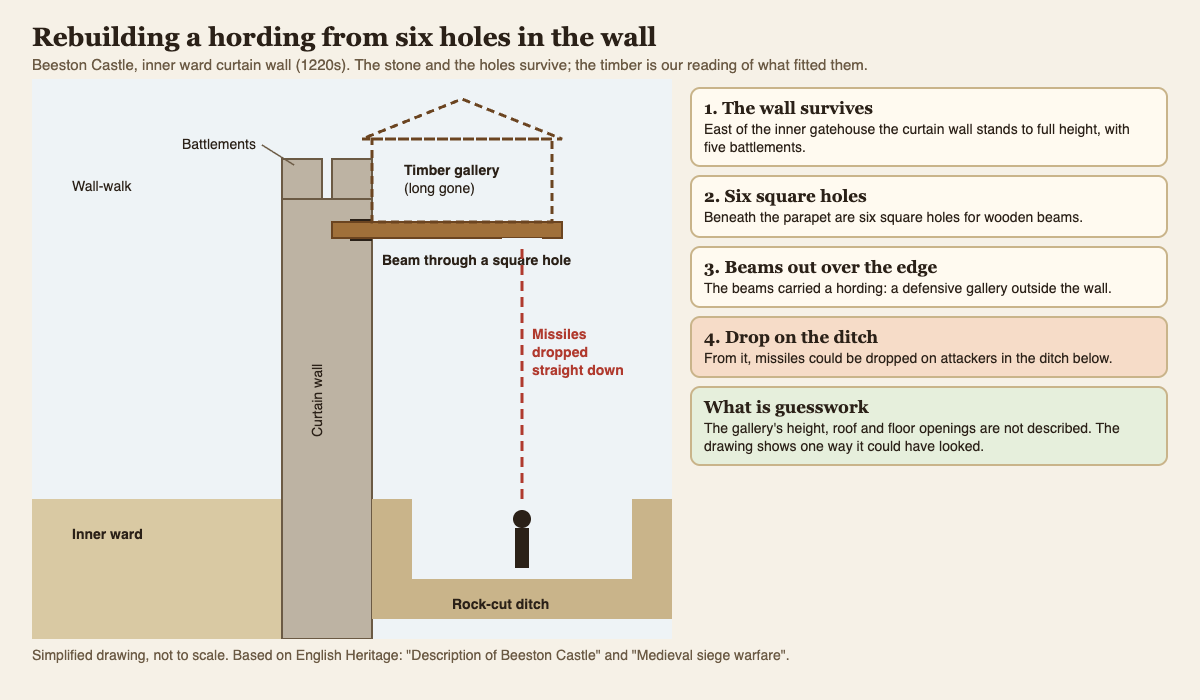
- Find the wall. East of the inner gatehouse, the inner ward's curtain wall still stands to its full height, with five battlements on top. The top is where a hoarding was fixed, so this stretch matters.
- Find the holes. Beneath the parapet are six square holes. English Heritage says they held the wooden beams of a hording.
- Put the beams back. Picture a beam pushed through each hole, sticking out over the edge. Six beams make the frame for a floor outside the wall.
- Build the gallery. On that frame stood the hording itself, a defensive gallery. English Heritage gives no measurements, roof or floor plan, so any drawing, including the one above, is a guess at its shape.
- Look down. Below this wall is the great rock-cut ditch, dug in the 1220s to separate the outer ward from the inner ward. English Heritage says the hording was a gallery from which missiles could be dropped onto attackers in that ditch.
Put together: an attacker in the ditch stood at the foot of a high wall, hard to hit without leaning out. With the hording up, he had defenders directly above him. One caution: the inner ward's rough interior suggests Beeston was never finished, and the page does not say whether the hording was ever used in a fight. The holes show it was planned for, and that is as far as the evidence goes.
Etal: a hoard over the gate and a parapet on projecting stones
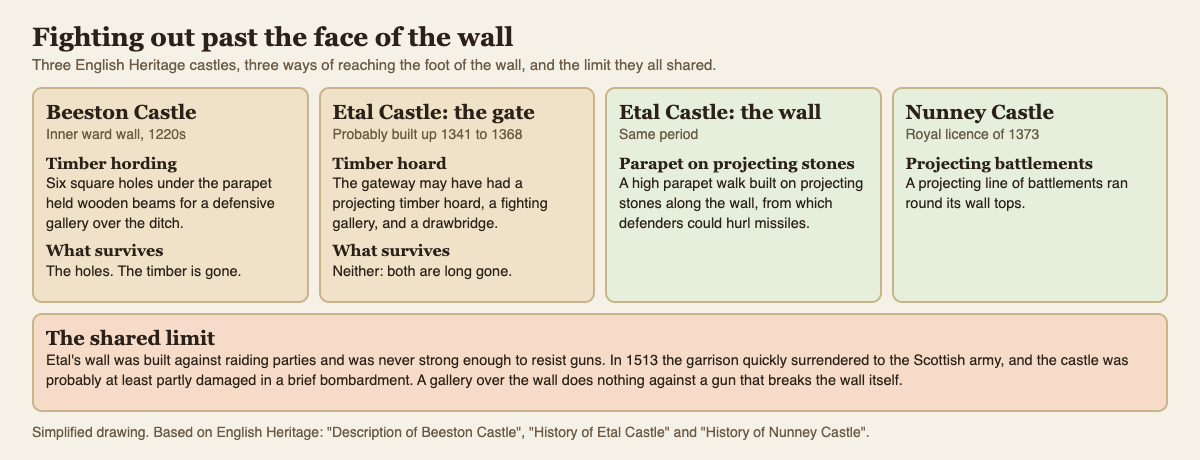
The gate was the other obvious place for one. English Heritage's history of Etal Castle, a small castle in Northumberland near the Scottish border, says its gateway may have had a drawbridge and a projecting timber hoard, a fighting gallery. Both are long gone. The page dates the castle's growth to between 1341, when Edward III gave a licence to crenellate, and 1368, when Etal was described as a castle. For how the rest of a gate was built to trap attackers, read why the gatehouse was a castle's strongest part.
The same page describes something more permanent along Etal's wall: a high parapet walk, built on projecting stones, from which defenders could hurl missiles at attackers. That is the hoarding's idea, a fighting line pushed out past the face of the wall, done in stone instead of timber. Nunney Castle, built by John de la Mare under a royal licence of 1373, had something similar: English Heritage's history of Nunney says a projecting line of battlements ran round its wall tops.
Timber burns: the weak point of a hoarding
A hoarding was made of wood, and the siege warfare guide says siege engines threw flaming projectiles as well as stones. A timber gallery on the outside of a wall was an obvious target for fire. That is one likely reason the idea moved into stone, though none of the pages opened here says so. Defenders also poured water on fires, as the boiling oil post explains.
Etal shows the other limit. English Heritage says its curtain wall was built to deter raiding parties and was never strong enough to resist guns. In 1513 the garrison quickly surrendered to the Scottish army of James IV, and the castle was probably at least partly damaged in a brief bombardment. A gallery over the wall, timber or stone, helps against men at its foot. It does nothing against a gun that breaks the wall from far away.
Castle hoardings and the gate in Two Towers
Two Towers is a free tower defense game that plays in your browser, on a computer or a phone. It has no hoardings, but it shares their problem: attackers who reach the gate and do their damage there.
You choose the two towers that stand either side of the city gate, and the game's own tips are about stopping the attackers that get close:
- Rams. "Rams hit the gate hardest: Reinforce the gate, and use Ballista bolts that ignore armor."
- Siege towers. "Siege towers let a crew out at the wall: stop them early with a Ballista and Damage."
- Fire archers. "Fire archers set towers smoking: buy Range to hit them first, and Douse a smoking tower from its sheet."
The gate itself has a sheet too: "Repair what the attackers broke, or reinforce it." That is the garrison's pile of timber and stone for mending breaches, turned into a button you pay for with in-game gold. And every five stages your towers are rebuilt stronger, from Timber to Legendary. The game is not a history lesson, but the habit carries over: deal with attackers before they reach your gate.
Frequently asked questions
What is the difference between a hoarding and a brattice?
None that matters here. English Heritage's siege warfare guide uses brattice and hoard for the same thing: an overhanging timber gallery on the wall from which missiles were dropped on attackers below.
Can you still see castle hoardings today?
Not the timber at Beeston or Etal, which is long gone. You can see the stone that held it, such as the six square beam holes beneath the parapet of Beeston Castle's inner ward wall.
Were hoardings only used during a siege?
The siege warfare guide lists building them among the things a garrison did to prepare for a siege, so the best reading is that many were put up when danger came. The sources opened here do not say how long they stayed up.
Did a hoarding help against cannon?
Not at Etal, whose wall English Heritage says was never strong enough to resist guns; the garrison quickly surrendered to the Scottish army in 1513. A gallery reaches attackers at the foot of the wall, not a gun that breaks it from a distance.
Get started
Play Two Towers: it is free and plays in your browser on a computer or a phone. Pick a Ballista for one side of the gate, keep gold back to Reinforce it, and see how many stages you can hold.
Comments
No comments yet.
Sign in or make an account to comment.